O co tu naprawdę chodzi
Zapomnij na chwilę, czy to, co zrobiłem, było słuszne. Zapomnij, czy korzystanie z FSD było legalne. Nie o to chodzi.
Liczy się to: Tesli nie spodobało się, że zmodyfikowałem samochód, którego jestem pełnym właścicielem — więc sięgnęła do niego i zdalnie zablokowała jego część. I to nie tylko funkcję, którą niektórzy uważają za nielegalną (nie jest, na drogach prywatnych) — ale w pełni legalne funkcje bezpieczeństwa, z którymi samochód wyjechał z fabryki, część tego samego pakietu za 6 200 € + VAT, za który zapłaciłem.
To nie jest sklep Kindle. To nie Steam. To samochód — rzecz fizyczna, którą kupiłem i posiadam — sprzedany mi z listą funkcji, z których każdą Tesla może wyłączyć ze swojego serwera. (Spytajcie kogokolwiek, kto pamięta dawny „Pakiet zimowy”). Złam warunki Tesli, a samochód w praktyce sam odjedzie z powrotem do fabryki. Bez zwrotu pieniędzy. Dziesiątki tysięcy euro przepadają.
Tesla milczy — ale zachowuje się tak, jakbym w ogóle nie kupił samochodu. Jakbym jedynie wykupił licencję na prawo do korzystania z niego. Prawdziwe pytanie nie dotyczy więc mnie. Dotyczy każdego, kto prowadzi:
Ile mnie to kosztuje
Już wykupiłem FSD na własność — 6200 € + VAT, zapłacone w całości. 8 kwietnia 2026 r. Tesla wyłączyła go zdalnie — i od tamtej pory mój samochód nie zatrzymuje się na czerwonym świetle ani przy znakach stopu, czyli funkcjach, za które zapłaciłem, a z których nie mogę już korzystać. Każdy miesiąc kosztuje mnie cenę abonamentu, którego w ogóle nie powinienem potrzebować — i nie ma żadnego abonamentu, który mógłbym anulować, żeby to zatrzymać.
01Co kupiłem
W systemie zamówień Tesli pakiet Full Self-Driving Capability widniał w cenie 6 200 € (netto, przed VAT). Zapłaciłem ją. Poniższy zrzut ekranu to dokładnie to, co kupiłem.
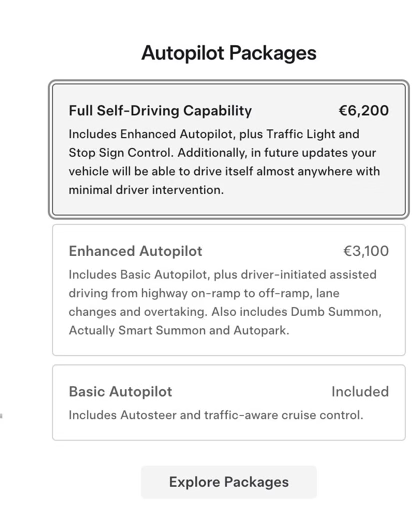
Ta ostatnia linijka ma znaczenie. Sterowanie na podstawie świateł i znaków stopu było dla mnie prawdziwą funkcją bezpieczeństwa: automatycznie zatrzymuje samochód na czerwonym świetle i przy znakach stopu. Do dziś oficjalna aplikacja mobilna Tesli wciąż pokazuje pakiet Full Self-Driving Capability jako dołączony do mojego pojazdu.
02Działał — przez wiele miesięcy
Po odbiorze korzystałem z reklamowanych funkcji pakietu w całej Europie. Sterowanie na podstawie świateł i znaków stopu działało razem z Autopilotem, w pełni i niezawodnie. Samochód jeździł bez problemu przez wiele miesięcy.
Jestem pełnym właścicielem samochodu — nie wziąłem go w leasing od Tesli. Uważam, że mam prawo modyfikować samochód, który posiadam, tak samo jak mógłbym założyć inne felgi, body kit czy nowe zawieszenie, bez tego, by producent karał mnie za to.
„Modyfikacje” w całości
Używałem dwóch urządzeń diagnostycznych CANBUS — „Commander” od enhauto.com oraz urządzenia o nazwie „Cybertool”. Żadne z nich nie modyfikuje samochodu ani jego oprogramowania. Łączą się wyłącznie ze standardowym portem diagnostycznym CANBUS — tym samym interfejsem, który producenci udostępniają do diagnostyki — i wysyłają polecenia, które pojazd już obsługuje.
Na przykład Commander sprawia, że wewnętrzne diody LED zmieniają kolor na niebieski, gdy włączony jest Autopilot. Samochód odczytuje obsługiwany sygnał, wysyła obsługiwane polecenie i kolor się zmienia. Gdyby samochód nie obsługiwał tego polecenia, nic by się nie stało. Żadnej zmodyfikowanej płytki PCB. Żadnego zmienionego komponentu. Żadnej zmodyfikowanej oryginalnej części. Sama Tesla publicznie deklaruje, że oprogramowanie pojazdu jest niezmienialne przez podmioty trzecie.
Cybertool działa tak samo. Tak jak Commander każe samochodowi zmienić kolor wewnętrznych diod LED na niebieski, tak Cybertool wysłał do samochodu polecenie, które ten już obsługiwał — by włączyć pakiet Full Self-Driving w regionach, w których Tesla jeszcze go nie udostępniła. Nie odblokował niczego nowego: po prostu włączył funkcję, do której mój samochód był stworzony i za którą już zapłaciłem. Samochód albo obsługuje dane polecenie, albo nie; mój obsługiwał, bo pakiet był do niego przypisany licencyjnie.
To ta sama kategoria działania, co wyłączenie przez Commandera sygnału dźwiękowego biegu wstecznego — coś, co Commander otwarcie robi, mimo że ten sygnał jest w UE obowiązkowy. I żeby być całkowicie uczciwym: Full Self-Driving nie jest jeszcze dopuszczony do ruchu po drogach publicznych w każdym regionie, tak samo jak głośny wydech czy opony slick nie są dopuszczone do ruchu drogowego. To nie czyni samego wyposażenia nielegalnym — na torze możesz jeździć na slickach i z głośnym wydechem. Włączenie funkcji, do której samochód został zbudowany i za którą zapłacono, to nie to samo, co łamanie nią prawa: gdzie i jak się jej używa, to odpowiedzialność kierowcy, a nie coś, o czym decyduje polecenie diagnostyczne.
Żaden system bezpieczeństwa — sprzętowy ani programowy — nie został w żaden sposób zmodyfikowany.
03Co się wydarzyło
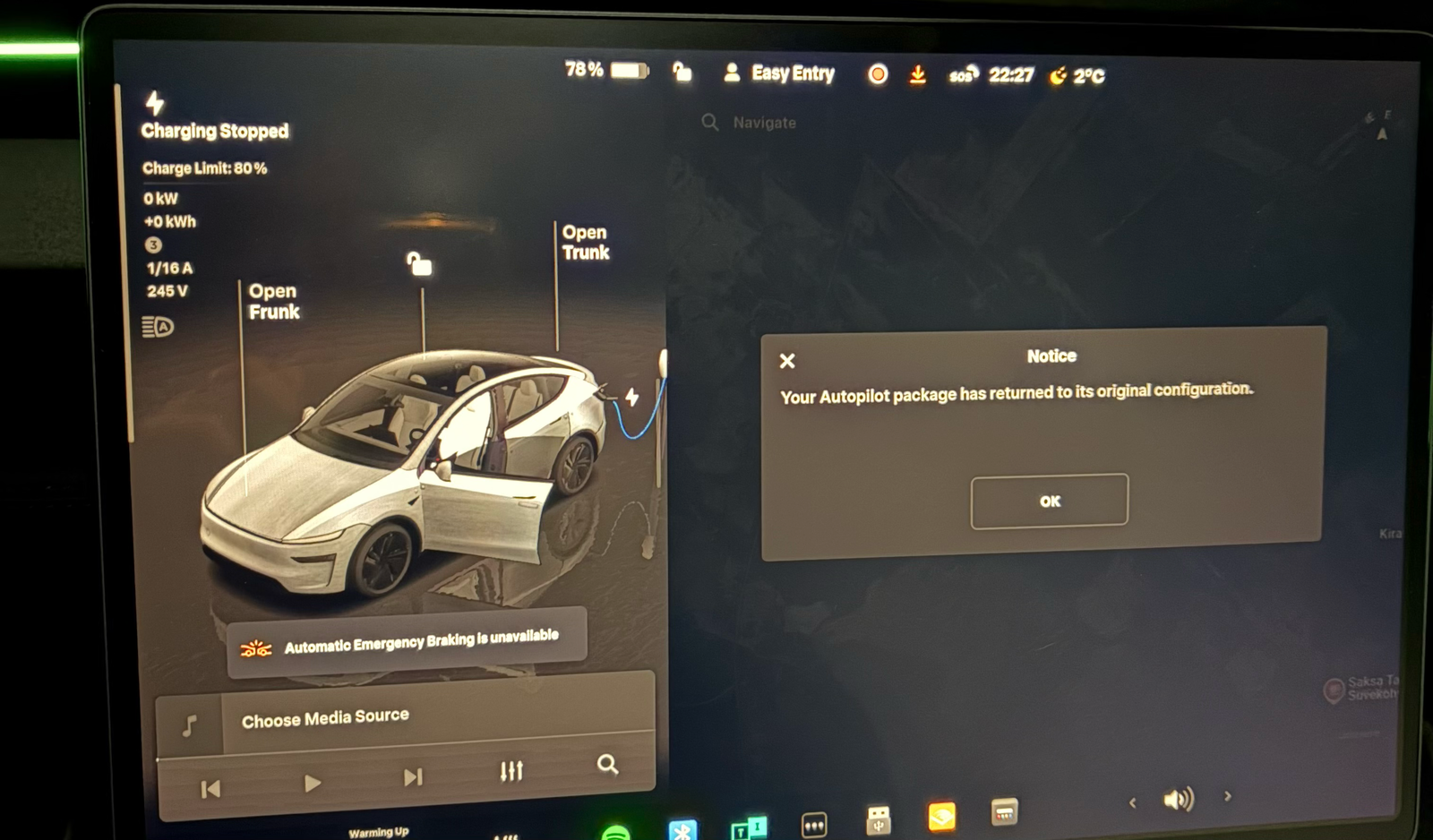
8 kwietnia o 22:27 mój samochód otrzymał zdalną aktualizację konfiguracji pakietu poprzez Tesla Cloud Config. W praktyce Tesla zdalnie powiedziała mojemu samochodowi, że pakiet za 6 200 € + VAT nigdy nie został zakupiony.
Mniej więcej trzy godziny później, o 02:00, przyszedł ten e-mail.
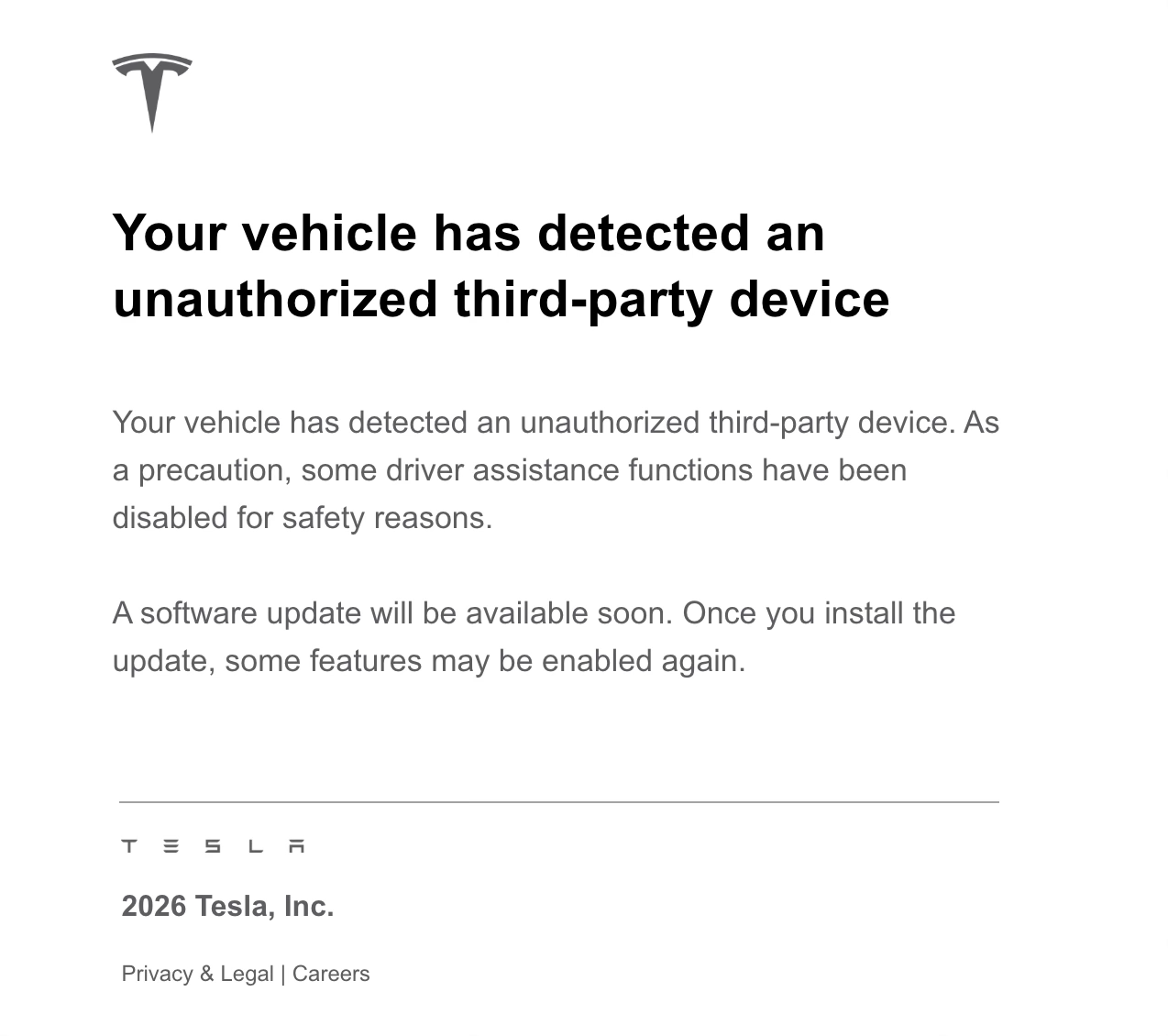
Jest wyjątkowo ogólnikowy. Nie mówi, które urządzenie wykryto, na czym polegało zagrożenie dla bezpieczeństwa, jak długo funkcje będą wyłączone ani nawet czy wrócą. A samo sformułowanie mnie zastanawia: nieautoryzowane urządzenie innego producenta — nieautoryzowane przez kogo? Każde urządzenie w moim samochodzie zostało autoryzowane przez jego właściciela. Przeze mnie.
04Sprzeczność
Dopuszczenie FSD pojawiało się kolejno w całej Europie — najpierw Holandia, potem Litwa, następnie Estonia 29 maja (gdzie zarejestrowany jest mój samochód), a po niej Belgia. Mój samochód otrzymał aktualizację 2026.17.5, która włącza nowy system. To był moment, w którym moja inwestycja powinna się wreszcie zwrócić.
Zamiast tego samochód oferuje mi przycisk „Subskrybuj” — tak jakbym nigdy go nie kupił.
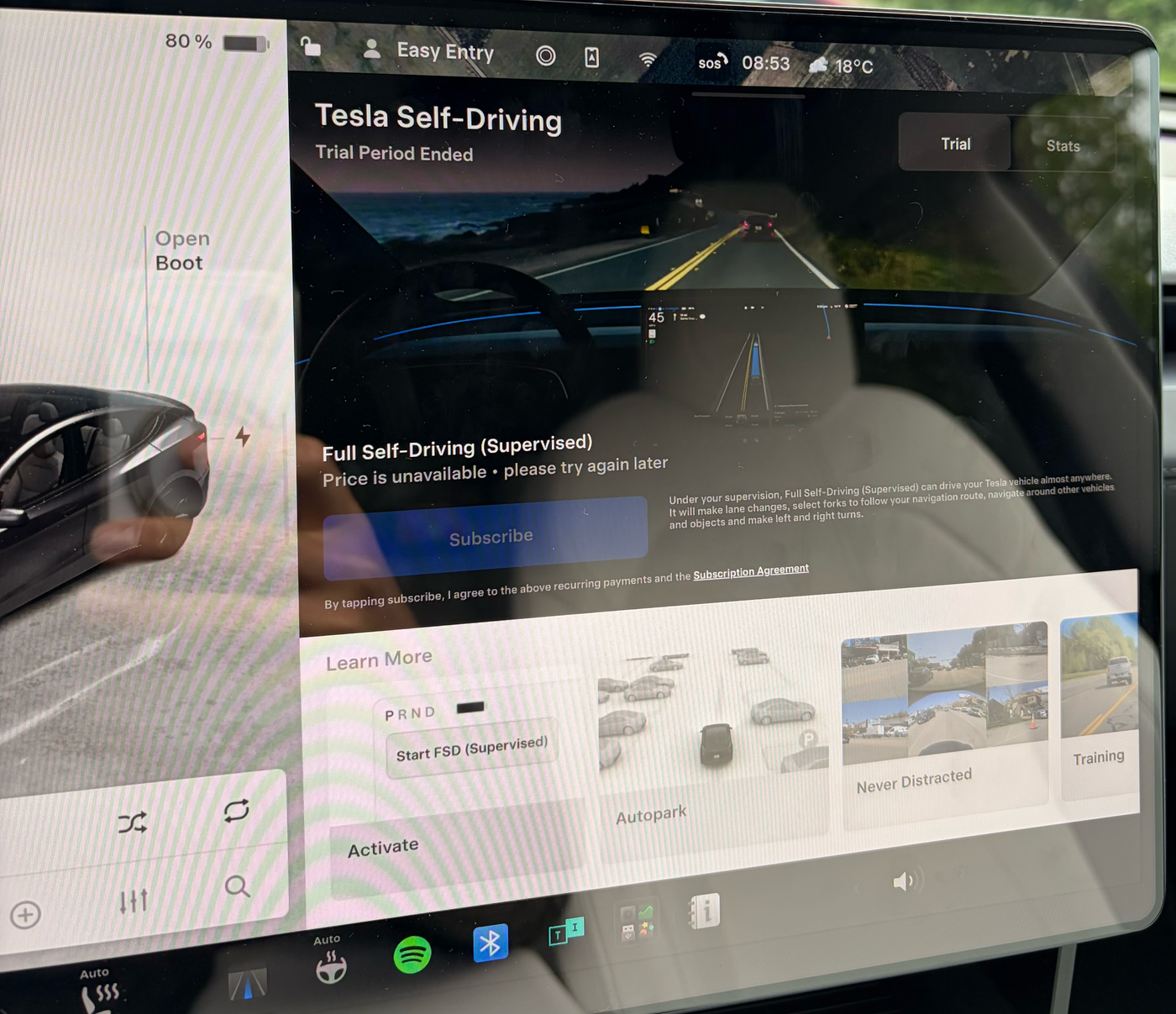
Zapłaciłem 6 200 € + VAT za pakiet. Samochód potwierdza, że pakiet jest „W zestawie”. I ten sam samochód zachowuje się tak, jakby nigdy nie został kupiony.
05Skąd samochód wie, co posiada
Każda Tesla wyjeżdża z fabryki z tym samym oprogramowaniem i tym samym pełnym zestawem możliwości. Poszczególne funkcje są włączane lub wyłączane zdalnie poprzez „Tesla Cloud Config”, powiązany z konkretnym samochodem. To ten sam mechanizm, który kiedyś pozwalał Tesli sprzedawać samochody z fizycznie obecnym, ale wyłączonym sprzętem do podgrzewania tylnych siedzeń — a później pozwalał właścicielom zapłacić online za jego odblokowanie.
To także sposób, w jaki Tesla odróżnia Basic Autopilot od Enhanced Autopilot i od Full Self-Driving. Rozróżnienie jest czysto programowe. Co oznacza, że funkcję, za którą zapłaciłeś, można cofnąć jedną zdalną flagą — dokładnie to, co spotkało mnie.
06Odmówiono naprawy gwarancyjnej
Mój samochód jest objęty gwarancją, więc skontaktowałem się z serwisami Tesli w Turku w Finlandii i w Warszawie w Polsce. Oba potwierdziły, że funkcja nie działa. Oba potwierdziły, że samochód jest na gwarancji. Oba odrzuciły zgłoszenie — twierdząc, że jest „nieserwisowalne”, ponieważ samochód został celowo wyłączony „ze względów bezpieczeństwa”.
Serwis fiński powiedział mi, że nie może ponownie aktywować funkcji, mimo że urządzenie zostało usunięte, ponieważ „może je pan zamontować ponownie”. Idąc tym tokiem rozumowania, dlaczego nie wyłączyć tej funkcji w każdej Tesli — skoro w każdym samochodzie można zamontować takie urządzenie?
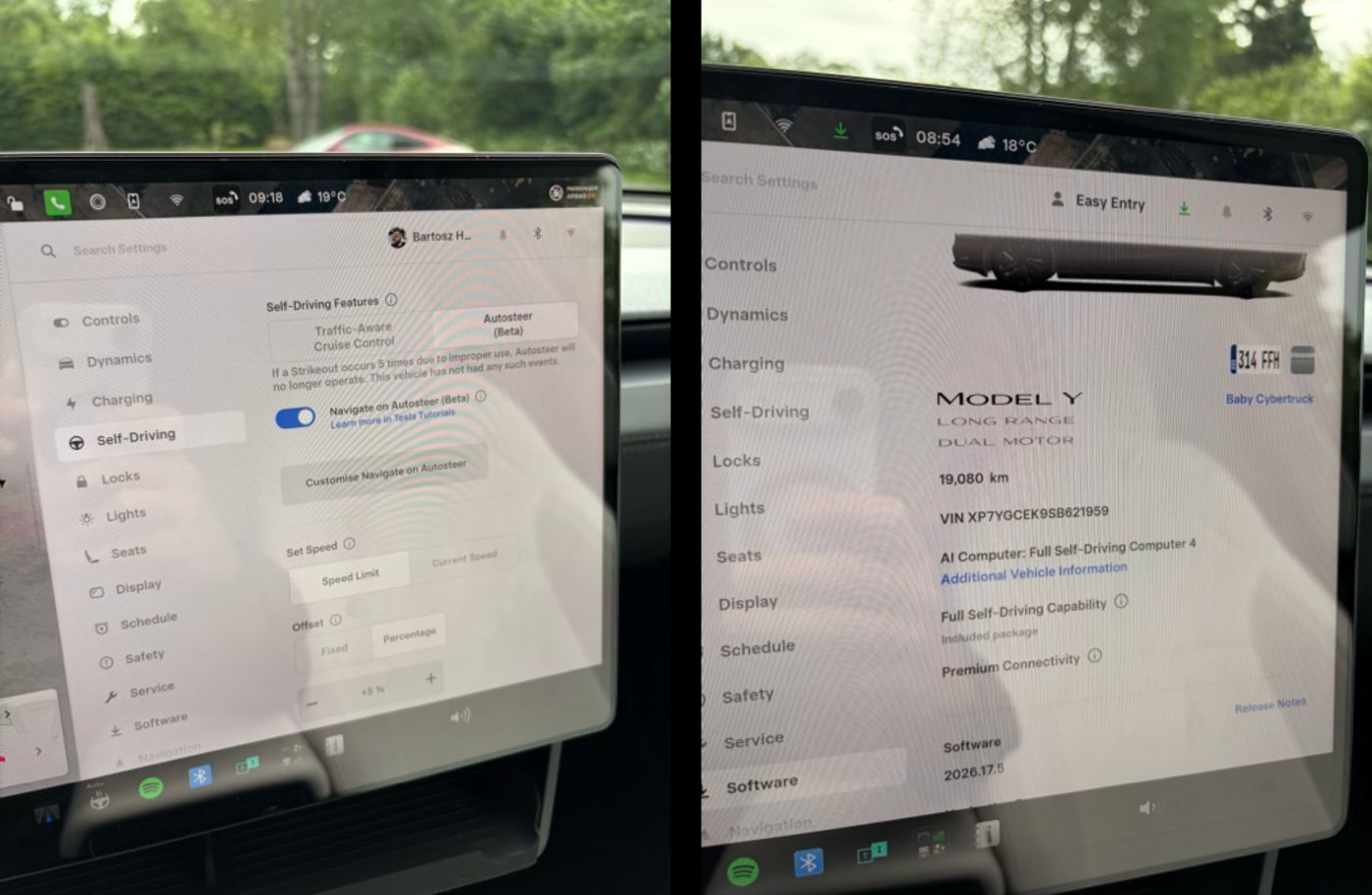
Nie potrafię znaleźć innego wyjaśnienia niż to: przywoływane „względy bezpieczeństwa” w rzeczywistości obniżają moje bezpieczeństwo. Przez osiem tygodni mój samochód nie potrafił wykrywać znaków stopu ani sygnalizacji świetlnej — funkcji, na której zacząłem polegać.
07Pytania, na które Tesla nie odpowie
Zadałem te pytania Tesli i jej serwisom. Pozostają bez odpowiedzi. Pogrupowałem je tematycznie.
A Odmowa naprawy gwarancyjnej
B Decyzja o wyłączeniu
C Przywoływane „względy bezpieczeństwa”
D Przywrócenie opłaconych funkcji
E Odszkodowanie
F Polityka wobec modyfikacji i urządzeń innych producentów
Poprosiłem o pisemną odpowiedź w ciągu 14 dni, odnoszącą się do każdego punktu. Wciąż czekam.
08Nie jestem przeciwnikiem Tesli
Naprawdę wierzę w tę technologię. Kupiłem dwie Tesle i wpłaciłem z góry łącznie 12 400 € + VAT w zamian za obietnicę FSD. Spełnienie tej obietnicy trwało tak długo, że sprzedałem jeden z samochodów — tracąc wartość pakietu na nim.
Teraz mam wreszcie działający samochód, z zakupionym FSD, w kraju, który dopuszcza FSD. A Tesla celowo uniemożliwia mi korzystanie z tego, za co zapłaciłem. Chcę po prostu funkcji, którą kupiłem, odpowiedzi na moje pytania i tego, by to nie spotkało po cichu nikogo innego.
09Kalendarium
- 2025Kupuję Model Y z 2025 roku jako pierwszy właściciel z FSD Capability — 6 200 € + VAT.
- Kilka miesięcy po odbiorzeFunkcje FSD, w tym sterowanie na podstawie znaków stopu i świateł, działają niezawodnie w całej Europie.
- 8 kwi 2026 · 22:27Zdalna aktualizacja Cloud Config: „Twój pakiet Autopilot powrócił do pierwotnej konfiguracji”. Funkcje utracone.
- 9 kwi 2026 · 02:00Tesla wysyła e-mail o „nieautoryzowanym urządzeniu innego producenta” wyłączonym „ze względów bezpieczeństwa”.
- 8 tygodniBrak dalszych informacji. Urządzenie diagnostyczne zostaje usunięte; w samochodzie nie ma już żadnego urządzenia innego producenta.
- 29 maj 2026Estonia — gdzie zarejestrowany jest mój samochód — dopuszcza FSD na drogach publicznych (po Holandii i Litwie, przed Belgią). Pojawia się aktualizacja 2026.17.5.
- 15 lip 2026Instaluję oprogramowanie 2026.21.100 — FSD nadal nie działa. Wysyłam do Tesli formalną skargę i wezwanie do przywrócenia funkcji, zwrotu kosztów i odszkodowania.
- 30 lip 2026W Korei zbanowane samochody z HW3 odzyskują cały pakiet — i tracą go ponownie po dwudziestu minutach, zdalnie, bez żadnej aktualizacji w którąkolwiek stronę.
- 31 lip 2026Sześć godzin po tym, jak zapowiadam skargę do organu ochrony danych, Biuro Ochrony Danych Tesli przyznaje sobie dwa dodatkowe miesiące — zob. sekcja 15.
- 3 sie 2026Odpowiadam na przedłużenie terminu i składam skargę z art. 77 RODO na Teslę do estońskiej Inspekcji Ochrony Danych. Przyjęta tego samego dnia — sekcja 16.
- 11 sie 2026Reklamacja drugiego właściciela w sprawie po cichu usuniętego pakietu zostaje zamknięta — a zgłoszenie usunięte z jego konta Tesli — sekcja 17.
- TerazSamochód oferuje przycisk „Subskrybuj” dla FSD, o którym mówi, że jest „W zestawie”. Dwa serwisy odmawiają naprawy gwarancyjnej.
10Tesla odpowiedziała. Oto moja odpowiedź.
30 czerwca 2026 r. Tesla Poland odpowiedziała na moją reklamację. Nie odpowiedziała na żadne z moich pytań — postawiła jednak cztery twierdzenia, które warto skomentować. Poniżej ich pismo i moja pełna odpowiedź.
Odpowiedź Tesli omijała każde pytanie. Moja replika punkt po punkcie oraz pytania wciąż bez odpowiedzi.Przeczytaj w całości
Dear Mr. Hernas,
Thank you for your email and for the questions you have raised.
At the outset, we would like to note that, in the absence of any site visits carried out and any information on file regarding you, we do not see grounds to address the questions listed above.
The vehicle was purchased by you from a third party. In your message you stated that you are the first owner, which is not consistent with our records. Vehicles acquired second-hand are always outside the scope of our standard processes.
Given that the vehicle is registered in our system as being in Estonia, we ask that you await a response from the appropriate department.
Sincerely,
Tesla Poland
Thank you for your reply. With respect, it does not answer any of the questions I raised, and several of its statements are either factually incorrect or contradict Tesla’s own instructions to me. Let me address each point.
“In the absence of any site visits and any information on file regarding you, we do not see grounds to address the questions.”
That is exactly the problem: no site visit has taken place because Tesla has not carried one out. When I approached the service centres in Turku and Warsaw to have the car repaired under warranty, both confirmed the features do not work and that the car is under warranty — yet both declined to proceed, so no inspection ever happened. You cannot refuse to examine the car and then cite the absence of an examination as the reason you cannot answer my questions. I am asking for written answers to written questions; a site visit is not a precondition for that. And if you do require one, name the centre and the date, and I will attend.
“Given that the vehicle is registered as being in Estonia, await a response from the appropriate department.”
Estonia has no Tesla service centre. Tesla’s own guidance is to use any service centre in the EU — which is exactly what I did, having serviced this car in Finland several times. Please name the “appropriate department” and give me its direct contact details; I cannot await a response from a department no one will identify. Your phrasing also implies you are tracking the car’s current location. I have disabled data sharing — so I am formally requesting, under Article 15 GDPR, all location data Tesla holds on this vehicle and the legal basis for collecting it.
“You stated you are the first owner, which is not consistent with our records.”
I am the first registered owner. The car was acquired through an intermediary for leasing, but I am the first owner named on the official EU registration documents. Tesla’s internal records do not determine legal ownership — the registration does. If your records say otherwise, send me the record you are relying on so the discrepancy can be corrected.
“Vehicles acquired second-hand are always outside the scope of our standard processes.”
Please state, in writing, what this means. Are you saying that a change of ownership voids the warranty? If so, cite the exact clause. Under EU consumer law the warranty attaches to the car, not to the owner, and transfers with it on resale. A warranty that can be switched off because a car changed hands is not a warranty.
Oraz pytania, które wciąż pozostają bez odpowiedzi:
- The exact warranty clause that excludes this fault from coverage.
- Who authorised the remote disablement, on what documented evidence, and on what legal basis.
- What the “unauthorized third-party device” was — make, model, log entry, and timestamp.
- The specific safety risk the device is alleged to have created, with documentation.
- The date by which the paid features will be restored, and the formal appeals process.
- The compensation Tesla will provide for the period the paid features were disabled.
I reiterate my request for a written response addressing each point within 14 days. Absent that, I will treat this as Tesla’s final refusal and escalate to the relevant consumer-protection and data-protection authorities. — Bartosz Hernas
Oba pisma przytoczono dosłownie. Oryginalna korespondencja jest w języku angielskim; dane osobowe (adres zamieszkania) zostały zredagowane.
11Droga przez ochronę danych
Nie ma żadnego sposobu, by dotrzeć do kogokolwiek w Tesli ponad poziomem serwisu — żadnego adresu e-mail, żadnego nazwiska, żadnej ścieżki eskalacji — a serwisy powiedziały mi wprost, że nie mogą nic zrobić. Skorzystałem więc z jedynego kanału, na który Tesla ma obowiązek odpowiedzieć: ochrony danych osobowych. Na podstawie RODO złożyłem wniosek o dostęp do danych — telemetrii, którą Tesla wykorzystała do wyłączenia pakietu, za który zapłaciłem. Oto ta korespondencja, w całości. Na tym się nie skończyło — sekcja 15 opisuje, co było dalej.
Wniosek RODO o dostęp do telemetrii, którą Tesla wykorzystała do wyłączenia FSD — oraz odpowiedź Tesli, że nie posiada takich danych.Przeczytaj w całości
I would like to reiterate that I would also like to have any telemetry data you used to deny my warranty claims.
My car has the Full Self-Driving package purchased, and this package has been illegally disabled by a remote configuration change — in effect tricking the car into thinking FSD had never been purchased.
I have lost legally available, previously working functionality: Traffic Light Awareness on Autopilot. This was part of a €6,200 extra payment. It was remotely disabled, with no refund.
Your reasoning was that your telemetry discovered a third-party device — even though on the day it was disabled I had telemetry opt-out enabled in my car. I would therefore like all the data associated with that telemetry.
I would also like to know whether the Tesla cars you sell are owned by their owners (me), or whether they are rented/subscribed to but owned by Tesla. If I own the car, I would like Tesla not to tell me what I can and cannot do with a car I paid full price for.
I want to ensure there are no future violations of my privacy: please remove all telemetry data sent from my cars to your servers, and ensure no future telemetry data is sent out, on all cars of which I am the owner.
I need this data to follow up on the loss of value of the car following the remote bricking of legal functionality, and Tesla’s full denial of my warranty claim to restore the car to full functionality.
Thank you for contacting us. Our records indicate that your access request was fulfilled on 01/06/2026. As described in our Privacy Notice, from the moment you take delivery, Tesla does not associate the vehicle data generated by your driving with your identity or account by default. As a result, no one – including Tesla – would have knowledge of your activities. In order for vehicle data to be linked to your account or VIN, a specific condition must be triggered such as the occurrence of a safety event (collision or airbag deployment), service or repair appointment, a raised hardware or software issue, or your consent – in which case it is provided as part of your data request.
Additionally, Tesla’s retention guidelines and data privacy practices implement techniques designed to minimize how much data we collect, use, or store.
When data isn’t provided, this is because it is either: in a form that is not personally identifiable or linked to your Tesla Account; stored in an end-to-end encrypted format that Tesla cannot decrypt; or not customer-related.
Note: Some data may have also been held only for a very short time and is no longer on our servers.
Thank you for your response of 25 June 2026. I am writing to dispute the completeness of my access request and to make a further, specific request under Articles 15 and 22 of the GDPR.
Your response states that Tesla does not associate vehicle data generated by driving with my identity or account “by default,” and that linkage only occurs when a specific condition is triggered — including “a raised hardware or software issue” or “your consent.”
This is directly contradicted by Tesla’s own prior written communication to me, in which Tesla stated that an unauthorised device was detected in my vehicle and that Full Self-Driving was consequently disabled. That detection and that decision necessarily relied on vehicle telemetry linked to my specific VIN and account. By your own framework, this is exactly the kind of “specific condition” that triggers linkage — meaning the underlying data exists, is associated with my identity, and falls squarely within the scope of my access request.
Dane, o które poprosiłem, a których nie udostępniono:
- All telemetry, diagnostic, and event data from my vehicle (VIN XP7YGCEK9SB621959) that Tesla used, referenced, or relied upon to detect the alleged unauthorised device and to disable functionality. This is personal data under Article 4(1).
- The specific date(s) and time(s) this data was collected and processed.
- Under Article 15(1)(h) and Article 22, meaningful information about the logic involved in the automated decision to disable functionality, including the criteria used to classify a device as “unauthorised.”
- Under Article 15(1)(c), the recipients or categories of recipients to whom this data has been or will be disclosed.
- Under Article 15(1)(d), the retention period applied to this category of data, and confirmation of whether it is still held.
Article 15 does not permit a controller to withhold data on the basis that it is “not provided by default.” Where data has in fact been linked to my identity and used to make a decision affecting me, it is personal data and must be disclosed. If Tesla maintains that any of the requested data is not held, I request a clear statement to that effect for each item, together with the legal basis. — Bartosz Hernas
Wszystkie trzy pisma przytoczono dosłownie. Korespondencja jest w języku angielskim; dane osobowe (adres zamieszkania) zostały zredagowane.
12Jak przeprowadzane jest wyłączenie
Inny właściciel, który znalazł się w tej samej sytuacji, skontaktował się ze mną, przedstawiając techniczny szczegół tego, jak faktycznie robi się to samochodowi. Za pomocą własnej metody włączania FSD udało mu się także zarejestrować — choć nie przechwycić — interakcję Tesli z pojazdem. 8 kwietnia 2026 r., około 11:00 PST, jego samochód otrzymał od teleforce żądanie aktualizacji konfiguracji bramki (gateway). Przytaczamy je poniżej z redakcjami dokonanymi przez samego autora — każde XXX pochodzi od niego.
Surowe polecenie konfiguracji bramki teleforce, które przechwycił inny właściciel — dokładne bajty wyłączające FSD, wraz z podpisem kryptograficznym.Przeczytaj w całości
odin.core.engine.handlers.message_handler - INFO - received request, request_id: XXX, product_id: XXX, message_type: command, response_topic: vehicle_service.mothership-dub_worker.teleforce, request: {'command': 'execute', 'token': {'user': 'sa-teleforce', 'principals': ['authenticated', 'tbx-service', 'tbx-internal', 'tbx-mothership', 'tbx-service-engineering', 'tbx-technical-specialist', 'odin-service-repair-and-maintenance', 'odin-service-security-operations', 'odin-research-and-development-level1', 'odin-software-update-management-system', 'odin-service-robotaxi', 'tbx-robotaxi-data'], 'product_id': 'XXX', 'expires_at': '2026-04-XXX0'}, 'tokenv2': {'token': {'user': 'sa-teleforce', 'principals': ['authenticated', 'tbx-service', 'tbx-internal', 'tbx-mothership', 'tbx-service-engineering', 'tbx-technical-specialist', 'odin-service-repair-and-maintenance', 'odin-service-security-operations', 'odin-research-and-development-level1', 'odin-software-update-management-system', 'odin-service-robotaxi', 'tbx-robotaxi-data'], 'product_id': 'XXX', 'expires_at': '2026-04-XXX0'}, 'intermediate_certificate': '-----BEGIN CERTIFICATE-----\nMIICGjCCAb+gAwIBAgIIWE8E/tPO4rYwCgYIKoZIzj0EAwIwJDEiMCAGA1UEAwwZ\nVGVzbGEgU2VydmljZXMgQ29tbWFuZCBDQTAeFw0yNjA0MDgxMjUwMjhaFw0yNjA0\nMTgxMjUwMjhaMIGJMSowKAYDVQQDDCFpbnRlcm5hbC5vZGluLnByb2QudGVzbGEu\nc2VydmljZXMxFTATBgNVBAsMDFRlc2xhIE1vdG9yczEOMAwGA1UECgwFVGVzbGEx\nEjAQBgNVBAcMCVBhbG8gQWx0bzETMBEGA1UECAwKQ2FsaWZvcm5pYTELMAkGA1UE\nBhMCVVMwWTATBgcqhkjOPQIBBggqhkjOPQMBBwNCAARLEFIVmg4s93fAU9tFTuQy\nHiQYr9EBoIL8V7Pwhzg8TmBXtNucZkAT+VOJS9ua2NgXf2UL5bco9MXPoMn75gTo\no3UwczAdBgNVHQ4EFgQUEtro+JN4/jwURhxoYNqw4p9AOq0wDAYDVR0TAQH/BAIw\nADAfBgNVHSMEGDAWgBSEHWFVJ3GUwSiIrRJlO681Ad5DxTAOBgNVHQ8BAf8EBAMC\nBeAwEwYDVR0lBAwwCgYIKwYBBQUHAwMwCgYIKoZIzj0EAwIDSQAwRgIhAMOT6W/2\naOZri1Nebjaw6H8Blyjz/0YE2d54kiTyMlfEAiEA+hmbXXD2NDMdHnA+ABcT25dY\nZFGU6Ilvv/0eTms8GyQ=\n-----END CERTIFICATE-----\n'}, 'args': {'name': 'PROC_ICE_X_SAFE-SET-VEHICLE-CONFIGS', 'kw': {'configParams': [{'configid': 29, 'data': '02', 'signature': '50XXX07'}, {'configid': 88, 'data': '0200000000', 'signature': '50XXX0f'}], 'configs_require_ice_reboot': []}}, 'allow_concurrent': True, 'request_id': 'XXX', 'message_type': 'command', 'broadcast_permanent_topics': True}, hermes_req_txid: XXX command_type: 42Co robi to polecenie:
Config IDs 29 and 88 are what tell Autopilot which package you have bought:
- Config autopilot —
id 29(02= EAP,03= FSD) - Config autopilotSubscription —
id 88 - The values set in this command mean “EAP” — i.e. Full Self-Driving switched off.
The car applied those configs and rebooted Autopilot — landing in exactly the state this whole site is about: the UI still shows FSD as “Included,” but the features are gone.
Argument autora: dzięki podpisowi zawartemu w poleceniu jest on w stanie — jak twierdzi — udowodnić kryptograficznie, że wydała je sama Tesla. Użytkownikiem tokenu jest sa-teleforce — „sa” oznacza service account (konto usługowe), czyli automatyczny system, a nie konkretnego pracownika. Gdy polecenie wydaje człowiek, w tym polu — jak twierdzi — pojawia się rzeczywiste nazwisko. Udostępnione tutaj na wypadek, gdyby pomogło innym właścicielom; przytoczone dosłownie z redakcjami dokonanymi przez autora.
13Formalna skarga
15 lipca 2026 r. wysłałem do Tesli formalną skargę i wezwanie prawne — o natychmiastowe przywrócenie pakietu, za który zapłaciłem, zwrot kosztów za utratę możliwości korzystania, odszkodowanie za szkody oraz pisemne odpowiedzi na osiemnaście konkretnych pytań. Pismo trafiło do Tesla Resolutions / Tesla International B.V. i zostało przesłane do wiadomości adresów prasowych, prawnych, ds. prywatności, relacji inwestorskich oraz zarządu Tesli. Oto ono w całości.
Formalne wezwanie prawne: przywrócić pakiet, zwrócić koszty utraty możliwości korzystania, wypłacić odszkodowanie za szkody i odpowiedzieć na osiemnaście pytań w ciągu 14 dni.Przeczytaj w całości
For the attention of Tesla Resolutions / Tesla International B.V.
Dear Sir or Madam,
I am writing to make a formal complaint and a formal demand for the restoration of functionality I paid for and own, together with reimbursement, compensation, and written answers to the specific questions set out below. This follows my earlier correspondence, which remains substantively unanswered.
1. What I paid for and what happened
I purchased a 2025 Model Y with the Full Self-Driving Capability package for €6,200 plus VAT, paid in full. That package — expressly including Traffic Light and Stop Sign Control — worked reliably for months after delivery. On 8 April 2026 at 22:27, a remote Tesla Cloud Config update reset my vehicle to its “original configuration,” removing features I had paid for, including the automatic stopping at red lights and stop signs. Roughly three hours later I received an email citing an “unauthorized third-party device,” naming no device, specifying no risk, and giving no timeframe for restoration. To this day, the Tesla app and the car’s own settings still list the Full Self-Driving package as “Included.”
2. Why the disablement is unlawful and unjustified
The use of third-party equipment for vehicle diagnostics and maintenance falls within the framework established by Article 61 of Regulation (EU) 2018/858. The concept of an “unauthorized third-party device” has no basis in that regulatory framework and cannot lawfully be used to determine what equipment an owner may connect to a vehicle they own outright. The devices I used are standard CANBUS diagnostic tools that modify no hardware, no component, and no software — they send only commands the vehicle already supports, through the manufacturer’s own diagnostic interface. No safety system, in hardware or software, was modified in any way.
The claim that such equipment could “potentially interfere with” Full Self-Driving does not justify remotely and unilaterally disabling features that were previously working normally. The result is paradoxical: since the intervention, my vehicle no longer stops automatically at red lights or stop signs, so presenting the removal of these features as a “safety measure” is untenable — the car is now demonstrably less safe than before. If Tesla had a genuine concern, I could simply have been asked to disconnect the device. I have now removed it. The features have still not been restored.
Since the features were disabled remotely, they can plainly be re-enabled remotely. Referring to “a future software update” under which features “may” be re-enabled guarantees neither full restoration nor any reasonable timeframe. Meanwhile, Full Self-Driving is now approved on public roads in Estonia, where my car is registered (from 29 May 2026), so I am now blocked from using a feature that is both paid for and legal.
3. Warranty
The vehicle is under warranty. Service centres in Turku (Finland) and Warsaw (Poland) each confirmed that the features do not work and that the car is under warranty, yet each refused to remedy the fault. Under EU consumer law the warranty attaches to the vehicle and transfers with it; it is not extinguished by a change of registered owner, and no site visit that Tesla itself declined to perform can be cited as a reason not to address this.
4. Questions requiring a written answer
The following questions have been put to Tesla and its service centres and remain unanswered. I require a specific written response to each.
The decision to disable:
- (i) Who authorised the remote disablement of the paid entitlement, by name or role, and on what documented evidence?
- (ii) Was the decision automatic or made manually by a person? If automatic, what specific trigger or rule caused it?
- (iii) On what legal basis does Tesla remotely disable functionality a customer has already paid for?
The detection:
- (iv) What exactly was the “unauthorized third-party device”? Provide its make and model.
- (v) Provide the specific log entries, telemetry, and timestamp that led to the detection.
- (vi) The vehicle had telemetry sharing disabled on the relevant date; explain how detection occurred and what data was transmitted, when, and under what legal basis.
The notification and the question of responsibility:
- (vii) How, and through what channel, was the owner contacted before — rather than after — the entitlement was removed?
- (viii) Tesla took no step to establish whether the registered owner installed or was even aware of any device. What process, if any, does Tesla follow to establish responsibility before penalising the owner, given that a device could be fitted by a previous keeper, an intermediary, a workshop, or a third party without the owner’s knowledge?
- (ix) On what basis does Tesla consider it proportionate to strip a paid entitlement rather than simply request that the device be removed — which I would have done, and have now done?
The “authorization” of devices:
- (x) Who at Tesla decides whether a third-party device is “authorized” or “unauthorized,” and by what published criteria?
- (xi) Is there a published list of approved and prohibited devices? If so, provide it; if not, explain how an owner is expected to know in advance.
- (xii) Does Tesla consider a standard CANBUS diagnostic device, used through the manufacturer’s own diagnostic port, “unauthorized”? If so, state that policy publicly.
The “safety reasons”:
- (xiii) Identify the specific safety risk the device is alleged to have created, with supporting documentation.
- (xiv) Explain how disabling stop-sign and traffic-light recognition — leaving the car unable to stop automatically at red lights — improves safety.
Warranty and restoration:
- (xv) State, in writing, the exact warranty clause relied upon to exclude this fault from coverage.
- (xvi) The device has been removed and no third-party device is now present — what is the remaining obstacle to restoration, and by what date will the features be restored?
- (xvii) What is the formal appeals process, and how do I begin it?
Scope of remote control:
- (xviii) What else can Tesla disable remotely on a vehicle an owner has paid for in full — could I lose app access, heated seats, charging, or other functions over a third-party part Tesla disapproves of? Where is this disclosed before purchase?
5. What I require
- (a) Immediate restoration of the full Full Self-Driving Capability package to my vehicle, given that the device concerned has been removed and no third-party device is now present.
- (b) A specific, dated commitment for that restoration — not a conditional reference to an unspecified future update.
- (c) Reimbursement for loss of use. Tesla’s own published subscription price for this functionality is approximately €99 per month. On that basis, the value of the functionality withheld from 8 April 2026 to the date of this letter (15 July 2026, 98 days) is approximately €319, increasing by approximately €99 for each further month until full restoration. I require reimbursement on this basis for the entire period of deprivation.
(d) Compensation for damages, in addition to (c). Separately from loss-of-use reimbursement, I require compensation for:
- (i) Diminution in value of the vehicle resulting from the remote removal of a paid, functioning package. The package was purchased for €6,200 + VAT; a vehicle whose paid features can be, and have been, remotely revoked is worth materially less than one where they cannot. I reserve the right to quantify this by independent valuation, but put its floor at the unamortised value of the package.
- (ii) Loss of a safety-relevant function — automatic stopping at red lights and stop signs — over a period now exceeding three months.
- (iii) Time, effort and costs incurred pursuing a matter Tesla can resolve with a single remote configuration change.
I invite Tesla to propose a figure for (d); failing agreement, it will be quantified with supporting evidence in any subsequent proceedings.
- (e) If the Service Centre does not have the means to resolve this, direct contact from a person at Tesla with the authority to re-enable the functionality, together with the identity of the department responsible.
6. Timeframe
Please provide a written response addressing each numbered question and each lettered requirement within 14 days of this email. Absent a substantive response, I will treat this as Tesla’s final refusal and escalate to the competent consumer-protection and data-protection authorities, and pursue the matter further as advised. To my knowledge, several hundred European owners are affected by the same practice.
This complaint, and Tesla’s responses to date, form part of a documented public record at TeslaTookWhatIPaidFor.com.
Yours faithfully, Bartosz Hernas — Tesla shareholder, Owner of 2025 Tesla Model Y · VIN XP7YGCEK9SB621959
Przytoczono dosłownie. Dane osobowe (adres zamieszkania) zostały zredagowane; adresy odbiorców podano tak, jak w wysłanym piśmie.
14Korea: oddane i znów odebrane
30 lipca 2026 r. koreańscy właściciele, którzy dostali bana w kwietniu — bana po numerze VIN, dokładnie tak jak ja — patrzyli, jak Tesla z powrotem włącza im Full Self-Driving. A po niespełna dwudziestu minutach patrzyli, jak wyłącza je ponownie. Bez aktualizacji oprogramowania w którąkolwiek stronę. Flaga, przełączona dwa razy w ciągu jednego popołudnia.
Cynk dostałem od innego właściciela, który stracił swój pakiet w tym samym miesiącu co ja. Wskazał mi koreański kanał na Discordzie ev-open-can-tools, gdzie kilku właścicielom samochodów z HW3 i kompilacją na rynek koreański 2026.20.6.3 — wydaniem „v14 lite” — nagle zdjęto bana. Korzystali z dongli CAN, dokładnie jak ja. I — co sam podkreślił — ułaskawienie nie przyszło od samej aktualizacji: pojawiło się nagle, jakiś czas po niej, dokładnie w taki sposób, w jaki wcześniej pojawił się ban. Jak jakiś cron job.
Ten szczegół ma znaczenie, bo koreańskie samochody to te trudne przypadki. W Chinach taką blokadę da się zdjąć, przenosząc samochód na inne konto Tesli. W Korei — jak w Europie — jest przypisana do VIN-u i zmiana właściciela jej nie usuwa. To były takie same blokady jak ta w moim samochodzie.
Co się stało tego popołudnia, czasu koreańskiego:
- 30 lip 2026 · 15:46Pierwsze zgłoszenie: FSD po prostu znów tam jest — w aplikacji i w samochodzie, a informacje o wydaniu prawidłowo wymieniają Full Self-Driving. Autopark i pełny zestaw funkcji potwierdzone jako działające.
- Kilka minut późniejOdzywają się kolejne zbanowane samochody, w tym te, które dostały kompilację 2026.20.6.3 bez FSD. Właściciele zakładają oficjalną premierę w Korei albo że sama liczba skarg wymusiła odwrót.
- ~16:00„다시 뺏어갔습니다” — „znowu nam to odebrali”. FSD pierwszego właściciela zostaje zdalnie odebrane, w aplikacji i w samochodzie. Bez komunikatu, bez powiadomienia: po prostu znika.
- 18:31Drugi właściciel przejeżdża krótko na przywróconym FSD, parkuje, idzie na górę. Pięć minut później wersja z FSD zniknęła z aplikacji i z samochodu. Znowu bez jakiegokolwiek ostrzeżenia.
- Tego wieczoruNikt nie zgłasza, by zrobił cokolwiek, co mogłoby to wywołać — żadnego podłączonego z powrotem urządzenia, żadnej włożonej karty SIM, żadnych wysłanych komend. Jedyna widoczna prawidłowość: najszybciej tracą FSD samochody, które nigdy nie zmieniały właściciela.
Tesla powiedziała mi, że funkcje „mogą zostać ponownie włączone w przyszłej aktualizacji oprogramowania”. Korea widziała, jak włączają się i wyłączają w ciągu dwudziestu minut — całkiem bez aktualizacji.
To ta część, którą każdy europejski właściciel powinien przeczytać dwa razy. Cztery miesiące odmów opierają się na jednym twierdzeniu: że tego nie da się odkręcić z miejsca, w którym siedzi osoba po drugiej stronie — że potrzebne jest wydanie firmware’u, inny dział, oględziny, procedura. 30 lipca w Korei uprawnienie zostało nadane zdalnie i odebrane zdalnie w ciągu tej samej godziny. To flaga po stronie serwera. Przywrócenie jej to jeden zapis konfiguracji — sekcja 12 zawiera dokładne polecenie, bajt po bajcie.
Druga rzecz, którą to pokazuje: nie jest to zapomniana kwietniowa akcja. Ta blokada jest aktywnie utrzymywana. Coś zauważyło w ciągu dwudziestu minut, że samochody, które nie powinny mieć FSD, mają FSD — i przywróciło poprzedni stan. Ktokolwiek albo cokolwiek przygląda się temu tak uważnie, jest w pełni zdolny odpowiedzieć na moje maile.
Zbanowane samochody z HW3 w Korei odzyskały 30 lipca cały pakiet — i straciły go po dwudziestu minutach. Dowód, że przełącznik działa w obie strony, bez żadnej aktualizacji.Przeczytaj w całości
Hi Bartek — I’m in much the same situation as you. I was banned in April too.
On the ev-open-can-tools Discord, in the Koreans’ channel, several people with HW3 cars on update v14 lite 2026.20.6.3 — from what I can see, an update for the Korean market — have been un-banned. They had been using CAN dongles, the same as us. Not un-banned by the software update itself, even though it happened after the update, but presumably by some cron job — the same way we got banned, i.e. suddenly.
The Koreans were blocked in the same way we were, by VIN — not like the Chinese, where changing the owner of the Tesla account helps.
So, as you can see, “it can be done.” But I wouldn’t count on European concrete: they’ll probably go on saying that no such possibility exists.
Co zauważyli koreańscy właściciele:
- Uprawnienie to czysty zdalny przełącznik. FSD zostało włączone i wyłączone bez żadnego wgrania firmware’u pomiędzy — wprost zaprzeczając temu, co obsługa klienta mówi właścicielom: że wymagana jest aktualizacja oprogramowania.
- Nikt nie „zawinił” ponownie. Nikt nie zgłosił, że przed odebraniem funkcji podłączył z powrotem urządzenie, włożył kartę SIM czy wysłał jakiekolwiek komendy CAN.
- Samochody bez niedawnej zmiany właściciela lub konta traciły FSD najszybciej.
- Samochody z przeniesieniem własności w historii utrzymywały je dłużej — w tym jeden, który przez pewien czas był na koncie kanadyjskim, a potem wrócił na koreańskie — przynajmniej tak długo, jak długo rejestrowano rozmowę.
- Interpretacja samych właścicieli: że Tesla na chwilę zdjęła flagę — test, reakcja na skargi z rynku wtórnego albo wewnętrzna pomyłka — a potem nałożyła ją ponownie, gdy wykryła odblokowania w telemetrii albo przeczytała wpisy samej społeczności. Możliwe, że wystarczyła sama jazda z przywróconym pakietem, by znów zostać oznaczonym.
Słowo o tym, czym to jest. To relacja społeczności, z zapisu czatu po koreańsku, o samochodach, które nie są moje; nie siedziałem w nich i nie jestem źródłem. Publikuję ją, bo po raz pierwszy widzę ten mechanizm zademonstrowany w obie strony tego samego dnia, niezależnie przez kilka osób — i bo Tesla mogłaby to potwierdzić albo zdementować jednym zdaniem.
Źródło: koreański kanał Discorda ev-open-can-tools, 30 lipca 2026 (bezpośredni link do kanału). Cynk przytoczono po angielsku, w tłumaczeniu z polskiego, bez nazwiska nadawcy i bez jednej dygresji; pseudonimy koreańskich właścicieli pominięto.
15Termin, który się przesunął
31 lipca 2026 r. — trzydzieści dni po tym, jak zadałem pięć konkretnych pytań, i sześć godzin po tym, jak zapowiedziałem Tesli skargę do organu nadzorczego — odpowiedziało Biuro Ochrony Danych Tesli. Nie odpowiedziami: przedłużeniem terminu. Wniosek jest otwarty od 1 czerwca. Termin przypada teraz na 1 października.
Kolejność ma znaczenie, więc podaję ją wprost. 1 czerwca poprosiłem o telemetrię, którą Tesla wykorzystała do wyłączenia pakietu, za który zapłaciłem. 25 czerwca Tesla odpisała, że wniosek został „zrealizowany” tego samego dnia, w którym go złożyłem, i przytoczyła swoją Politykę prywatności — całe to pismo jest w sekcji 11. 1 lipca zakwestionowałem to i zadałem pięć konkretnych pytań na podstawie art. 15 i 22, co ponownie uruchomiło miesięczny termin: odpowiedzi były należne do 1 sierpnia. Potem trzydzieści dni ciszy. 31 lipca o 11:44 napisałem, że nie zawiadomiono mnie o żadnym przedłużeniu i że złożę skargę do estońskiej Inspekcji Ochrony Danych. O 18:30 tego samego dnia Tesla wzięła sobie dwa dodatkowe miesiące.
Przedłużenie terminu nie jest formalnością, którą firma przyznaje sobie sama. Na podstawie art. 12 ust. 3 przysługuje ono, gdy żądanie jest skomplikowane albo gdy żądań jest wiele; musi zostać zgłoszone w ciągu miesiąca; i trzeba podać przyczyny opóźnienia. Podana przez Teslę przyczyna to fakt, że moje zapytanie „zostało złożone w kilku działach” i że Tesla „uzgadnia te wnioski”. To opis wewnętrznego obiegu dokumentów w Tesli, a nie złożoności mojego żądania. Zadałem pięć pytań o jedną automatyczną decyzję, podjętą wobec jednego numeru VIN, w jedno popołudnie. Odpowiedziałem 3 sierpnia, a moje stanowisko jest takie: o dwa z tych pięciu punktów prosiłem już 1 czerwca, a dla nich miesięczny termin upłynął 1 lipca i nie zawiadomiono mnie o żadnym przedłużeniu. Przedłużenia nie da się zastosować wstecz do terminu, który już minął. Te dwa punkty są należne teraz.
Trzydzieści dni ciszy, a potem — sześć godzin po tym, jak wskazałem organ nadzorczy — Tesla przyznała sobie dwa dodatkowe miesiące. Wniosek ma już cztery miesiące.Przeczytaj w całości
I refer to my email of 1 July 2026 (your reference J27NGDL), to which I have received no response.
That email set out five specific items requested under Articles 15 and 22 GDPR, none of which have been answered. Under Article 12(3) your response was due within one month, i.e. by 1 August 2026. No extension has been notified to me at any point, so no extension under Article 12(3) is available to Tesla.
I also note that your reply of 25 June 2026 did not inform me of my right to lodge a complaint with a supervisory authority or to seek a judicial remedy, as required by Article 12(4).
If I do not receive a substantive response to each of the five items by 1 August 2026, I will lodge a complaint with the Estonian Data Protection Inspectorate (Andmekaitse Inspektsioon) under Article 77 GDPR, for onward handling with the Autoriteit Persoonsgegevens as Tesla’s lead supervisory authority.
For the avoidance of doubt, a restatement of your general Privacy Notice will not be treated as a response. If Tesla holds none of the requested data, I require a clear statement to that effect for each of the five items individually, together with the legal basis relied upon.
Thank you for your follow-up and for providing the additional information.
Please be assured that we are actively working on your request. We have identified that your inquiry has been submitted across several departments, and we are currently reconciling those requests to ensure that we provide you with a complete and accurate response.
Given the scope of your request, we require additional time to complete our review. We will get back to you as soon as possible and, in any event, within the legally prescribed time period of two additional months permitted under local regulations.
We appreciate your patience and understanding. If we require any further information to process your request, we will promptly contact you.
Thank you for your email of 31 July 2026. I note that you now require two further months under Article 12(3) GDPR. My position on that is as follows.
1. Scope of the extension
Items 1 and 2 of my email of 1 July 2026 — the telemetry, diagnostic and event data relied upon to detect the alleged unauthorised device and to disable Full Self-Driving, and the dates and times on which that data was collected and processed — were already expressly requested in my email of 1 June 2026. In respect of those items the one-month period under Article 12(3) expired on 1 July 2026 and no extension was notified within it. An extension cannot be applied retrospectively to a period that has already expired. I therefore do not accept that the extension operates in respect of items 1 and 2, and I require those items now. As to items 3 to 5, which were first raised on 1 July 2026, I accept that your notice of 31 July 2026 was given in time.
2. A specific date
Your email gives no date. Please confirm in writing the precise date by which you will respond, and the date of receipt from which you are calculating the extension.
3. Reasons for the delay
Article 12(3) requires you to inform me of the reasons for the delay. That my inquiry “has been submitted across several departments” and that you are “reconciling those requests” describes Tesla’s internal routing, not the complexity or number of my requests. If Tesla maintains that the request is complex within the meaning of Article 12(3), please state the specific reasons.
4. Applicable law
For the avoidance of doubt, the applicable instrument is Regulation (EU) 2016/679, not “local regulations”. Tesla International B.V. is the controller and the extension available is that in the second sentence of Article 12(3).
5. Your position of 25 June 2026
You informed me on 25 June 2026 that my access request “was fulfilled on 01/06/2026”. That is inconsistent with now requiring three months in total to answer it. Please confirm whether Tesla withdraws the statement that the request was fulfilled.
6. Right to complain
Your response of 25 June 2026 declined to provide the data requested but did not inform me of the reasons for not acting, of my right to lodge a complaint with a supervisory authority, or of my right to seek a judicial remedy, as Article 12(4) requires. I note that failure.
I reserve all rights, including the right to lodge a complaint under Article 77 GDPR and to seek a judicial remedy under Article 79, and I am proceeding on that basis in parallel with this correspondence. — Bartosz Hernas
Wszystkie trzy pisma przytoczono w oryginale (po angielsku), bez zwrotów powitalnych, podpisów, powtarzanych identyfikatorów pojazdu i konta oraz cytowanej historii wątku. „J27NGDL” to własny numer referencyjny Tesli dla tego wniosku.
Pięć pytań o jedną automatyczną decyzję. Gdyby odpowiedź istniała i była zapisana, zajęłaby jedno popołudnie.
Oto, co z tego wyciągam — i jest to moja interpretacja, a nie coś, co potrafię udowodnić. Firma, która wyłącza funkcję zdalną komendą, ma gdzieś zapis tego, dlaczego to zrobiła: telemetrię, którą dopasowała, regułę, którą zastosowała, konto, które podpisało polecenie. Sekcja 12 pokazuje, jak taka komenda wygląda w transmisji. Gdyby ten zapis był pod ręką, odpowiedź zajęłaby jedno popołudnie. Cztery miesiące i przedłużenie terminu nie wyglądają jak posiadanie odpowiedzi; wyglądają jak ustalanie odpowiedzi. Wolałbym się mylić — i opublikuję to, co przyjdzie 1 października. Nie czekałem jednak na to: tego samego dnia złożyłem skargę do estońskiego organu ochrony danych, a sekcja 16 opisuje, co w niej jest.
16Skarga do organu nadzorczego
Nie czekałem do 1 października. 3 sierpnia 2026 r. złożyłem skargę na Tesla International B.V. na podstawie art. 77 RODO do estońskiej Inspekcji Ochrony Danych — Andmekaitse Inspektsioon. Została przyjęta tego samego dnia.
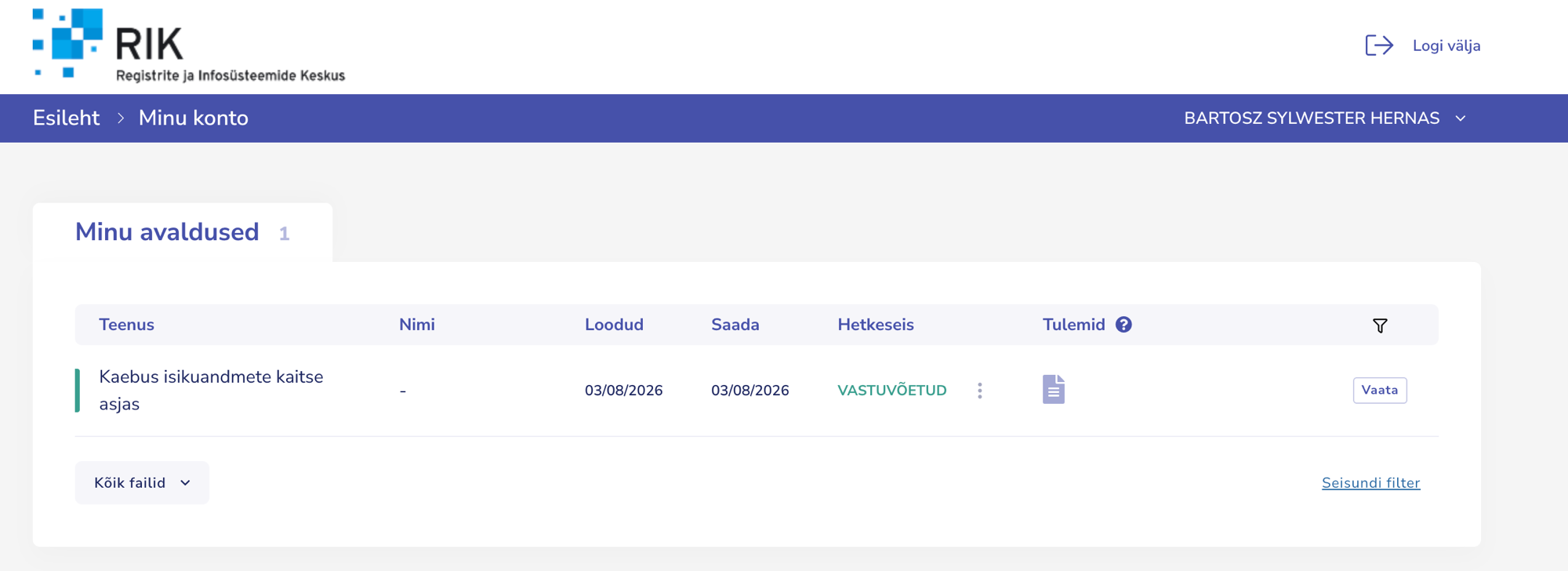
Skarga zarzuca siedem naruszeń: brak poinformowania mnie o środkach ochrony prawnej, niepełny dostęp do danych i nie do obrony podstawę odmowy, uchybienie miesięcznemu terminowi co do dwóch punktów, o które prosiłem 1 czerwca, brak wskazania odbiorców, okresu przechowywania i logiki decyzji, zautomatyzowaną decyzję w rozumieniu art. 22 podjętą bez oceny człowieka, brak jakiegokolwiek ułatwienia wykonywania moich praw oraz całkowity brak odpowiedzi na żądanie usunięcia danych. Wnoszę, by Inspekcja współpracowała z niderlandzkim Autoriteit Persoonsgegevens — wiodącym organem nadzorczym Tesli w UE — w trybie art. 60. Złożyłem ją teraz, a nie w październiku, bo te naruszenia już się dokonały: cokolwiek Tesla prześle za dwa miesiące, nie odwróci tego, że nie poinformowała mnie o prawie do skargi.
Złożona w estońskim organie ochrony danych 3 sierpnia i przyjęta tego samego dnia: siedem zarzucanych naruszeń i wniosek o włączenie niderlandzkiego organu wiodącego. 3 września Inspekcja przedłużyła rozpatrywanie skargi do 5 października.Przeczytaj w całości
Summary of the complaint
On 1 June 2026 the complainant made a request under Article 15 GDPR for, among other things, the telemetry, diagnostic and event data that Tesla relied upon when it remotely disabled Full Self-Driving functionality on the complainant’s vehicle — functionality purchased for EUR 6,200 — on the stated ground that an unauthorised third-party device had been detected. Tesla supplied only a standard account-data export, which contained none of that data.
On 25 June 2026 Tesla asserted that the request had been “fulfilled on 01/06/2026” and that vehicle data is not associated with the complainant’s identity “by default”. That position is irreconcilable with Tesla’s own conduct. A remote decision to disable a specific feature on a specific VIN, taken because of what Tesla says its systems detected in that vehicle, necessarily involved personal data linked to the complainant. Tesla’s own reply lists “a raised hardware or software issue” as a condition that triggers precisely such linkage. That reply also declined the request without informing the complainant of his right to complain to a supervisory authority or to seek a judicial remedy.
On 1 July 2026 the complainant set out five specific items under Articles 15 and 22 GDPR. On 31 July 2026 Tesla stated that it requires two further months. This complaint is nevertheless lodged now, because the infringements are already complete and do not depend on the outcome of the extension.
The controller’s own notifications
The notification is itself proof of linkage. Tesla could not have generated and sent the email of 8 April 2026 unless the detection event had been transmitted from the vehicle to Tesla and associated there with the complainant’s account and email address. Tesla’s statement of 25 June 2026 that “no one – including Tesla – would have knowledge of your activities” cannot stand alongside a notification that Tesla itself sent to him about an event in his vehicle.
A second Tesla department describes a centrally imposed decision. On 25 June 2026, the same day as the privacy response, Tesla’s Warsaw service centre wrote to the complainant in Polish that “Blokada została nałożona odgórnie i jest software’owa, z powodów bezpieczeństwa po wykryciu modyfikacji systemów FSD” — “the block was imposed centrally and is software-based, for safety reasons, after detection of modification of FSD systems”. A block imposed centrally by Tesla following detection is a decision taken by the controller on the basis of vehicle data attributed to this vehicle and this account. It is not an autonomous act of the car, as the wording “your vehicle has detected” implies.
The notifications were dispatched in bulk. An identical notification was sent twenty-three seconds later, at 23:00:23 UTC on 8 April 2026, in respect of a different vehicle, to a further email address controlled by the complainant. The complainant advances no claim in respect of that vehicle or its owner and refers to it only as evidence that these notifications, and the disablements they announced, were dispatched as an automated bulk action rather than following any individual assessment of the vehicle concerned.
Infringements alleged
Article 12(4) — failure to inform of remedies. Tesla’s reply of 25 June 2026 declined to provide the data requested but did not inform the complainant of the reasons for not acting, of the possibility of lodging a complaint with a supervisory authority, or of seeking a judicial remedy. This infringement is complete and is unaffected by the extension of 31 July 2026.
Article 15(1) and 15(3) — incomplete access, and an untenable ground for withholding. A generic account-data export was supplied in place of the personal data actually identified in the request, and Tesla declared the request “fulfilled”. Data that has in fact been linked to the complainant and used to take a decision affecting him is personal data within Article 4(1) and cannot be withheld on the ground that linkage does not occur “by default”.
Article 12(3) — failure to respond within one month as to items 1 and 2. The telemetry data and the dates and times of its processing fell due on 1 July 2026. No extension was notified within that period. These items remain outstanding.
Article 15(1)(c), (d) and (h) — failure to supply required accompanying information. Recipients, retention period, and information on the logic of the automated decision were all requested and none has been provided.
Article 22 — automated decision-making. The disablement appears to have been an automated decision producing a significant effect on the complainant (loss of paid functionality valued at EUR 6,200, with no refund and no restoration under warranty). Tesla has provided no information about the logic applied and no meaningful route to human intervention or to contest the decision. The bulk dispatch of identical notifications seconds apart in respect of different vehicles indicates that no individual human assessment preceded the decision.
Article 12(1) and 12(2) — failure to facilitate the exercise of rights. Tesla’s substantive reply restated its general Privacy Notice and redirected the complainant to Customer Support rather than answering the request. Tesla has since attributed the delay to the request having been spread across its own departments, having itself directed the complainant to a further department.
Article 17 — no response to the erasure request. The request of 1 June 2026 for erasure of telemetry data and cessation of further transmission has never been addressed in any reply.
Action requested
- That the Inspectorate register this complaint and investigate it, in cooperation with the Autoriteit Persoonsgegevens under Article 60 GDPR.
- That the Inspectorate find the infringement of Article 12(4) in respect of the response of 25 June 2026, which does not depend on the extension.
- That the Inspectorate order Tesla under Article 58(2)(c) to comply forthwith as to items 1 and 2, which fell due on 1 July 2026.
- That the Inspectorate require Tesla to state, in writing and to the complainant, the specific date by which it will respond and the reasons for the delay required by Article 12(3).
- That, if Tesla has not fully answered items 3 to 5 by the expiry of the extended period, the Inspectorate proceed on those items without requiring a fresh complaint.
- That the Inspectorate require Tesla to provide the information owed under Article 15(1)(h) and Article 22 concerning the logic and criteria of the automated decision to disable purchased functionality.
- That the Inspectorate examine whether Tesla processed vehicle telemetry from the complainant’s vehicle at a time when telemetry sharing was set to opt-out, and on what legal basis under Article 6.
- That the Inspectorate consider whether the practice complained of extends beyond the complainant, Tesla having reportedly applied the same remote entitlement change to a substantial number of other vehicles.
- That the complainant be informed of the progress and outcome of the complaint under Article 77(2).
I confirm that the information given in this complaint is true and complete to the best of my knowledge, and that I have attempted to resolve the matter directly with the controller. — Bartosz Hernas, 3 August 2026, signed digitally (ID-card / Mobiil-ID)
Przytoczono w oryginale (po angielsku), zgodnie z treścią złożonej skargi. Pominięto części zawierające moje dane kontaktowe, kalendarium, pięć żądanych punktów i wykaz załączników — adres domowy i numer telefonu są usunięte w całym tekście, a reszta znajduje się już w <a href="#privacy">sekcji 11</a> i <a href="#deadline">sekcji 15</a>. Do skargi dołączono dwanaście załączników, w tym cały wątek e-mailowy.
Dwie rzeczy z tej skargi nie pojawiły się wcześniej na tej stronie, a obie wyszły przy zbieraniu dowodów. Pierwsza: powiadomienie, które dostałem 8 kwietnia o 23:00 UTC, nie zostało wysłane tylko do mnie. Identyczne poszło dwadzieścia trzy sekundy później, w sprawie innego samochodu, na inny mój adres. Cokolwiek podjęło tę decyzję, przechodziło po liście. Druga: 25 czerwca — tego samego dnia, w którym zespół ds. prywatności napisał mi, że dane z pojazdu nie są powiązane z moją tożsamością — warszawski serwis Tesli napisał do mnie, że „blokada została nałożona odgórnie i jest software’owa, z powodów bezpieczeństwa po wykryciu modyfikacji systemów FSD”. Jeden dział Tesli opisuje wprost to, czemu inny zaprzeczał.
Inspekcja tymczasem odpisała — nie rozstrzygnięciem, lecz własnym terminem. 3 września 2026 r. AKI przedłużyła termin rozpatrzenia mojej skargi na podstawie § 61 ust. 2 estońskiej ustawy o ochronie danych osobowych do 5 października 2026 r., aby — jak sama pisze — dodatkowo wyjaśnić i przeanalizować okoliczności niezbędne do rozstrzygnięcia sprawy. Pismo podpisał wskazany z imienia i nazwiska prawnik urzędu, z upoważnienia dyrektora generalnego. To przedłużenie terminu, a ja poświęciłem całą sekcję temu, jak to jest je dostać, więc warto być dokładnym co do różnicy. To tutaj wskazuje przepis, z którego korzysta, podaje powód dotyczący sprawy, a nie wewnętrznego systemu obiegu dokumentów, wyznacza jedną datę i jest opatrzone nazwiskiem. Przedłużenie Tesli, które przyszło sześć godzin po tym, jak po raz pierwszy wspomniałem o organie nadzorczym, nie zrobiło żadnej z tych rzeczy — sekcja 15. Nic w piśmie nie dotyka współpracy z organem niderlandzkim w trybie art. 60, o którą wnosiła skarga; na to pytanie, jeśli w ogóle, odpowiedź przyjdzie później. Do listy dochodzi więc czwarta data: 11 września na regulamin, 14 września na pieniądze, 1 października na odpowiedź Tesli w sprawie sprzeciwu — i 5 października na odpowiedź organu.
17Hiszpania: bez e-maila, bez powiadomienia, miesiące po fali
Drugi właściciel, w Hiszpanii, który kupił Full Self-Driving na własność — 7 500 €, bezterminowo. Jego samochód też przestał hamować na czerwonych światłach i przed znakami stop. Różnica polega na tym, jak się o tym dowiedział: nikt mu nic nie powiedział. Żadnego e-maila, żadnego powiadomienia w samochodzie. Zauważył, że auto przejeżdża przez światła, zaczął szukać i stwierdził, że opcja zniknęła z ustawień Autopilota, a w instrukcji samochodu nie ma jej wcale — „jakby nigdy nie istniała”. I nie stało się to w kwietniu: jego słowami, „zdarzyło się to niedawno, nie miesiące temu jak ta »fala«”.
Do odkrycia doprowadził go hałasujący bagażnik. Zgłosił samochód do serwisu, a pracownik piszący do niego zapytał — bez żadnego związku, przy naprawie bagażnika — czy dokonywał jakichkolwiek modyfikacji pojazdu, instalował aplikacje lub monitoring innych producentów, ingerował w samochód, montując coś w środku, albo przerabiał instalację elektryczną. Był, jak mówi, w szoku: nikt go wcześniej o to nie pytał. Odpowiedział szczerze. W jego samochodzie są dwie rzeczy: zestaw S3XY stalks — jego Model 3 Highland jest fabrycznie bez dźwigienek — oraz przystosowanie do jazdy wyłącznie rękami, dla osoby o ograniczonej sprawności ruchowej. Oba zarejestrowane i legalne od ponad dwóch lat. Podsumowanie Tesli brzmiało: „Prosimy usunąć wszystko, co jest możliwe albo nielegalne, aby uniknąć problemów z gwarancją”.
Potem ponad godzina rozmowy telefonicznej z kierownikiem serwisu na jego region, z której wyszło „nie wiem” i „nie mam takiej informacji” — choć dla niego było jasne, że kierownik wie więcej i nie chce tego powiedzieć. Dostał link do strony Tesli, na której nie było nic istotnego, potem telefon zwrotny, a potem termin w kolejnym serwisie. Ostatecznie zaproponowana teoria brzmiała: skoro montaż S3XY stalks jest nielegalny, unieważnia gwarancję, więc Autopilot został wyłączony — a przyszła aktualizacja go przywróci. To zdanie usłyszałem w kwietniu ja i usłyszeli je koreańscy właściciele, zanim przełącznik zgasł i zapalił się w ciągu dwudziestu minut — sekcja 14. Nikt natomiast nie daje mu listy. Jego określenie: „sekretne” wybieranie po uważaniu.
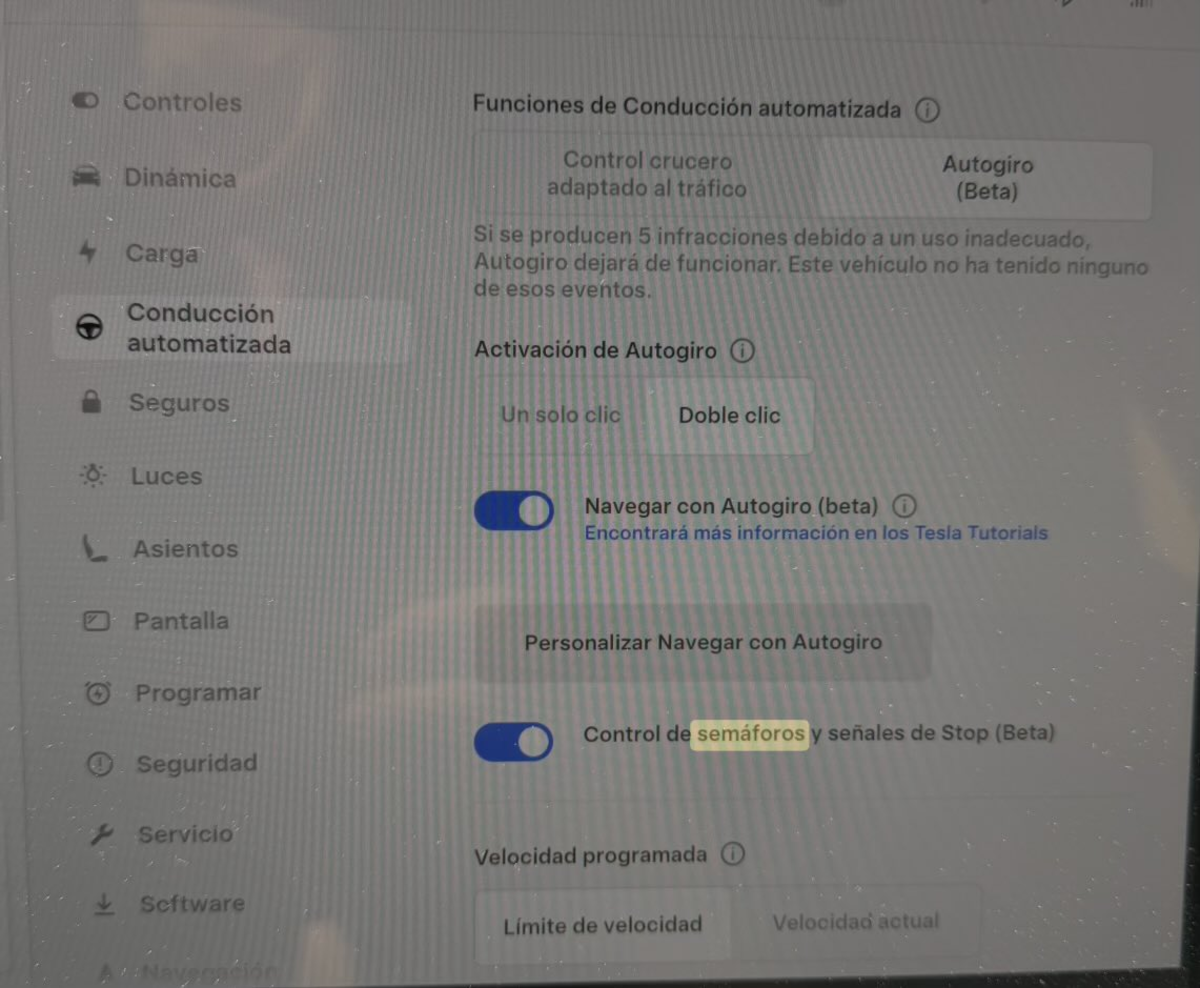 28 kwietnia 2026
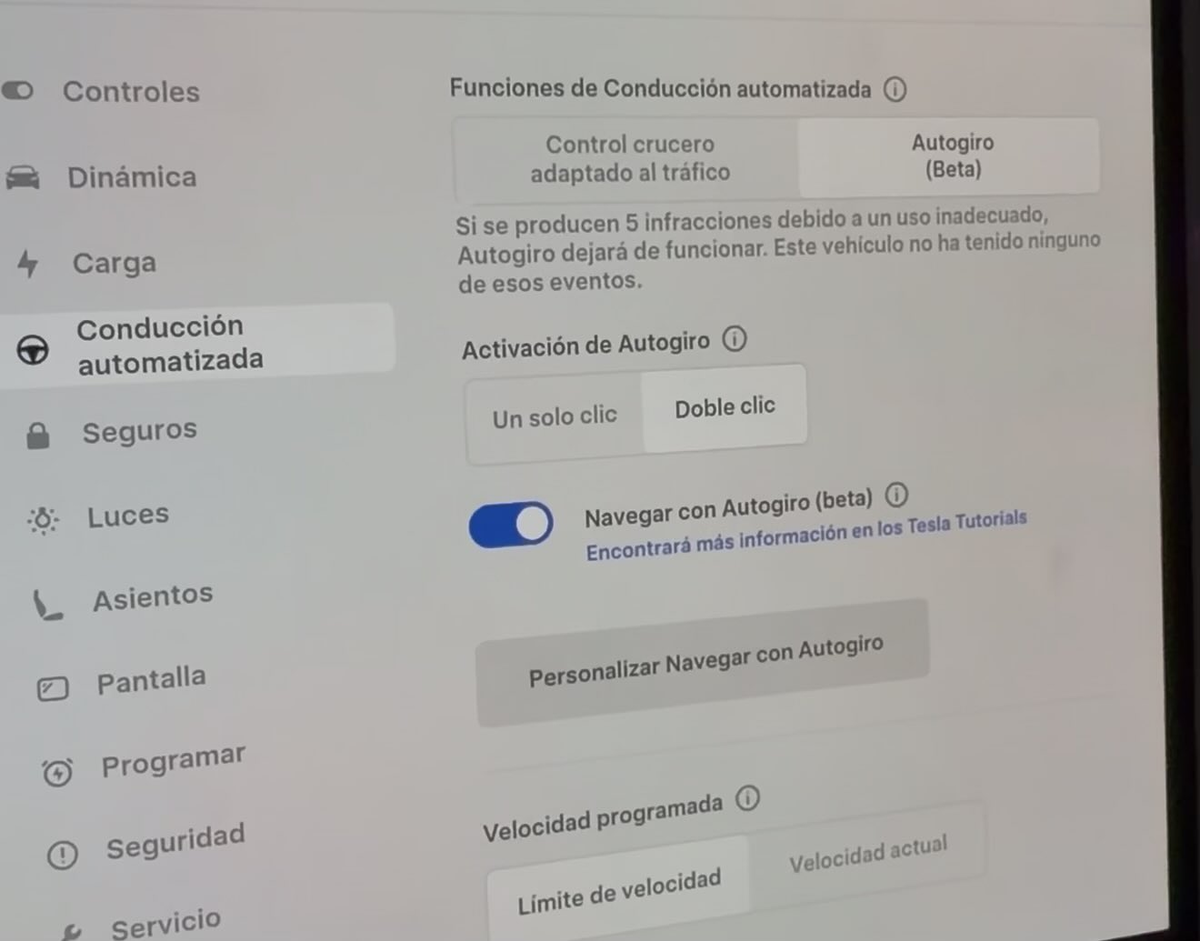 7 sierpnia 2026
„Nie mam żadnego maila, żadnych powiadomień… nic. Funkcja po prostu zniknęła i tyle, po cichu”.
Drugi właściciel, 7 500 € za bezterminowy FSD, zniknęło bez jednego e-maila. Tesla kazała mu to udowodnić na wideo, obwiniła sygnalizację świetlną — a potem zamknęła reklamację i usunęła zgłoszenie z jego konta.Przeczytaj w całości
Trzy rzeczy są tu gorsze niż w moim przypadku. Zestaw dźwigienek zamontowany w samochodzie, który ich fabrycznie nie ma, nie może włączyć Full Self-Driving — cokolwiek zostało wykryte, nie było odblokowaniem funkcji. Nie dostał żadnego powiadomienia; ja przynajmniej dostałem e-mail o drugiej w nocy. I stało się to niedawno, nie w kwietniowej fali — co znaczy, że to nie porządkowanie starej sprawy, ale praktyka, która trwa. Wysłał już do Tesli długą reklamację: o cichym usunięciu funkcji, o tym, że za nią zapłacił, i o różnym traktowaniu poszczególnych klientów; mówi, że jeśli nic się nie zmieni, zażąda zwrotu pieniędzy. Jego obawa wychodzi poza własny samochód: jeśli opłacone funkcje można usuwać po cichu, co powstrzyma ich przed usunięciem automatycznego hamowania awaryjnego?
To, co stało się potem, warto opowiedzieć po kolei, bo trwało osiem dni i skończyło się w miejscu, którego się nie spodziewałem. Najpierw Tesla kazała mu udowodnić stratę. Kierownik serwisu chciał nagrania brakujących ustawień — „żeby móc eskalować dalej”, jak mu powiedziano — więc nagrał ekran i wysłał. To nie wystarczyło. Potem poproszono go, żeby nagrał się w trakcie jazdy i pokazał usterkę w ruchu. A wyjaśnienie, które wracało, zaczęło się zmieniać: problemem nie jest samochód, tylko otoczenie — próbuje uruchomić funkcję w warunkach zbyt złych, by mogła zadziałać — a w pewnym momencie, że problemem może być samo światło. Przez cały ten czas serwis nadal pytał go, co konkretnie zniknęło, mając przed sobą oba powyższe zrzuty ekranu. Jedna z tych wiadomości dotarła do niego o 21:41, ponad cztery godziny po zamknięciu serwisu.
Potem wykonał ich pracę za nich. 10 sierpnia pojechał na wizytę w sprawie stukającego bagażnika — tę pierwotną. Technik, który go obsługiwał — i który sam z siebie wspomniał, że zna wielu właścicieli z tym samym akcesorium i bez żadnych problemów — zaproponował oczywistą diagnostykę: tryb serwisowy, ponowna instalacja oprogramowania samochodu bez niczego podłączonego, i test. Zrobił dokładnie to i odczekał, aż samochód przeinstaluje oprogramowanie. Nic się nie zmieniło. Ani świateł, ani znaków stop. To, co zauważył potem, jest szczegółem, do którego ciągle wracam: funkcja zniknęła również z instrukcji obsługi w samochodzie — podczas gdy ta sama instrukcja w aplikacji Tesli w jego telefonie nadal ją opisuje, a jego konto nadal pokazuje pakiet Full Self-Driving jako jego. Jego słowami: to tak, jakby zrobiono aktualizację wyłącznie dla jego samochodu, żeby funkcja wyglądała, jakby nigdy nie istniała.
A potem, 11 sierpnia, zniknęła sama reklamacja. Tesla zamknęła jego zgłoszenie serwisowe i usunęła je z historii konta — nie zarchiwizowała, nie oznaczyła jako rozwiązane: po prostu nie ma go w aplikacji, jakby nigdy nie zostało złożone. Zadzwonił do serwisu, żeby upewnić się, że to nie błąd synchronizacji, i usłyszał wprost, że zgłoszenie zostało zamknięte i — słowem, którego wobec niego użyto — „shadowed”, przyciemnione. Rozmowę z czatu nagrał, zanim zniknęła.
„Zamknęli moje zgłoszenie i usunęli je z historii — ono nie istnieje na moim koncie”.
Pisemny powód, kiedy wreszcie przyszedł, był trzecią wersją. On streszcza go tak: warsztat sprawdził pojazd i nie może udzielić dalszych informacji; nawet homologowane urządzenie jest niezgodne z magistralą CAN pojazdu, więc pewne funkcje mogły zostać ograniczone dla bezpieczeństwa Autopilota przy nieoryginalnym wyposażeniu; przyszłe aktualizacje mogą przywrócić te funkcje; a zgłoszenie zostaje zamknięte, bo po ich stronie nie da się nic zmienić. Zestawmy to z powodem sprzed tygodnia — że montaż S3XY stalks jest nielegalny i unieważnia gwarancję — i to nie jest to samo twierdzenie. Żadna z wersji nie wymienia funkcji, urządzenia, daty ani przepisu. Obie kończą się zdaniem, które ja usłyszałem 9 kwietnia, a koreańscy właściciele 30 lipca: że przyszła aktualizacja może to przywrócić. W Korei to samo uprawnienie zgasło i zapaliło się z powrotem w dwadzieścia minut, bez żadnej aktualizacji — sekcja 14. Sprawę otworzył ponownie i przedstawił im pięć punktów: że umowa, którą podpisał, dopuszcza to, co ma zamontowane; że nikt go o niczym nie powiadomił i teraz żąda audytu wszystkich funkcji usuniętych lub potencjalnie usuniętych; że w samochodzie nic się nie zmieniło między dwoma latami bezproblemowej jazdy a kilkoma tygodniami temu, a wszystko, co zamontowane, jest homologowane; że jeśli naprawdę chodzi o bezpieczeństwo, to niech powiedzą, co jest niesprawne — akcesoria zdjął tygodnie temu, oprogramowanie przeinstalował, a to nadal nie działa; i wreszcie: albo przywrócenie funkcji, albo zwrot 7 500 €. Powiedziano mu, że oddzwonią.
The guy who was typing me said: Did I made any vehicle modifications? Have you got a third party app or monitoring? Did you made any intervention to install something to the car? Did you modified the wiring?
I was shock. They never asked me that and they was saying all the time. And just for a trunk noisy service.
I said the S3XY stalks (model 3 highland stalkless). And a modification to drive with hands only (reduced mobility). All registered and legal for over 2 years.
The summary is: Please remove everything if possible or not legal, to avoid warranty issues.
I have no mail, no notifications… nothing. The function just vanished and that’s it, silently. Even in the car manuals it’s not appearing, like never existed.
And it happened recently. Not months ago like the “wave”.
Basically he said that is it possible that, because installing s3xy stalks it’s illegal, voids my warranty and they disabled the autopilot, and soon in new updates they’ll give me that back.
My car is adapted to a reduced mobility person so it’s not a choice and was fully homologated over 2 years ago.
So angry right now, they are not giving me details, list of what is banned or not, what’s wrong or not, it’s a “secret” cherry pick and it happened. They don’t know anything, poor guys.
It’s so annoying, I’m worried about if they remove functions silently what’s next? Remove automatic brake collision?
Today the service manager asked me to share a video about my autopilot settings missing and I paid for it. He asked me the video in order to keep escalating it.
The Tesla service closes at 17:00. Well the manager wrote me at 21:41. What the hell? He only said: What options you miss.
That guy said the problem is not the car, it’s the environment. I’m trying to activate it without good conditions that’s why it fails. They asked me to record a video driving demonstrating that. Is not enough recording a video showing autopilot options were gone.
They said, maybe the problem is the traffic light which is so baaad.
They keep asking, but what disappeared? I don’t know if more functions disappeared because I had no more pictures from before.
He told me to try: service mode, reinstall car firmware without commander connected, test it. He knows a lot of commanders and no issues.
Nothing, still same. I’ve noticed the option also disappeared on the car manual. But in my iPhone i see the option in the manual and my car has fsd capability package. It’s like they did an update or modification only to my car making it seem like it does not exist.
They closed my ticket and removed it from the history — it does not exist in my account. I called the service and they told me directly that the ticket was closed and “shadowed” which is strange. We ensured it was not an app bug or sync — no, they DELETED the ticket in my app. Thankfully I recorded the whole chat.
Why 2 years ago no and some weeks ago yes? Nothing changed in the car and all features are HOMOLOGATED. Return me the money or the features.
Feels good, they are playing like it’s a video game. Again, not a big deal the features removed, because were shitty, but they opened the door and it’s super annoying while I didn’t sign for that.
To relacja innego właściciela o samochodzie, który nie jest mój. Nie siedziałem w nim i nie jestem źródłem. Publikuję ją z jego zgodą, bez jego tożsamości i lokalizacji, na jego prośbę, a jego wiadomości przytaczam w oryginale. Wiadomość Tesli z 11 sierpnia to jego własne angielskie streszczenie hiszpańskiego oryginału i podaję ją jako mowę zależną, nie jako cytat. Tesla mogłaby potwierdzić albo zdementować każdy z tych punktów jednym zdaniem.
18Show me the contract
Every refusal I have had in four months rests on the same unstated thing: the terms. So on 11 August 2026 I asked Tesla one question, in writing — which Terms of Service does Tesla say I am bound by? Produce the document. Point at the clause.
It is worth seeing how much has been decided without a document ever being named. The car was reset to its “original configuration” — no clause. An “unauthorized third-party device” justified removing a package I had paid for — no clause. Two service centres called a fault under warranty “not serviceable” — no clause. Tesla Poland wrote that “vehicles acquired second-hand are always outside the scope of our standard processes” — no clause, and no scope, and no process. At no point in four months has anyone at Tesla quoted a single line of a single agreement to me.
And this is the part that sharpens it: I was never given anything to sign. The car reached me through an intermediary rather than across a Tesla counter — no order agreement, no terms of service, no FSD licence, nothing presented and nothing accepted. Whatever Tesla believes binds me, I have not read it, because nobody has ever shown it to me. So I asked for six things: the agreement Tesla says governs us; the legal basis on which it says that agreement reaches me; the version in force on the day the car was registered, with proof of how I was notified or deemed to have accepted it; whether different terms apply because an intermediary was involved; the clause relied on to switch off Full Self-Driving; and the clause relied on to decline to answer or to refund. The letter doubles as an Article 15 GDPR request, which puts a date on it: 11 September 2026.
I am not asking for anything beyond clarity on which specific terms Tesla is relying on: which Terms of Service are being invoked to remotely disable FSD I paid for, and to avoid responding to or refunding affected customers.
I asked Tesla to produce the Terms of Service it says I am bound by, and the clause it relies on. The letter doubles as an Article 15 GDPR request, which puts a date on the answer: 11 September 2026.Przeczytaj w całości
To Tesla Privacy, Resolutions, EU Customer Happiness, and Legal teams,
I am the registered first owner of a Tesla Model Y, VIN XP7YGCEK9SB621959, registered on 05.05.2025, equipped with Full Self-Driving (FSD).
My vehicle was purchased through an Estonian intermediary, rather than directly from Tesla or through a lease/financing arrangement with an Estonian bank. As a result, I have never been presented with, signed, or explicitly accepted any Tesla Motor Vehicle Order Agreement, Terms of Service, or FSD-specific purchase agreement. My understanding of any contractual relationship with Tesla is based solely on Tesla’s general assertion that use of the vehicle constitutes acceptance of unspecified terms.
Given that Tesla has disabled the FSD functionality on my vehicle, I am requesting that you provide me directly with:
- 1. The specific, complete Terms of Service, Motor Vehicle Order Agreement, and/or FSD Purchase/License Agreement that Tesla contends governs my relationship with Tesla as the first registered owner and end user of this vehicle;
- 2. Confirmation of the legal basis on which Tesla asserts these terms apply to me, given that I did not purchase the vehicle directly from Tesla nor sign any agreement with Tesla or a Tesla-affiliated financing entity;
- 3. The version of the FSD terms that was in effect at the time of vehicle registration (05.05.2025), together with any documentation showing how or when I was notified of, or deemed to have accepted, those terms;
- 4. Confirmation of whether any different or additional terms apply because the vehicle was acquired through a third-party intermediary rather than directly from Tesla;
- 5. The specific clause(s) of the Terms of Service Tesla is relying on to justify remotely disabling FSD functionality that I paid for and had active on my vehicle;
- 6. The specific clause(s) of the Terms of Service Tesla is relying on to decline to respond substantively to my prior contact attempts, and/or to decline a refund for the disabled FSD functionality.
This request also constitutes a request for personal data and related processing information concerning me under Article 15 of the GDPR, insofar as it relates to records of my account, my acceptance (or lack thereof) of any agreement, and any internal records associating me with specific contractual terms. Under Article 12(3) GDPR, I expect a substantive response without undue delay and in any event within one month of the date of this email — i.e., by 11 September 2026. If Tesla considers this request complex and intends to invoke the further two-month extension permitted under Article 12(3), please notify me of that fact, and the reasons for it, within the initial one-month period.
Please provide the actual requested documents rather than a general link to Tesla’s public website, since those pages are subject to change and do not establish what applied to me at the relevant time.
For context, I am documenting this dispute publicly at TeslaTookWhatIPaidFor.com, which covers the remote disablement of FSD functionality I purchased. This correspondence, including Tesla’s response or lack thereof, will be published there as part of that record. I am not asking for anything beyond clarity on which specific terms Tesla is relying on: I simply want to know which Terms of Service Tesla is invoking to (a) remotely disable FSD I paid for, and (b) avoid responding to or refunding affected customers.
I look forward to your response within the timeline set out above.
Regards, Bartosz Hernas — [email protected] · VIN XP7YGCEK9SB621959
One correction to my own letter. Its third paragraph is loose about the financing: the car was supplied through the intermediary and, in the end, leased through a partner. I am leaving the sentence as it was sent rather than quietly editing it, and correcting it here instead. It changes nothing about the request — the point is the chain the car travelled down, and that at no stage of it did Tesla present me with an agreement to read, sign or accept.
Reproduced verbatim, as sent, save that the intermediary is not named here.
19142 days later, the switch flips back
On 27 August 2026 my car installed software update 2026.27.100.1. A day later, on 28 August, Full Self-Driving was simply there again — the package restored, announced by nothing more than a notice on the car’s own screen.
That notice was the mirror of 8 April — the same kind of message on the screen that announced the ban — section 3. Except that this time, no email followed. The disablement at least produced one, at two in the morning, citing “safety reasons”; the restoration produced nothing in writing at all. Just the car’s software flags, updated. And note the timing, because it is the sequence Korea saw in July — section 14: the restoration did not arrive with the update, it arrived on its own, about a day after it. Between the update finishing and the package appearing, nothing on my side changed — no visit to a service centre, no inspection passed, no appeal granted. For four months, every refusal rested on the claim that this could not simply be undone — that it needed a firmware release, another department, a process. In the end it was undone the way it was done: a flag, flipped on a server, and 142 days of “not serviceable” ended without anyone having to do anything at all.
Here is what the restoration does not change. Tesla has still not answered a single one of the questions in section 7 — not which device it detected, not who decided, not under which clause, not why two service centres refused a repair under warranty. It has not explained why the package was taken on 8 April, and it has not explained why it came back on 28 August. And it has not offered a cent for the 142 days I was locked out of a safety feature I had paid for in full — the meter above stopped where it stood, at what the lockout cost priced at Tesla’s own subscription rate. Getting back what I already owned is not a resolution. It is the minimum, arriving 142 days late, with no explanation attached.
And the restoration did not reach everyone. As far as I can tell from other owners, the flag flipped back only for cars in regions where FSD is approved. Everywhere else, banned owners are still where I was for 142 days: locked out not just of FSD but of Traffic Light and Stop Sign Control — a feature that is fully legal on any road, that shipped working, and that they paid for. And Tesla has still not answered the question that matters most for them: how were owners informed that this part was being removed — or was it simply assumed they would notice? I was never told that stop-sign recognition was going along with the rest; the 9 April email named no feature at all — section 3. Other owners tell the same story, and some tell it the hard way: I have heard accounts of near-crashes from drivers taken by surprise when a car that had always braked for stop signs stopped recognising them out of the blue. A safety feature does not become less dangerous to remove because it was removed quietly.
One remote flag took the package away. One remote flag gave it back. Neither came with a single answer.
So nothing about the legal route changes. The Article 77 complaint with the Estonian Data Protection Inspectorate stands — section 16 — because the infringements it alleges are already complete, and switching the feature back on un-does none of them. Tesla still owes me the terms it says bind me and the clause it relied on, due 11 September — section 18. Its Data Protection Office still owes me the answers it granted itself until 1 October to produce — section 15; what it sent instead, three days after the restoration, is in section 20. And the question this site opened with is sharper now, not duller: if a feature you paid for can be switched off for 142 days and switched back on overnight — no process, no notice, no accountability in either direction — what exactly do any of us own?
20Install the update
On 31 August 2026, at 20:34, Tesla’s Data Protection Office answered — a month before the deadline it had granted itself. Four claims: no automated decision was made; my access request was “fulfilled” on 1 June and 3 August; the “appropriate software update” has already been made available; and unauthorized devices may, under “our Terms” and “local road authorities,” cost you FSD. Then a bulleted list of how to install the update.
Take the claims in turn. “No automated-decision processing was performed.” Good — then a person did it. Someone at Tesla looked at data linked to my VIN on 8 April, decided a diagnostic reader was “unauthorized,” and signed off on removing a package I had paid for. That rules out Article 22 and makes every other question sharper, not softer: who, on what data, by what criteria. “Fulfilled on 01/06/2026 and 03/08/2026.” The first is the day I made the request — Tesla already claimed that in June, section 11. The second is the day I answered its extension and lodged the complaint with the regulator — sections 15 and 16. On neither day did Tesla send me a byte of vehicle data. “The appropriate software update has already been made available.” It had been installed on 27 August, and the package had come back on 28 August — section 19. Tesla’s first written word on the restoration was a set of instructions for installing an update my car had already installed, arriving three days after the restoration it describes.
Then the terms. “As set out in our Terms and as required by local road authorities, such use may result in the restriction or disablement of certain features.” The word “Terms” is a link to a webpage. Three weeks earlier I had asked Tesla to name the document and the clause — section 18 — and asked, in so many words, not to be sent a general link to the public site, because that page can change and does not establish what applied to me. This is that general link, from the office that owes me the answer by 11 September. As for “local road authorities”: the road authority where my car is registered approved FSD, which is the only reason the package was usable at all, and no road authority I know of has required Tesla to switch off stop-sign recognition on a car with a diagnostic reader in the port. If one has, Tesla can name it. I asked it to.
Tesla’s first written word about the restoration was a set of instructions for installing an update my car had already installed.
Tesla’s Data Protection Office answered a month early: no automated decision, request “fulfilled,” install the update — three days after the package had already come back. I have asked for the 142 days back in money, for the clause, and, separately, for Tesla to stop using my car’s data to decide what I may use.Przeczytaj w całości
Thank you for contacting us. No automated-decision processing was performed on the matter with regard to your reference to Article 15. Our records show that your data subject access request was fulfilled on 01/06/2026 and 03/08/2026, and further show that the appropriate software update has already been made available to your vehicle in connection with the unauthorized third-party device detection dated 8 April 2026.
Please note that the use of unauthorized third-party devices can create a safety risk to the driver and other road users. As set out in our Terms and as required by local road authorities, such use may result in the restriction or disablement of certain features, including Full Self-Driving (FSD), for safety reasons.
Steps to install the software update:
- Connect your vehicle to Wi-Fi
- On the touchscreen, go to Controls > Software, download the available update, then select Install now or schedule installation for a convenient time
- After installation, go to Controls > Self-Driving and enable Full Self-Driving (Supervised)
We apologize for any inconvenience. Should you have any feedback about your experience, please do not hesitate to contact Customer Support.
I confirm that following your last message the Full Self-Driving Capability package has been restored to my vehicle. Thank you.
The restoration is welcome, but it also settles the central point of my complaint: the functionality was Tesla’s to restore at any time, by remote configuration, and was restored once challenged. That confirms it was withdrawn unilaterally and could have been reinstated at any point during the period it was withheld. Restoration therefore resolves the feature, but not the complaint. Two matters remain outstanding, and your last message addressed neither.
1. Reimbursement and compensation
From 8 April 2026 until its restoration — a period of over three months — I was deprived of functionality I had paid for in full. In particular, my vehicle lost Traffic Light and Stop Sign Control: it no longer recognised or stopped automatically at red lights and stop signs. This is a safety-relevant driver-assistance function that was working normally before Tesla’s intervention.
Crucially, I was never informed in advance that this feature would be removed. The remote change was applied first, on 8 April 2026 at 22:27, and only afterwards did I receive an email — which itself did not clearly state that stop-sign and traffic-light recognition specifically would cease to function. I was therefore driving a vehicle whose safety behaviour had been silently altered, without notice. That is the basis of my claim: not an abstract inconvenience, but the uncompensated loss of a paid safety function, removed without warning.
I therefore require:
- (a) Reimbursement for loss of use over the full period. Tesla’s own published subscription price for this functionality is approximately €99 per month, and I ask that reimbursement be calculated on that basis for the entire duration of the deprivation.
- (b) Compensation, separately, for the diminution in value of the vehicle caused by the demonstrated fact that paid features can be and were remotely revoked, and for the time and cost incurred in obtaining a restoration Tesla could have performed at any moment. I invite Tesla to propose a figure; failing agreement, it will be quantified with supporting evidence.
2. The “Terms” you rely upon
Your message states that such use “may result in the restriction or disablement of certain features... as set out in our Terms.” Before Tesla relies on any such Terms, I require you to establish that they bind me at all:
- (i) Identify the exact document and the exact clause relied upon.
- (ii) State when, and by what act, I am said to have agreed to those Terms. I did not agree to any term permitting Tesla to remotely disable a paid safety feature, and Tesla has not shown otherwise.
- (iii) State where, before purchase, it was disclosed that paid features could be remotely disabled over the presence of a third-party device.
A clause a customer never agreed to, and was never shown before purchase, cannot be the basis for removing something that customer paid for.
3. The questions that remain unanswered
My previous letter put eighteen specific questions to Tesla. Your reply answered none of them. The following in particular require a written answer, because they concern whether this will recur, to me or to others:
- (iv) Who authorised the disablement of the paid entitlement, and on what documented evidence? Your latest message states that no automated processing occurred — which means a person made this decision. I ask again who, and on what basis.
- (v) What specifically was the detected device (make and model), and what log or telemetry entry, with timestamp, led to its detection?
- (vi) Who at Tesla determines whether a device is “authorized” or “unauthorized,” by what published criteria, and is there a list an owner can consult in advance? Does Tesla regard a standard CANBUS diagnostic tool, used through the manufacturer’s own diagnostic port, as “unauthorized”?
- (vii) What process does Tesla follow to establish whether the registered owner installed or was even aware of a device before penalising that owner — given that a device may be fitted by a previous keeper, an intermediary, or a workshop without the owner’s knowledge?
Your reference to “our Terms” and to “local road authorities” in the abstract is not an answer. I ask you to identify the specific clause and the specific authority relied upon.
Please respond in writing within 14 days. In the absence of a substantive response on reimbursement, compensation, the basis of the Terms, and the questions above, I will treat the matter as unresolved and escalate to the competent consumer-protection authority. This correspondence forms part of a documented public record at TeslaTookWhatIPaidFor.com. — Bartosz Hernas
Further to my last message, I want to record one point that remains entirely unaddressed.
Tesla states that an “unauthorized third-party device” was detected on my vehicle on 8 April 2026, and that Full Self-Driving was disabled as a result. To this day I have not been given the data that detection was based on. Specifically, Tesla has not identified:
- what data was collected from my vehicle;
- what within that data was interpreted as indicating a device;
- the date, time, and source of that data; and
- the logic or criteria by which that data was judged to indicate an “unauthorized” device.
This is not a new request. I first requested this data on 1 June 2026, and reiterated it on 1 July 2026. The one-month period under Article 12(3) in respect of it expired on 1 July 2026, and no extension was validly notified within that period. It is therefore already overdue, independently of the two-month extension Tesla later purported to take for my other items.
Your reply of 31 August 2026 states that “no automated-decision processing was performed.” If that is correct, then a person reviewed specific data linked to my VIN and account and reached a decision — which makes the underlying data plainly my personal data and plainly disclosable under Article 15. If instead the detection was automated, then Article 15(1)(h) and Article 22 entitle me to meaningful information about the logic involved. Either way, the data and the basis for the decision must be disclosed. They have not been.
Tesla cannot both assert that a device was detected via vehicle data and decline to show me the vehicle data said to have detected it. I therefore repeat my request for the specific telemetry, diagnostic, and event data — with timestamps — that Tesla relied upon to conclude a device was present and to disable the feature I paid for. If Tesla maintains it holds no such data, I require a clear statement to that effect, given that Tesla’s own notification asserts the detection occurred.
This remains outstanding and forms part of the complaint already lodged with the Estonian Data Protection Inspectorate.
Following the remote disablement of paid functionality on my vehicle based on data Tesla collected from it, I am exercising my rights under the GDPR in respect of the personal data generated by my vehicle. This letter concerns the future processing of that data; my outstanding access request regarding the detection of 8 April 2026 remains separate and unanswered.
1. What I am asking
I do not consent to my vehicle transmitting to Tesla, or to Tesla processing, any data that identifies me or that can be linked to me, my account, or my vehicle (including by VIN), beyond what is strictly necessary. In particular, I object to the collection or use of any such data for the purpose of monitoring, detecting third-party equipment, or making decisions that restrict or disable features of my vehicle.
2. The rights I am relying on
- (a) Article 21 — I object to the processing of my personal data carried out on the basis of Tesla’s legitimate interests, including any profiling. This specifically includes processing used to detect “unauthorized third-party devices” and to determine whether to restrict or disable features.
- (b) Article 7(3) — to the extent any processing relies on my consent, I withdraw that consent with effect from the date of this letter.
- (c) Article 18 — I request restriction of processing of the relevant data pending your response to my objection and to my outstanding access request.
3. What I require Tesla to confirm in writing
- (i) A complete list of the categories of data transmitted from my vehicle to Tesla, and for each category, the specific legal basis relied upon (consent, contract, legal obligation, or legitimate interest).
- (ii) For each category relied upon as “legitimate interest” or “contract,” a specific explanation of why it is claimed to be strictly necessary, so that I may exercise my objection meaningfully.
- (iii) Which categories of transmission I am able to disable myself (for example via the vehicle’s data-sharing settings), and confirmation of the effect of disabling them.
- (iv) Confirmation that, following my objection, Tesla will cease any processing of my vehicle data for the purpose of detecting third-party equipment or of restricting or disabling paid features — or, if Tesla refuses, a clear statement of the specific lawful basis on which it intends to continue that processing over my objection.
- (v) Confirmation of whether disabling data transmission affects the vehicle’s functionality or any feature I have paid for, and if so, how.
4. Note
I understand that certain limited processing may be necessary for safety recalls, regulatory compliance, or the basic connected operation of the vehicle. I am not asking Tesla to breach a legal obligation. I am asking Tesla to identify precisely which processing it claims is necessary and on what basis, to stop everything that is not, and in particular to stop using my vehicle’s data to make decisions that take away what I have paid for. Where Tesla asserts a basis that overrides my objection, I require that assertion in writing so that it can be assessed by the supervisory authority.
Please respond within one month, as required by Article 12(3). This matter forms part of the complaint already lodged with the Estonian Data Protection Inspectorate. — Bartosz Hernas, owner, 2025 Tesla Model Y · VIN XP7YGCEK9SB621959
All four letters are reproduced verbatim; greetings and signature blocks have been removed. The correspondence is in English. In Tesla’s message, “Terms” and “Customer Support” are hyperlinks — the first to Tesla’s public terms page, the second to its support page; neither names a document or a clause.
I answered the same evening, and the answer starts from what the restoration proves. The package was Tesla’s to give back at any moment, by the same remote configuration that took it, and it was given back once challenged. So the feature is resolved; the complaint is not. I asked for two things. First, the 142 days back in money — loss of use priced at Tesla’s own subscription rate, the figure the meter above stopped at — and, separately, compensation for what it does to a car’s value when its paid features are shown to be revocable from a server, and for the months spent obtaining a restoration Tesla could have performed in an afternoon. Second, the clause: not a link, but the document, the provision, the act by which I am said to have agreed to it, and where, before purchase, anyone disclosed that a diagnostic reader could cost me a paid safety feature. And once more the questions Tesla has now, by its own account, a named human being able to answer: who decided, what device, what criteria, what process for checking the owner even knew. Fourteen days, so 14 September. A follow-up in the same thread records the item that is not merely unanswered but overdue: the data the detection was based on, first requested on 1 June, due 1 July, and still not produced. Tesla cannot say a device was detected through vehicle data and decline to show the vehicle data. If a person reviewed it, it is my personal data and Article 15 reaches it. If no person did, Article 22 does. There is no third option in which it stays in a drawer.
And on 1 September, in a separate letter, I turned to the mechanism rather than the incident. The package is back; the thing that took it is still running. So I objected under Article 21 to any processing of my car’s data on the basis of Tesla’s legitimate interests, withdrew under Article 7(3) whatever consent Tesla thinks it holds, and asked under Article 18 for the processing to be restricted while it answers. I am not asking Tesla to break a law. I am asking it to list what my car sends, name the legal basis for each item, say which of it I can switch off myself, and stop using the rest to decide what I am allowed to use. Under Article 12(3) that answer is due within a month — on 1 October, the day Tesla already owes me everything else.