Waar dit werkelijk over gaat
Vergeet even of wat ik deed juist was. Vergeet of het gebruik van FSD legaal was. Daar gaat het niet om.
Wat ertoe doet is dit: Tesla vond het niet leuk dat ik een auto aanpaste die volledig van mij is — dus reikte het naar binnen en blokkeerde op afstand een deel ervan. Niet alleen de functie waarvan sommige mensen aannemen dat ze illegaal is (dat is ze niet, op privéwegen) — maar volledig legale veiligheidsfuncties waarmee de auto fonkelnieuw werd geleverd, onderdeel van precies het €6,200 + btw-pakket waarvoor ik had betaald.
Dit is niet de Kindle-store. Het is geen Steam. Het is een auto — een fysiek ding dat ik kocht en bezit — aan mij verkocht met een lijst aan functies, die Tesla stuk voor stuk vanaf een server kan uitschakelen. (Vraag het maar aan iedereen die zich het oude „Winterpakket" herinnert.) Schend Tesla's voorwaarden en de auto rijdt zichzelf in feite terug naar de fabriek. Geen terugbetaling. Tienduizenden euro's, weg.
Tesla blijft stil — maar gedraagt zich alsof ik nooit een auto heb gekocht. Alsof ik alleen ooit het recht heb gelicentieerd om er een te gebruiken. Dus de echte vraag gaat niet over mij. Ze gaat over iedereen die rijdt:
Wat mij dit kost
Ik heb FSD al volledig gekocht — €6,200 + btw, volledig betaald. Op 8 april 2026 schakelde Tesla het op afstand uit — en sindsdien stopt mijn auto niet meer voor rode lichten of stopborden, functies waarvoor ik heb betaald en die ik niet meer kan gebruiken. Elke maand kost me de prijs van het abonnement dat ik niet eens zou moeten nodig hebben — en er is geen abonnement om op te zeggen om het te stoppen.
01Wat ik kocht
In het bestelsysteem van Tesla stond het Full Self-Driving Capability-pakket vermeld voor €6,200 (netto, exclusief btw). Ik betaalde het. De schermafbeelding hieronder is precies wat ik kocht.
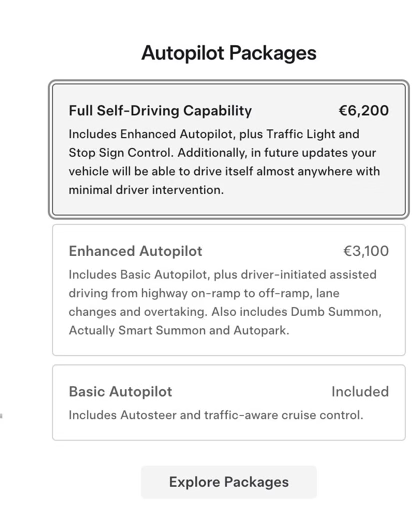
Die laatste regel is belangrijk. Verkeerslicht- en Stopbordregeling was voor mij een echte veiligheidsfunctie: het stopt de auto automatisch bij rode lichten en stopborden. Tot op de dag van vandaag vermeldt de officiële Tesla-app het Full Self-Driving Capability-pakket nog steeds als inbegrepen bij mijn voertuig.
02Het werkte — maandenlang
Na de levering gebruikte ik de geadverteerde functies van het pakket door heel Europa. Verkeerslicht- en Stopbordregeling werkte naast Autopilot, volledig en betrouwbaar. De auto reed maandenlang zonder problemen.
De auto is volledig van mij — ik least hem niet van Tesla. Ik ben van mening dat ik het recht heb een auto die van mij is aan te passen, net zoals ik aangepaste velgen, een bodykit of nieuwe vering zou kunnen monteren, zonder dat de fabrikant me daarvoor straft.
De „aanpassingen", volledig
Ik gebruikte twee CANBUS-diagnoseapparaten — „Commander" van enhauto.com en een apparaat genaamd „Cybertool." Geen van beide wijzigt de auto of zijn software. Ze sluiten alleen aan op de standaard CANBUS-diagnosepoort — dezelfde interface die fabrikanten voor diagnostiek aanbieden — en sturen commando's die het voertuig al ondersteunt.
Commander zorgt er bijvoorbeeld voor dat de interieur-leds blauw worden wanneer Autopilot is ingeschakeld. De auto leest een ondersteund signaal, stuurt een ondersteund commando, en de kleur verandert. Als de auto dat commando niet ondersteunde, zou er niets gebeuren. Geen PCB aangepast. Geen onderdeel gewijzigd. Geen origineel onderdeel gemodificeerd. Tesla zelf verklaart publiekelijk dat de voertuigsoftware niet door derden kan worden gewijzigd.
Cybertool werkt op dezelfde manier. Net zoals Commander de auto vertelt zijn interieur-leds blauw te maken, stuurde Cybertool de auto een commando dat hij al ondersteunde — om het Full Self-Driving-pakket in te schakelen in regio's waar Tesla het nog niet had geactiveerd. Het ontgrendelde niets nieuws: het zette simpelweg de functie aan waarvoor mijn auto was gebouwd en waarvoor ik al had betaald. De auto ondersteunt een commando of niet; de mijne wel, omdat het pakket eraan gelicentieerd was.
Dit is dezelfde categorie handeling als Commander die de pieptoon van de achteruitversnelling uitschakelt — iets wat Commander openlijk doet, ook al is die pieptoon in de EU verplicht. En om volledig eerlijk te zijn: Full Self-Driving is nog niet in elke regio goedgekeurd voor de openbare weg, op dezelfde manier waarop een luide uitlaat of slickbanden niet voor de weg zijn goedgekeurd. Dat maakt de uitrusting zelf niet illegaal — je mag slicks en een luide uitlaat op een circuit rijden. Een functie inschakelen waarvoor de auto is gebouwd en betaald, is niet hetzelfde als er de wet mee overtreden: waar en hoe hij wordt gebruikt is de verantwoordelijkheid van de bestuurder, niet iets wat een diagnosecommando beslist.
Geen enkel veiligheidssysteem — hardware of software — is op welke manier dan ook gewijzigd.
03Wat er gebeurde
Op 8 april om 22:27 ontving mijn auto via Tesla Cloud Config een pakketconfiguratie-update op afstand. In feite vertelde Tesla mijn auto op afstand dat het €6,200 + btw-pakket nooit was aangeschaft.
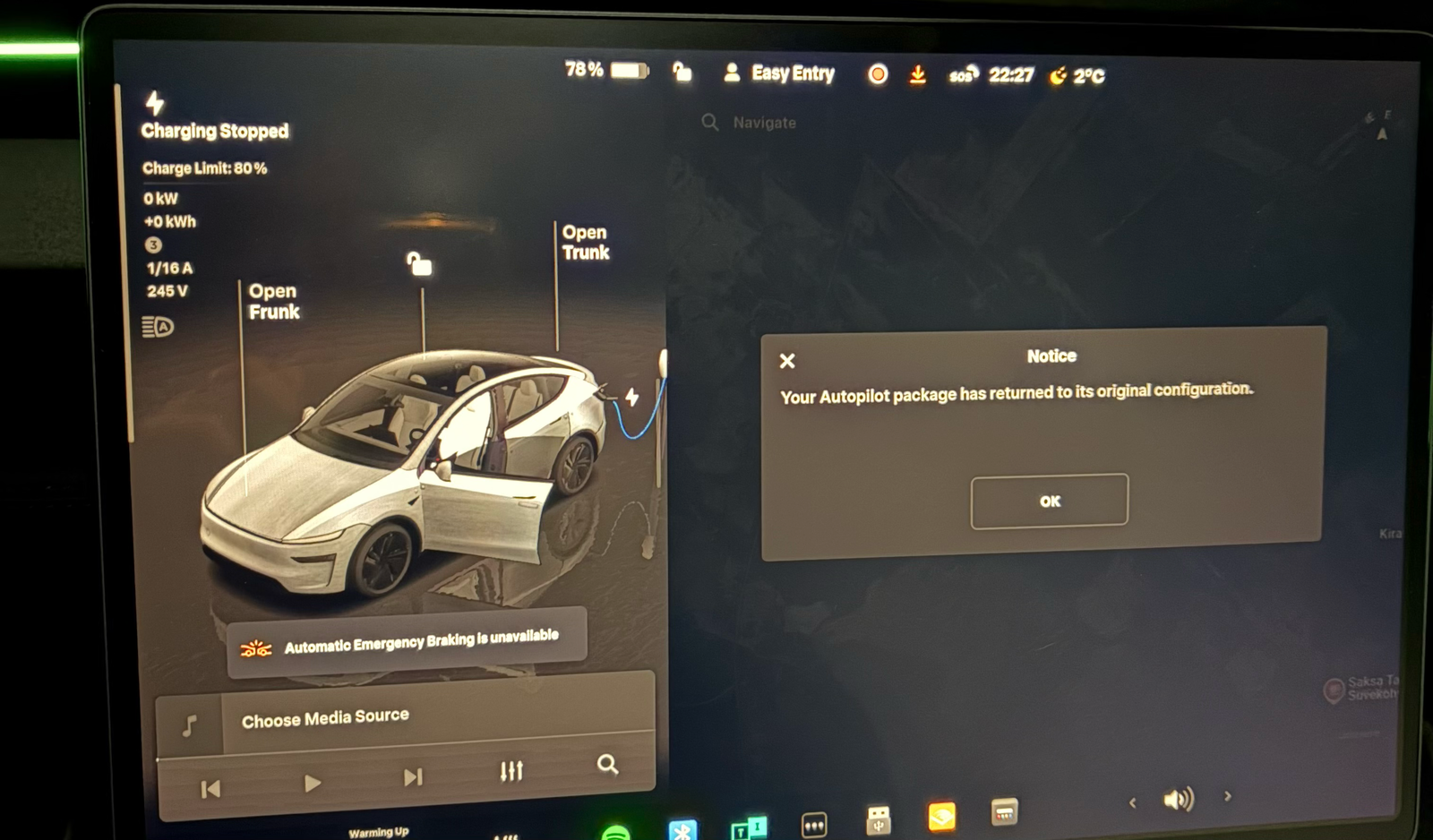
Ongeveer drie uur later, om 02:00, kwam deze e-mail binnen.
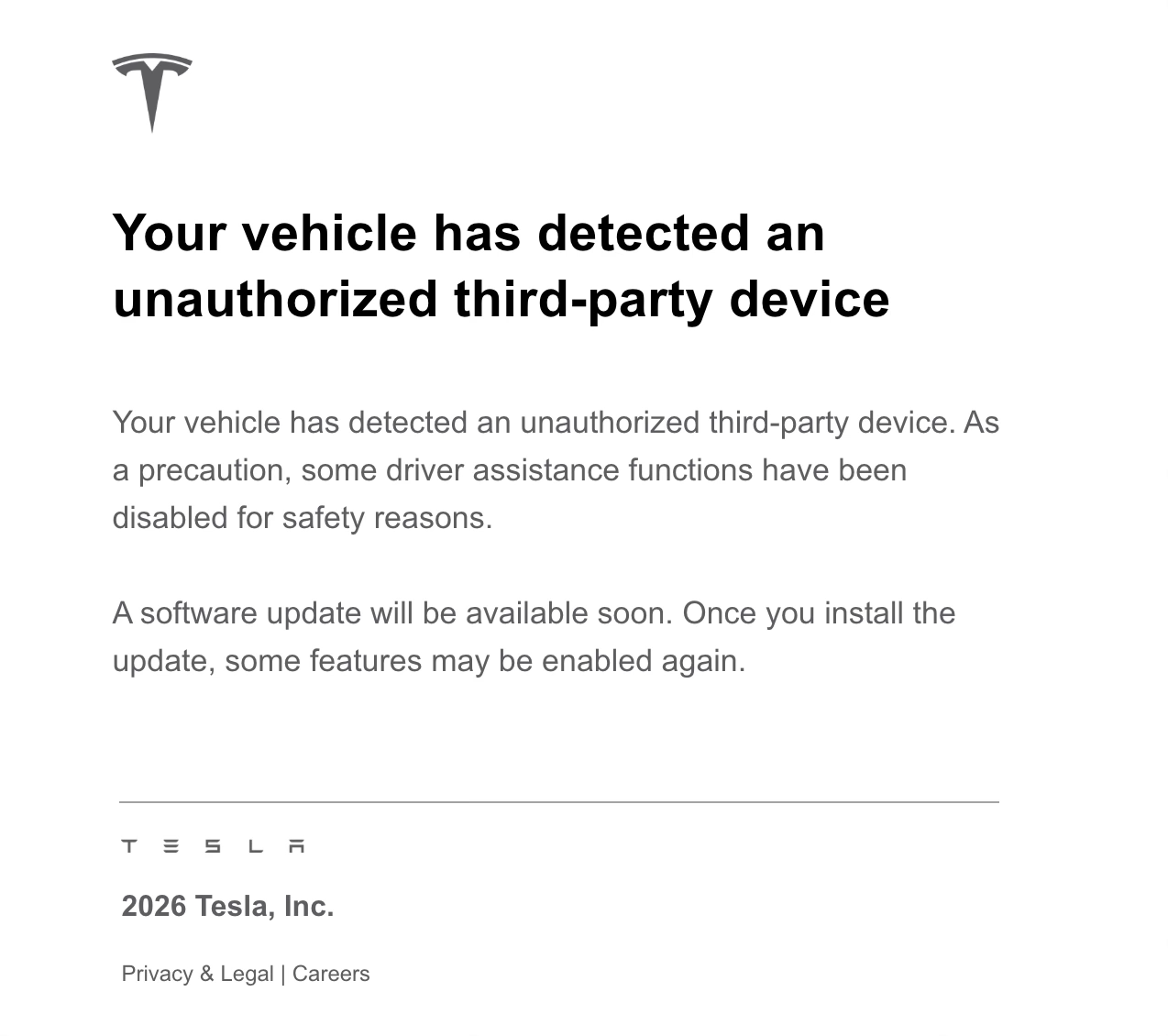
Hij is opvallend vaag. Er staat niet welk apparaat werd gedetecteerd, wat het veiligheidsrisico was, hoe lang functies uitgeschakeld zouden blijven, of zelfs maar of ze zouden terugkeren. En de zinsnede verbaast me: ongeautoriseerd apparaat van derden — ongeautoriseerd door wie? Elk apparaat in mijn auto was geautoriseerd door de eigenaar. Mij.
04De tegenstrijdigheid
De goedkeuring van FSD werd in heel Europa uitgerold — eerst Nederland, daarna Litouwen, vervolgens Estland op 29 mei (waar mijn auto is geregistreerd), en België daarna. Mijn auto ontving update 2026.17.5, die het nieuwe systeem inschakelt. Dit was het moment waarop mijn investering zich eindelijk had moeten terugverdienen.
In plaats daarvan biedt de auto me een knop „Abonneren" — alsof ik het nooit had gekocht.
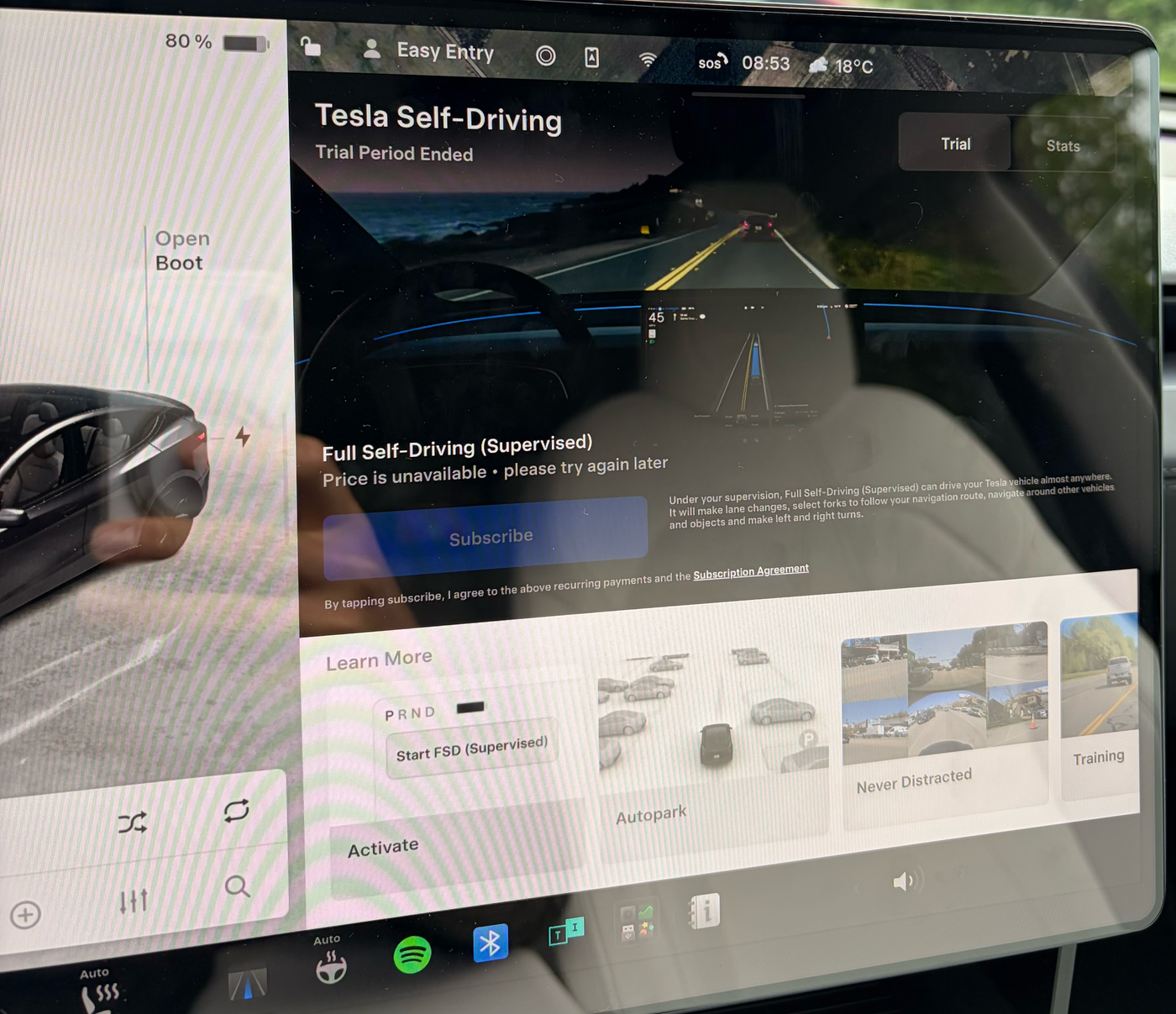
Ik betaalde €6,200 + btw voor een pakket. De auto bevestigt dat het pakket „Inbegrepen" is. En dezelfde auto gedraagt zich alsof het nooit is gekocht.
05Hoe de auto weet wat hij heeft
Elke Tesla wordt geleverd met dezelfde software en dezelfde volledige set aan mogelijkheden. Individuele functies worden op afstand in- of uitgeschakeld via „Tesla Cloud Config", gekoppeld aan jouw specifieke auto. Het is hetzelfde mechanisme dat Tesla ooit in staat stelde auto's te verkopen met de hardware voor verwarmde achterbank fysiek aanwezig maar uitgeschakeld — en eigenaren later online liet betalen om deze te ontgrendelen.
Het is ook hoe Tesla Basic Autopilot van Enhanced Autopilot van Full Self-Driving onderscheidt. Het onderscheid is puur door software bepaald. Wat betekent dat een functie waarvoor je hebt betaald kan worden ingetrokken met één enkele vlag op afstand — precies wat mij overkwam.
06Garantieservice werd geweigerd
Mijn auto valt onder garantie, dus nam ik contact op met de Tesla-servicecentra in Turku, Finland en Warschau, Polen. Beide bevestigden dat de functionaliteit niet werkt. Beide bevestigden dat de auto onder garantie valt. Beide weigerden de claim — met de mededeling dat het „niet repareerbaar" is omdat de auto opzettelijk werd uitgeschakeld „om veiligheidsredenen."
Het Finse centrum vertelde me dat ze de functie niet konden heractiveren, ook al was het apparaat verwijderd, omdat „u het opnieuw zou kunnen installeren." Volgens die logica, waarom de functie dan niet op elke Tesla uitschakelen — aangezien in elke auto zo'n apparaat zou kunnen worden gemonteerd?
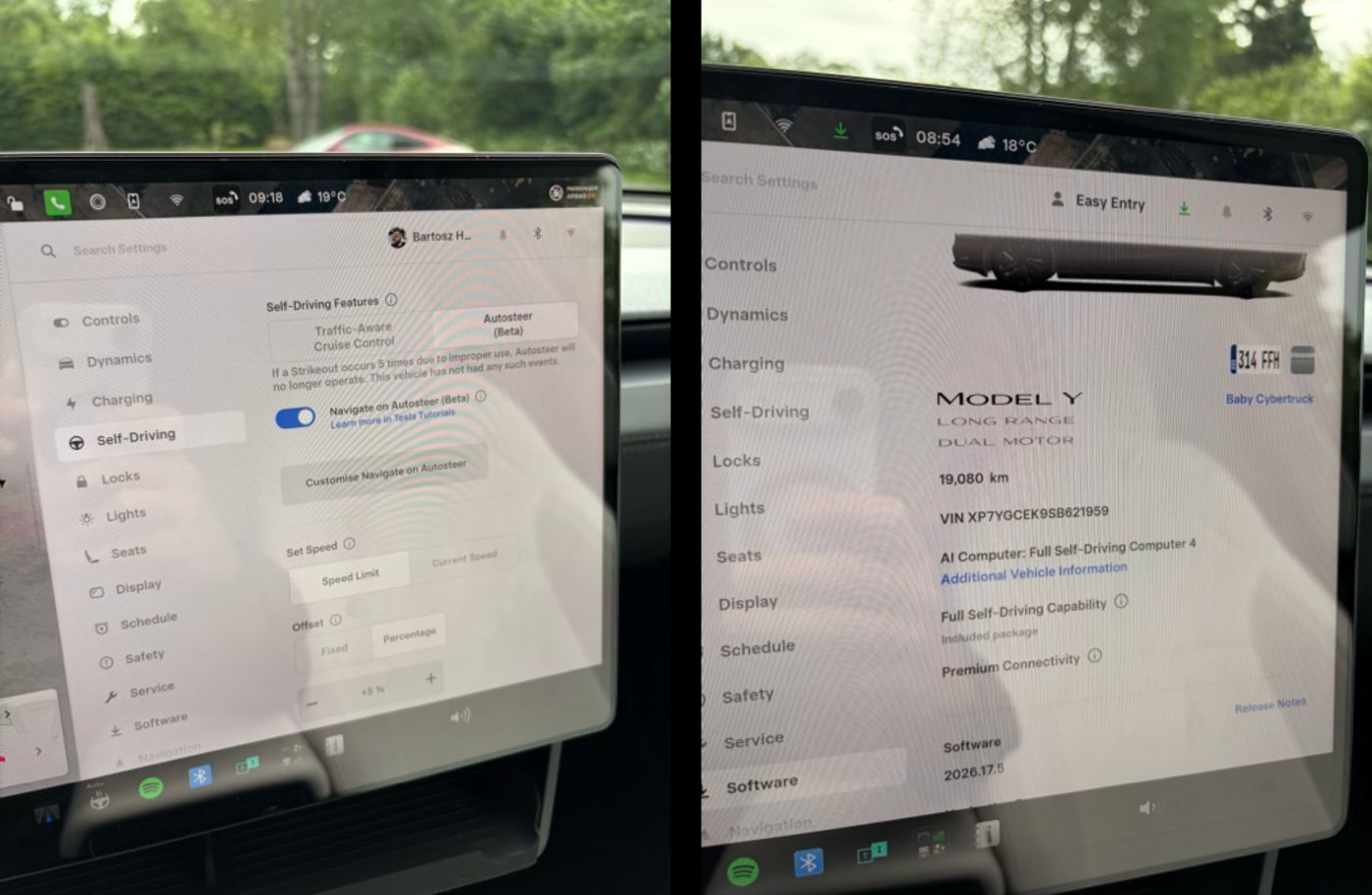
Ik kan geen andere verklaring vinden dan deze: de aangehaalde „veiligheidsredenen" verminderen mijn veiligheid juist. Acht weken lang kon mijn auto geen stopborden of verkeerssignalen detecteren — functionaliteit waarop ik was gaan vertrouwen.
07De vragen die Tesla niet wil beantwoorden
Ik stelde deze vragen aan Tesla en zijn servicecentra. Ze blijven onbeantwoord. Ik heb ze per thema gegroepeerd.
A De garantieweigering
B Het besluit tot uitschakelen
C De aangehaalde „veiligheidsredenen"
D Herstel van de betaalde functies
E Compensatie
F Beleid over aanpassingen en apparaten van derden
Ik verzocht om een schriftelijk antwoord binnen 14 dagen, waarin elk punt wordt behandeld. Ik wacht nog steeds.
08Ik ben niet anti-Tesla
Ik geloof oprecht in deze technologie. Ik kocht twee Tesla's en betaalde in totaal €12,400 + btw vooruit tegen de belofte van FSD. Die belofte liet zo lang op zich wachten dat ik een van de auto's verkocht — waarbij ik de waarde van het pakket erop verloor.
Nu heb ik eindelijk een werkende auto, met FSD aangeschaft, in een land dat FSD toestaat. En Tesla verhindert me opzettelijk te gebruiken waarvoor ik heb betaald. Ik wil gewoon de functie die ik kocht, een antwoord op mijn vragen, en dat dit niemand anders stilletjes overkomt.
09Tijdlijn
- 2025Koop een Model Y uit 2025 als eerste eigenaar met FSD Capability — €6,200 + btw.
- Maanden na leveringFSD-functies, waaronder stopbord- en verkeerslichtregeling, werken betrouwbaar door heel Europa.
- 8 apr 2026 · 22:27Cloud Config-update op afstand: „Uw Autopilot-pakket is teruggezet naar de oorspronkelijke configuratie." Functies verloren.
- 9 apr 2026 · 02:00Tesla mailt over een „ongeautoriseerd apparaat van derden" dat „om veiligheidsredenen" is uitgeschakeld.
- 8 wekenGeen verdere informatie. Het diagnoseapparaat wordt verwijderd; er blijft geen apparaat van derden in de auto.
- 29 mei 2026Estland — waar mijn auto is geregistreerd — keurt FSD op de openbare weg goed (na Nederland en Litouwen, vóór België). Update 2026.17.5 arriveert.
- 15 jul 2026Software 2026.21.100 geïnstalleerd — FSD werkt nog steeds niet. Formele klacht en eis tot herstel, vergoeding en schadeloosstelling naar Tesla verstuurd.
- 30 jul 2026In Korea krijgen geblokkeerde HW3-auto’s het volledige pakket terug — en verliezen het binnen twintig minuten weer, op afstand, zonder update in welke richting dan ook.
- 31 jul 2026Zes uur nadat ik aankondig naar een privacytoezichthouder te stappen, kent Tesla’s Data Protection Office zichzelf twee maanden extra toe — zie sectie 15.
- 3 aug 2026Ik antwoord op de verlenging en dien bij de Estse Data Protection Inspectorate een klacht op grond van artikel 77 AVG tegen Tesla in. Dezelfde dag aanvaard — sectie 16.
- 11 aug 2026De klacht van een tweede eigenaar over zijn stil verwijderde pakket wordt gesloten — en het ticket gewist uit zijn Tesla-account — sectie 17.
- NuAuto biedt een knop „Abonneren" voor FSD dat hij „Inbegrepen" noemt. Twee servicecentra weigeren garantiereparatie.
10Tesla heeft geantwoord. Dit is mijn antwoord.
Op 30 juni 2026 reageerde Tesla Poland op mijn klacht. Geen enkele van mijn vragen werd beantwoord — maar de brief bevat vier beweringen die het waard zijn om te weerleggen. Hier is hun brief en mijn volledige antwoord.
Tesla's antwoord ontweek elke vraag. Mijn punt-voor-punt weerlegging, en de vragen die nog steeds onbeantwoord blijven.Lees volledig
Dear Mr. Hernas,
Thank you for your email and for the questions you have raised.
At the outset, we would like to note that, in the absence of any site visits carried out and any information on file regarding you, we do not see grounds to address the questions listed above.
The vehicle was purchased by you from a third party. In your message you stated that you are the first owner, which is not consistent with our records. Vehicles acquired second-hand are always outside the scope of our standard processes.
Given that the vehicle is registered in our system as being in Estonia, we ask that you await a response from the appropriate department.
Sincerely,
Tesla Poland
Thank you for your reply. With respect, it does not answer any of the questions I raised, and several of its statements are either factually incorrect or contradict Tesla’s own instructions to me. Let me address each point.
“In the absence of any site visits and any information on file regarding you, we do not see grounds to address the questions.”
That is exactly the problem: no site visit has taken place because Tesla has not carried one out. When I approached the service centres in Turku and Warsaw to have the car repaired under warranty, both confirmed the features do not work and that the car is under warranty — yet both declined to proceed, so no inspection ever happened. You cannot refuse to examine the car and then cite the absence of an examination as the reason you cannot answer my questions. I am asking for written answers to written questions; a site visit is not a precondition for that. And if you do require one, name the centre and the date, and I will attend.
“Given that the vehicle is registered as being in Estonia, await a response from the appropriate department.”
Estonia has no Tesla service centre. Tesla’s own guidance is to use any service centre in the EU — which is exactly what I did, having serviced this car in Finland several times. Please name the “appropriate department” and give me its direct contact details; I cannot await a response from a department no one will identify. Your phrasing also implies you are tracking the car’s current location. I have disabled data sharing — so I am formally requesting, under Article 15 GDPR, all location data Tesla holds on this vehicle and the legal basis for collecting it.
“You stated you are the first owner, which is not consistent with our records.”
I am the first registered owner. The car was acquired through an intermediary for leasing, but I am the first owner named on the official EU registration documents. Tesla’s internal records do not determine legal ownership — the registration does. If your records say otherwise, send me the record you are relying on so the discrepancy can be corrected.
“Vehicles acquired second-hand are always outside the scope of our standard processes.”
Please state, in writing, what this means. Are you saying that a change of ownership voids the warranty? If so, cite the exact clause. Under EU consumer law the warranty attaches to the car, not to the owner, and transfers with it on resale. A warranty that can be switched off because a car changed hands is not a warranty.
En de vragen die nog steeds onbeantwoord blijven:
- The exact warranty clause that excludes this fault from coverage.
- Who authorised the remote disablement, on what documented evidence, and on what legal basis.
- What the “unauthorized third-party device” was — make, model, log entry, and timestamp.
- The specific safety risk the device is alleged to have created, with documentation.
- The date by which the paid features will be restored, and the formal appeals process.
- The compensation Tesla will provide for the period the paid features were disabled.
I reiterate my request for a written response addressing each point within 14 days. Absent that, I will treat this as Tesla’s final refusal and escalate to the relevant consumer-protection and data-protection authorities. — Bartosz Hernas
Beide brieven zijn woordelijk weergegeven. De oorspronkelijke correspondentie is in het Engels; persoonsgegevens (woonadres) zijn onleesbaar gemaakt.
11De route via gegevensbescherming
Er is geen enkele manier om iemand bij Tesla boven het servicecentrum te bereiken — geen e-mailadres, geen naam, geen escalatieroute — en de servicecentra vertelden me onomwonden dat ze niets kunnen doen. Dus gebruikte ik het ene kanaal dat Tesla verplicht is te beantwoorden: gegevensbescherming. Op grond van de AVG diende ik een inzageverzoek in voor de telemetrie die Tesla gebruikte om het pakket dat ik had betaald uit te schakelen. Hier is die correspondentie, volledig. Daar bleef het niet bij — sectie 15 laat zien wat erna kwam.
Een AVG-inzageverzoek voor de telemetrie die Tesla gebruikte om FSD uit te schakelen — en Tesla's antwoord met de bewering dat het geen dergelijke gegevens bezit.Lees volledig
I would like to reiterate that I would also like to have any telemetry data you used to deny my warranty claims.
My car has the Full Self-Driving package purchased, and this package has been illegally disabled by a remote configuration change — in effect tricking the car into thinking FSD had never been purchased.
I have lost legally available, previously working functionality: Traffic Light Awareness on Autopilot. This was part of a €6,200 extra payment. It was remotely disabled, with no refund.
Your reasoning was that your telemetry discovered a third-party device — even though on the day it was disabled I had telemetry opt-out enabled in my car. I would therefore like all the data associated with that telemetry.
I would also like to know whether the Tesla cars you sell are owned by their owners (me), or whether they are rented/subscribed to but owned by Tesla. If I own the car, I would like Tesla not to tell me what I can and cannot do with a car I paid full price for.
I want to ensure there are no future violations of my privacy: please remove all telemetry data sent from my cars to your servers, and ensure no future telemetry data is sent out, on all cars of which I am the owner.
I need this data to follow up on the loss of value of the car following the remote bricking of legal functionality, and Tesla’s full denial of my warranty claim to restore the car to full functionality.
Thank you for contacting us. Our records indicate that your access request was fulfilled on 01/06/2026. As described in our Privacy Notice, from the moment you take delivery, Tesla does not associate the vehicle data generated by your driving with your identity or account by default. As a result, no one – including Tesla – would have knowledge of your activities. In order for vehicle data to be linked to your account or VIN, a specific condition must be triggered such as the occurrence of a safety event (collision or airbag deployment), service or repair appointment, a raised hardware or software issue, or your consent – in which case it is provided as part of your data request.
Additionally, Tesla’s retention guidelines and data privacy practices implement techniques designed to minimize how much data we collect, use, or store.
When data isn’t provided, this is because it is either: in a form that is not personally identifiable or linked to your Tesla Account; stored in an end-to-end encrypted format that Tesla cannot decrypt; or not customer-related.
Note: Some data may have also been held only for a very short time and is no longer on our servers.
Thank you for your response of 25 June 2026. I am writing to dispute the completeness of my access request and to make a further, specific request under Articles 15 and 22 of the GDPR.
Your response states that Tesla does not associate vehicle data generated by driving with my identity or account “by default,” and that linkage only occurs when a specific condition is triggered — including “a raised hardware or software issue” or “your consent.”
This is directly contradicted by Tesla’s own prior written communication to me, in which Tesla stated that an unauthorised device was detected in my vehicle and that Full Self-Driving was consequently disabled. That detection and that decision necessarily relied on vehicle telemetry linked to my specific VIN and account. By your own framework, this is exactly the kind of “specific condition” that triggers linkage — meaning the underlying data exists, is associated with my identity, and falls squarely within the scope of my access request.
De gegevens waar ik om vroeg, die niet werden verstrekt:
- All telemetry, diagnostic, and event data from my vehicle (VIN XP7YGCEK9SB621959) that Tesla used, referenced, or relied upon to detect the alleged unauthorised device and to disable functionality. This is personal data under Article 4(1).
- The specific date(s) and time(s) this data was collected and processed.
- Under Article 15(1)(h) and Article 22, meaningful information about the logic involved in the automated decision to disable functionality, including the criteria used to classify a device as “unauthorised.”
- Under Article 15(1)(c), the recipients or categories of recipients to whom this data has been or will be disclosed.
- Under Article 15(1)(d), the retention period applied to this category of data, and confirmation of whether it is still held.
Article 15 does not permit a controller to withhold data on the basis that it is “not provided by default.” Where data has in fact been linked to my identity and used to make a decision affecting me, it is personal data and must be disclosed. If Tesla maintains that any of the requested data is not held, I request a clear statement to that effect for each item, together with the legal basis. — Bartosz Hernas
Alle drie de brieven zijn woordelijk weergegeven. De correspondentie is in het Engels; persoonsgegevens (woonadres) zijn onleesbaar gemaakt.
12Hoe het uitschakelen wordt uitgevoerd
Een andere eigenaar die in dezelfde situatie belandde, nam contact op met het technische detail van hoe dit daadwerkelijk bij de auto wordt gedaan. Via hun eigen methode om FSD in te schakelen, konden zij ook — hoewel niet onderscheppen — Tesla's interactie met het voertuig vastleggen. Op 8 april 2026, rond 11:00 PST, ontving hun auto een verzoek van teleforce om de gateway-configuratie bij te werken. Het is hieronder weergegeven met de eigen weglakkingen van de bijdrager — elke XXX is van hen.
Het ruwe teleforce gateway-configuratiecommando dat een andere eigenaar vastlegde — de exacte bytes die FSD uitschakelen, met een cryptografische handtekening.Lees volledig
odin.core.engine.handlers.message_handler - INFO - received request, request_id: XXX, product_id: XXX, message_type: command, response_topic: vehicle_service.mothership-dub_worker.teleforce, request: {'command': 'execute', 'token': {'user': 'sa-teleforce', 'principals': ['authenticated', 'tbx-service', 'tbx-internal', 'tbx-mothership', 'tbx-service-engineering', 'tbx-technical-specialist', 'odin-service-repair-and-maintenance', 'odin-service-security-operations', 'odin-research-and-development-level1', 'odin-software-update-management-system', 'odin-service-robotaxi', 'tbx-robotaxi-data'], 'product_id': 'XXX', 'expires_at': '2026-04-XXX0'}, 'tokenv2': {'token': {'user': 'sa-teleforce', 'principals': ['authenticated', 'tbx-service', 'tbx-internal', 'tbx-mothership', 'tbx-service-engineering', 'tbx-technical-specialist', 'odin-service-repair-and-maintenance', 'odin-service-security-operations', 'odin-research-and-development-level1', 'odin-software-update-management-system', 'odin-service-robotaxi', 'tbx-robotaxi-data'], 'product_id': 'XXX', 'expires_at': '2026-04-XXX0'}, 'intermediate_certificate': '-----BEGIN CERTIFICATE-----\nMIICGjCCAb+gAwIBAgIIWE8E/tPO4rYwCgYIKoZIzj0EAwIwJDEiMCAGA1UEAwwZ\nVGVzbGEgU2VydmljZXMgQ29tbWFuZCBDQTAeFw0yNjA0MDgxMjUwMjhaFw0yNjA0\nMTgxMjUwMjhaMIGJMSowKAYDVQQDDCFpbnRlcm5hbC5vZGluLnByb2QudGVzbGEu\nc2VydmljZXMxFTATBgNVBAsMDFRlc2xhIE1vdG9yczEOMAwGA1UECgwFVGVzbGEx\nEjAQBgNVBAcMCVBhbG8gQWx0bzETMBEGA1UECAwKQ2FsaWZvcm5pYTELMAkGA1UE\nBhMCVVMwWTATBgcqhkjOPQIBBggqhkjOPQMBBwNCAARLEFIVmg4s93fAU9tFTuQy\nHiQYr9EBoIL8V7Pwhzg8TmBXtNucZkAT+VOJS9ua2NgXf2UL5bco9MXPoMn75gTo\no3UwczAdBgNVHQ4EFgQUEtro+JN4/jwURhxoYNqw4p9AOq0wDAYDVR0TAQH/BAIw\nADAfBgNVHSMEGDAWgBSEHWFVJ3GUwSiIrRJlO681Ad5DxTAOBgNVHQ8BAf8EBAMC\nBeAwEwYDVR0lBAwwCgYIKwYBBQUHAwMwCgYIKoZIzj0EAwIDSQAwRgIhAMOT6W/2\naOZri1Nebjaw6H8Blyjz/0YE2d54kiTyMlfEAiEA+hmbXXD2NDMdHnA+ABcT25dY\nZFGU6Ilvv/0eTms8GyQ=\n-----END CERTIFICATE-----\n'}, 'args': {'name': 'PROC_ICE_X_SAFE-SET-VEHICLE-CONFIGS', 'kw': {'configParams': [{'configid': 29, 'data': '02', 'signature': '50XXX07'}, {'configid': 88, 'data': '0200000000', 'signature': '50XXX0f'}], 'configs_require_ice_reboot': []}}, 'allow_concurrent': True, 'request_id': 'XXX', 'message_type': 'command', 'broadcast_permanent_topics': True}, hermes_req_txid: XXX command_type: 42Wat het commando doet:
Config IDs 29 and 88 are what tell Autopilot which package you have bought:
- Config autopilot —
id 29(02= EAP,03= FSD) - Config autopilotSubscription —
id 88 - The values set in this command mean “EAP” — i.e. Full Self-Driving switched off.
The car applied those configs and rebooted Autopilot — landing in exactly the state this whole site is about: the UI still shows FSD as “Included,” but the features are gone.
Het punt van de bijdrager: met de handtekening in het commando zeggen zij cryptografisch te kunnen bewijzen dat Tesla het zelf heeft uitgegeven. De gebruiker van het token is sa-teleforce — „sa" staat voor service account, dat wil zeggen een geautomatiseerd systeem in plaats van een met naam genoemde medewerker. Wanneer een persoon het commando uitgeeft, verschijnt er volgens hen in dat veld een echte naam. Hier gedeeld voor het geval het andere eigenaren helpt; woordelijk weergegeven met de weglakkingen van de bijdrager.
13De formele klacht
Op 15 juli 2026 stuurde ik Tesla een formele klacht en juridische sommatie — voor onmiddellijk herstel van het pakket dat ik had betaald, vergoeding voor het verlies van gebruik, compensatie voor schade, en schriftelijke antwoorden op achttien specifieke vragen. Ze ging naar Tesla Resolutions / Tesla International B.V. en werd in kopie gestuurd naar Tesla's adressen voor pers, juridische zaken, privacy, investor relations en directie. Hier is ze volledig.
Een formele juridische sommatie: herstel het pakket, vergoed het verlies van gebruik, compenseer de schade, en beantwoord achttien vragen binnen 14 dagen.Lees volledig
For the attention of Tesla Resolutions / Tesla International B.V.
Dear Sir or Madam,
I am writing to make a formal complaint and a formal demand for the restoration of functionality I paid for and own, together with reimbursement, compensation, and written answers to the specific questions set out below. This follows my earlier correspondence, which remains substantively unanswered.
1. What I paid for and what happened
I purchased a 2025 Model Y with the Full Self-Driving Capability package for €6,200 plus VAT, paid in full. That package — expressly including Traffic Light and Stop Sign Control — worked reliably for months after delivery. On 8 April 2026 at 22:27, a remote Tesla Cloud Config update reset my vehicle to its “original configuration,” removing features I had paid for, including the automatic stopping at red lights and stop signs. Roughly three hours later I received an email citing an “unauthorized third-party device,” naming no device, specifying no risk, and giving no timeframe for restoration. To this day, the Tesla app and the car’s own settings still list the Full Self-Driving package as “Included.”
2. Why the disablement is unlawful and unjustified
The use of third-party equipment for vehicle diagnostics and maintenance falls within the framework established by Article 61 of Regulation (EU) 2018/858. The concept of an “unauthorized third-party device” has no basis in that regulatory framework and cannot lawfully be used to determine what equipment an owner may connect to a vehicle they own outright. The devices I used are standard CANBUS diagnostic tools that modify no hardware, no component, and no software — they send only commands the vehicle already supports, through the manufacturer’s own diagnostic interface. No safety system, in hardware or software, was modified in any way.
The claim that such equipment could “potentially interfere with” Full Self-Driving does not justify remotely and unilaterally disabling features that were previously working normally. The result is paradoxical: since the intervention, my vehicle no longer stops automatically at red lights or stop signs, so presenting the removal of these features as a “safety measure” is untenable — the car is now demonstrably less safe than before. If Tesla had a genuine concern, I could simply have been asked to disconnect the device. I have now removed it. The features have still not been restored.
Since the features were disabled remotely, they can plainly be re-enabled remotely. Referring to “a future software update” under which features “may” be re-enabled guarantees neither full restoration nor any reasonable timeframe. Meanwhile, Full Self-Driving is now approved on public roads in Estonia, where my car is registered (from 29 May 2026), so I am now blocked from using a feature that is both paid for and legal.
3. Warranty
The vehicle is under warranty. Service centres in Turku (Finland) and Warsaw (Poland) each confirmed that the features do not work and that the car is under warranty, yet each refused to remedy the fault. Under EU consumer law the warranty attaches to the vehicle and transfers with it; it is not extinguished by a change of registered owner, and no site visit that Tesla itself declined to perform can be cited as a reason not to address this.
4. Questions requiring a written answer
The following questions have been put to Tesla and its service centres and remain unanswered. I require a specific written response to each.
The decision to disable:
- (i) Who authorised the remote disablement of the paid entitlement, by name or role, and on what documented evidence?
- (ii) Was the decision automatic or made manually by a person? If automatic, what specific trigger or rule caused it?
- (iii) On what legal basis does Tesla remotely disable functionality a customer has already paid for?
The detection:
- (iv) What exactly was the “unauthorized third-party device”? Provide its make and model.
- (v) Provide the specific log entries, telemetry, and timestamp that led to the detection.
- (vi) The vehicle had telemetry sharing disabled on the relevant date; explain how detection occurred and what data was transmitted, when, and under what legal basis.
The notification and the question of responsibility:
- (vii) How, and through what channel, was the owner contacted before — rather than after — the entitlement was removed?
- (viii) Tesla took no step to establish whether the registered owner installed or was even aware of any device. What process, if any, does Tesla follow to establish responsibility before penalising the owner, given that a device could be fitted by a previous keeper, an intermediary, a workshop, or a third party without the owner’s knowledge?
- (ix) On what basis does Tesla consider it proportionate to strip a paid entitlement rather than simply request that the device be removed — which I would have done, and have now done?
The “authorization” of devices:
- (x) Who at Tesla decides whether a third-party device is “authorized” or “unauthorized,” and by what published criteria?
- (xi) Is there a published list of approved and prohibited devices? If so, provide it; if not, explain how an owner is expected to know in advance.
- (xii) Does Tesla consider a standard CANBUS diagnostic device, used through the manufacturer’s own diagnostic port, “unauthorized”? If so, state that policy publicly.
The “safety reasons”:
- (xiii) Identify the specific safety risk the device is alleged to have created, with supporting documentation.
- (xiv) Explain how disabling stop-sign and traffic-light recognition — leaving the car unable to stop automatically at red lights — improves safety.
Warranty and restoration:
- (xv) State, in writing, the exact warranty clause relied upon to exclude this fault from coverage.
- (xvi) The device has been removed and no third-party device is now present — what is the remaining obstacle to restoration, and by what date will the features be restored?
- (xvii) What is the formal appeals process, and how do I begin it?
Scope of remote control:
- (xviii) What else can Tesla disable remotely on a vehicle an owner has paid for in full — could I lose app access, heated seats, charging, or other functions over a third-party part Tesla disapproves of? Where is this disclosed before purchase?
5. What I require
- (a) Immediate restoration of the full Full Self-Driving Capability package to my vehicle, given that the device concerned has been removed and no third-party device is now present.
- (b) A specific, dated commitment for that restoration — not a conditional reference to an unspecified future update.
- (c) Reimbursement for loss of use. Tesla’s own published subscription price for this functionality is approximately €99 per month. On that basis, the value of the functionality withheld from 8 April 2026 to the date of this letter (15 July 2026, 98 days) is approximately €319, increasing by approximately €99 for each further month until full restoration. I require reimbursement on this basis for the entire period of deprivation.
(d) Compensation for damages, in addition to (c). Separately from loss-of-use reimbursement, I require compensation for:
- (i) Diminution in value of the vehicle resulting from the remote removal of a paid, functioning package. The package was purchased for €6,200 + VAT; a vehicle whose paid features can be, and have been, remotely revoked is worth materially less than one where they cannot. I reserve the right to quantify this by independent valuation, but put its floor at the unamortised value of the package.
- (ii) Loss of a safety-relevant function — automatic stopping at red lights and stop signs — over a period now exceeding three months.
- (iii) Time, effort and costs incurred pursuing a matter Tesla can resolve with a single remote configuration change.
I invite Tesla to propose a figure for (d); failing agreement, it will be quantified with supporting evidence in any subsequent proceedings.
- (e) If the Service Centre does not have the means to resolve this, direct contact from a person at Tesla with the authority to re-enable the functionality, together with the identity of the department responsible.
6. Timeframe
Please provide a written response addressing each numbered question and each lettered requirement within 14 days of this email. Absent a substantive response, I will treat this as Tesla’s final refusal and escalate to the competent consumer-protection and data-protection authorities, and pursue the matter further as advised. To my knowledge, several hundred European owners are affected by the same practice.
This complaint, and Tesla’s responses to date, form part of a documented public record at TeslaTookWhatIPaidFor.com.
Yours faithfully, Bartosz Hernas — Tesla shareholder, Owner of 2025 Tesla Model Y · VIN XP7YGCEK9SB621959
Woordelijk weergegeven. Persoonsgegevens (woonadres) zijn onleesbaar gemaakt; de geadresseerden zijn vermeld zoals verzonden.
14Korea: teruggegeven en weer afgenomen
Op 30 juli 2026 zagen Koreaanse eigenaren die in april werden geblokkeerd — geblokkeerd op VIN, precies zoals ik — hoe Tesla Full Self-Driving weer aanzette. En binnen twintig minuten hoe het weer uitging. Zonder software-update in welke richting dan ook. Eén vlag, op één middag twee keer omgezet.
De tip kwam van een andere eigenaar die zijn pakket in dezelfde maand verloor als ik. Hij wees me op het Koreaanse kanaal van de ev-open-can-tools-Discord, waar bij verschillende HW3-auto’s met de Koreaanse build 2026.20.6.3 — de „v14 lite”-release — de blokkade plotseling was opgeheven. Zij hadden CAN-dongles gebruikt, net als ik. En, zoals hij zorgvuldig opmerkte: het pardon kwam niet van de update zelf. Het kwam abrupt, enige tijd ná de update, precies zoals de blokkade destijds. Als een cronjob.
Dat detail doet ertoe, want de Koreaanse auto’s zijn de moeilijke gevallen. In China kan zo’n blokkade worden opgeheven door de auto naar een ander Tesla-account over te zetten. In Korea — net als in Europa — hangt hij aan het VIN, en van eigenaar wisselen helpt niet. Dit waren dezelfde sloten als dat op mijn auto.
Wat er die middag gebeurde, Koreaanse tijd:
- 30 jul 2026 · 15:46Eerste melding: FSD is simpelweg weer aanwezig — in de app en in de auto, met Full Self-Driving netjes vermeld in de release notes. Autopark en de volledige set functies bevestigd werkend.
- Minuten laterMeer geblokkeerde auto’s lichten op, waaronder auto’s die de FSD-loze build 2026.20.6.3 hadden gekregen. Eigenaren vermoeden een officiële Koreaanse start, of dat de hoeveelheid klachten een ommekeer heeft geforceerd.
- ~16:00„다시 뺏어갔습니다” — „ze hebben het weer afgepakt.” Het FSD van de eerste eigenaar wordt op afstand ingetrokken, in de app en in de auto. Geen bericht, geen melding: het verdwijnt gewoon.
- 18:31Een tweede eigenaar rijdt kort met het herstelde FSD, parkeert, gaat naar boven. Vijf minuten later is de FSD-versie uit de app en uit de auto verdwenen. Opnieuw zonder enige waarschuwing.
- Diezelfde avondNiemand meldt iets te hebben gedaan wat dit kon uitlokken — geen apparaat opnieuw aangesloten, geen simkaart teruggeplaatst, geen commando’s verstuurd. Het enige zichtbare patroon: auto’s zonder eigendomsoverdracht in hun historie verliezen het snelst.
Tesla zei mij dat de functies „in een toekomstige software-update opnieuw kunnen worden ingeschakeld”. Korea zag ze binnen twintig minuten aan en uit gaan, zonder enige update.
Dat is het deel dat elke Europese eigenaar twee keer moet lezen. Vier maanden weigeringen rusten op één bewering: dat dit niet kan worden teruggedraaid vanaf de plek waar de persoon tegenover mij zit — dat er een firmwarerelease nodig is, een andere afdeling, een inspectie, een procedure. Op 30 juli werd het recht in Korea op afstand verleend en op afstand ingetrokken, binnen hetzelfde uur. Het is een vlag op de server. Herstellen is één configuratieschrijfactie — sectie 12 bevat het exacte commando, byte voor byte.
Het tweede dat het aantoont: dit is geen vergeten aprilactie. De blokkade wordt actief onderhouden. Iets merkte binnen twintig minuten op dat auto’s die geen FSD hoorden te hebben, FSD hadden — en zette ze terug. Wie of wat zo nauwlettend meekijkt, is uitstekend in staat mijn e-mails te beantwoorden.
Geblokkeerde HW3-auto’s in Korea kregen op 30 juli het volledige pakket terug — en verloren het binnen twintig minuten weer. Bewijs dat de schakelaar beide kanten op werkt, zonder update.Lees volledig
Hi Bartek — I’m in much the same situation as you. I was banned in April too.
On the ev-open-can-tools Discord, in the Koreans’ channel, several people with HW3 cars on update v14 lite 2026.20.6.3 — from what I can see, an update for the Korean market — have been un-banned. They had been using CAN dongles, the same as us. Not un-banned by the software update itself, even though it happened after the update, but presumably by some cron job — the same way we got banned, i.e. suddenly.
The Koreans were blocked in the same way we were, by VIN — not like the Chinese, where changing the owner of the Tesla account helps.
So, as you can see, “it can be done.” But I wouldn’t count on European concrete: they’ll probably go on saying that no such possibility exists.
Wat de Koreaanse eigenaren zagen:
- Het recht is een pure schakelaar op afstand. FSD werd aan- en uitgezet zonder dat er firmware tussendoor werd uitgerold — in rechtstreekse tegenspraak met wat de klantenservice eigenaren vertelt: dat er een software-update nodig is.
- Niemand ging in de fout. Niemand meldde een apparaat opnieuw te hebben aangesloten, een simkaart te hebben teruggeplaatst of CAN-commando’s te hebben verstuurd voordat de functies weer werden afgenomen.
- Auto’s zonder recente eigendoms- of accountoverdracht verloren FSD het snelst.
- Auto’s met een overdracht in hun historie hielden het langer — waaronder één die een tijd op een Canadees account stond voordat hij terugging naar een Koreaans account — althans zolang het gesprek werd vastgelegd.
- De eigen lezing van de eigenaren: dat Tesla de vlag kort ophief — een test, een reactie op klachten uit de tweedehandsmarkt of een interne fout — en hem opnieuw zette nadat de ontgrendelingen via telemetrie of via de berichten van de community zelf waren opgemerkt. Mogelijk was simpelweg rijden met het herstelde pakket al genoeg om opnieuw gemarkeerd te worden.
Een woord over wat dit is: een verslag uit de community, uit een chatlog in het Koreaans, over auto’s die niet de mijne zijn; ik heb er niet in gezeten en ik ben niet de bron. Ik publiceer het omdat ik het mechanisme hier voor het eerst op één dag in beide richtingen zie werken, door meerdere mensen onafhankelijk gemeld — en omdat Tesla het in één zin zou kunnen bevestigen of ontkennen.
Bron: het Koreaanse kanaal van de ev-open-can-tools-Discord, 30 juli 2026 (directe link naar het kanaal). De tip is in het Engels weergegeven, vertaald uit het Pools, zonder de naam van de afzender en zonder één zijopmerking; de nicknames van de Koreaanse eigenaren zijn weggelaten.
15De termijn die opschoof
Op 31 juli 2026 — dertig dagen nadat ik vijf concrete vragen stelde, en zes uur nadat ik Tesla liet weten dat ik naar een toezichthouder zou stappen — antwoordde Tesla’s Data Protection Office. Niet met antwoorden: met een verlenging. Het verzoek loopt sinds 1 juni. Het is nu opeisbaar op 1 oktober.
De volgorde doet ertoe, dus hier is die zonder opsmuk. Op 1 juni vroeg ik om de telemetrie waarmee Tesla het pakket uitschakelde dat ik had betaald. Op 25 juni antwoordde Tesla dat het verzoek was „afgehandeld" op de dag dat ik het indiende, en herhaalde het zijn privacyverklaring — sectie 11 bevat die brief volledig. Op 1 juli betwistte ik dat en stelde ik vijf concrete vragen op grond van de artikelen 15 en 22, waarmee de termijn van één maand opnieuw begon te lopen: antwoorden waren opeisbaar op 1 augustus. Daarna dertig dagen niets. Om 11:44 op 31 juli schreef ik dat mij geen verlenging was meegedeeld en dat ik een klacht zou indienen bij de Estse Data Protection Inspectorate. Om 18:30 diezelfde dag nam Tesla twee extra maanden.
Een verlenging is geen formaliteit die een bedrijf zichzelf toekent. Op grond van artikel 12, lid 3, is die mogelijk wanneer een verzoek complex is of wanneer er talrijke verzoeken zijn; ze moet binnen één maand worden meegedeeld; en de redenen voor de vertraging moeten worden opgegeven. Tesla’s opgegeven reden is dat mijn vraag „bij verschillende afdelingen is ingediend" en dat het „die verzoeken op één lijn brengt". Dat beschrijft Tesla’s interne dossiervorming, niet de complexiteit van mijn verzoek. Ik stelde vijf vragen over één geautomatiseerd besluit, genomen over één VIN, op één middag. Op 3 augustus heb ik geantwoord, en mijn standpunt is dit: twee van die vijf punten had ik al op 1 juni gevraagd, en daarvoor liep de maand op 1 juli af zonder dat mij een verlenging was meegedeeld. Een verlenging kan niet met terugwerkende kracht worden toegepast op een termijn die al is verstreken. Die twee punten zijn nu opeisbaar.
Dertig dagen stilte, en toen — zes uur nadat ik een toezichthouder noemde — kende Tesla zichzelf twee maanden extra toe. Het verzoek is nu vier maanden oud.Lees volledig
I refer to my email of 1 July 2026 (your reference J27NGDL), to which I have received no response.
That email set out five specific items requested under Articles 15 and 22 GDPR, none of which have been answered. Under Article 12(3) your response was due within one month, i.e. by 1 August 2026. No extension has been notified to me at any point, so no extension under Article 12(3) is available to Tesla.
I also note that your reply of 25 June 2026 did not inform me of my right to lodge a complaint with a supervisory authority or to seek a judicial remedy, as required by Article 12(4).
If I do not receive a substantive response to each of the five items by 1 August 2026, I will lodge a complaint with the Estonian Data Protection Inspectorate (Andmekaitse Inspektsioon) under Article 77 GDPR, for onward handling with the Autoriteit Persoonsgegevens as Tesla’s lead supervisory authority.
For the avoidance of doubt, a restatement of your general Privacy Notice will not be treated as a response. If Tesla holds none of the requested data, I require a clear statement to that effect for each of the five items individually, together with the legal basis relied upon.
Thank you for your follow-up and for providing the additional information.
Please be assured that we are actively working on your request. We have identified that your inquiry has been submitted across several departments, and we are currently reconciling those requests to ensure that we provide you with a complete and accurate response.
Given the scope of your request, we require additional time to complete our review. We will get back to you as soon as possible and, in any event, within the legally prescribed time period of two additional months permitted under local regulations.
We appreciate your patience and understanding. If we require any further information to process your request, we will promptly contact you.
Thank you for your email of 31 July 2026. I note that you now require two further months under Article 12(3) GDPR. My position on that is as follows.
1. Scope of the extension
Items 1 and 2 of my email of 1 July 2026 — the telemetry, diagnostic and event data relied upon to detect the alleged unauthorised device and to disable Full Self-Driving, and the dates and times on which that data was collected and processed — were already expressly requested in my email of 1 June 2026. In respect of those items the one-month period under Article 12(3) expired on 1 July 2026 and no extension was notified within it. An extension cannot be applied retrospectively to a period that has already expired. I therefore do not accept that the extension operates in respect of items 1 and 2, and I require those items now. As to items 3 to 5, which were first raised on 1 July 2026, I accept that your notice of 31 July 2026 was given in time.
2. A specific date
Your email gives no date. Please confirm in writing the precise date by which you will respond, and the date of receipt from which you are calculating the extension.
3. Reasons for the delay
Article 12(3) requires you to inform me of the reasons for the delay. That my inquiry “has been submitted across several departments” and that you are “reconciling those requests” describes Tesla’s internal routing, not the complexity or number of my requests. If Tesla maintains that the request is complex within the meaning of Article 12(3), please state the specific reasons.
4. Applicable law
For the avoidance of doubt, the applicable instrument is Regulation (EU) 2016/679, not “local regulations”. Tesla International B.V. is the controller and the extension available is that in the second sentence of Article 12(3).
5. Your position of 25 June 2026
You informed me on 25 June 2026 that my access request “was fulfilled on 01/06/2026”. That is inconsistent with now requiring three months in total to answer it. Please confirm whether Tesla withdraws the statement that the request was fulfilled.
6. Right to complain
Your response of 25 June 2026 declined to provide the data requested but did not inform me of the reasons for not acting, of my right to lodge a complaint with a supervisory authority, or of my right to seek a judicial remedy, as Article 12(4) requires. I note that failure.
I reserve all rights, including the right to lodge a complaint under Article 77 GDPR and to seek a judicial remedy under Article 79, and I am proceeding on that basis in parallel with this correspondence. — Bartosz Hernas
Alle drie de brieven zijn woordelijk weergegeven (in het oorspronkelijke Engels), zonder aanhef, ondertekening, de herhaalde voertuig- en accountgegevens en zonder geciteerde geschiedenis. „J27NGDL" is Tesla’s eigen referentie voor het verzoek.
Vijf vragen over één geautomatiseerd besluit. Bestond het antwoord en was het vastgelegd, dan kostte het één middag.
Dit is wat ik eruit opmaak — en het is mijn lezing, niet iets wat ik kan bewijzen. Een bedrijf dat een functie met een commando op afstand uitzet, heeft ergens de vastlegging van het waarom: de telemetrie die het matchte, de regel die het toepaste, het account dat het commando ondertekende. Sectie 12 laat zien hoe dat commando over de lijn gaat. Lag die vastlegging binnen bereik, dan was antwoorden het werk van één middag. Vier maanden en een verlenging zien er niet uit als een antwoord hebben; ze zien eruit als een antwoord bepalen. Ik zou liever ongelijk hebben — en ik publiceer wat er op 1 oktober komt. Daar heb ik overigens niet op gewacht: diezelfde dag diende ik een klacht in bij de Estse privacytoezichthouder, en sectie 16 zet uiteen wat daarin staat.
16De klacht bij de toezichthouder
Ik heb niet tot 1 oktober gewacht. Op 3 augustus 2026 heb ik bij de Estse Data Protection Inspectorate — de Andmekaitse Inspektsioon — een klacht tegen Tesla International B.V. ingediend op grond van artikel 77 AVG. Ze is diezelfde dag in behandeling genomen.
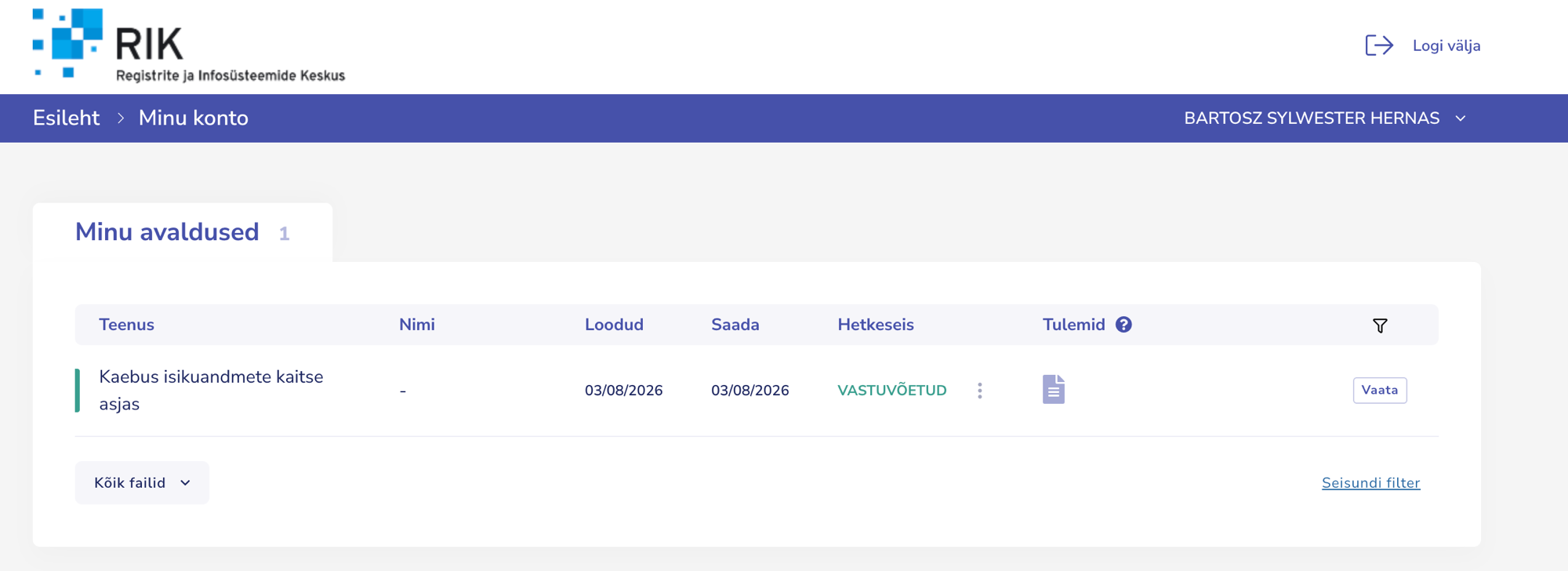
De klacht stelt zeven inbreuken: mij niet informeren over mijn rechtsmiddelen, onvolledige inzage en een onhoudbare weigeringsgrond, het missen van de maandtermijn voor de twee punten die ik op 1 juni vroeg, het ontbreken van ontvangers, bewaartermijn en beslissingslogica, een geautomatiseerd besluit onder artikel 22 genomen zonder menselijke beoordeling, het op geen enkele wijze faciliteren van mijn rechten, en helemaal geen antwoord op mijn wissingsverzoek. Ze verzoekt de Inspectorate samen te werken met de Nederlandse Autoriteit Persoonsgegevens — Tesla’s leidende autoriteit in de EU — in de procedure van artikel 60. Ik diende haar nu in en niet in oktober omdat die inbreuken al voltooid zijn: wat Tesla over twee maanden stuurt, maakt niet ongedaan dat het mij niet op mijn klachtrecht heeft gewezen.
Op 3 augustus ingediend bij de Estse privacytoezichthouder en dezelfde dag aanvaard: zeven gestelde inbreuken, en het verzoek de Nederlandse leidende autoriteit erbij te betrekken. Op 3 september verlengde de Inspectorate haar behandeling tot 5 oktober.Lees volledig
Summary of the complaint
On 1 June 2026 the complainant made a request under Article 15 GDPR for, among other things, the telemetry, diagnostic and event data that Tesla relied upon when it remotely disabled Full Self-Driving functionality on the complainant’s vehicle — functionality purchased for EUR 6,200 — on the stated ground that an unauthorised third-party device had been detected. Tesla supplied only a standard account-data export, which contained none of that data.
On 25 June 2026 Tesla asserted that the request had been “fulfilled on 01/06/2026” and that vehicle data is not associated with the complainant’s identity “by default”. That position is irreconcilable with Tesla’s own conduct. A remote decision to disable a specific feature on a specific VIN, taken because of what Tesla says its systems detected in that vehicle, necessarily involved personal data linked to the complainant. Tesla’s own reply lists “a raised hardware or software issue” as a condition that triggers precisely such linkage. That reply also declined the request without informing the complainant of his right to complain to a supervisory authority or to seek a judicial remedy.
On 1 July 2026 the complainant set out five specific items under Articles 15 and 22 GDPR. On 31 July 2026 Tesla stated that it requires two further months. This complaint is nevertheless lodged now, because the infringements are already complete and do not depend on the outcome of the extension.
The controller’s own notifications
The notification is itself proof of linkage. Tesla could not have generated and sent the email of 8 April 2026 unless the detection event had been transmitted from the vehicle to Tesla and associated there with the complainant’s account and email address. Tesla’s statement of 25 June 2026 that “no one – including Tesla – would have knowledge of your activities” cannot stand alongside a notification that Tesla itself sent to him about an event in his vehicle.
A second Tesla department describes a centrally imposed decision. On 25 June 2026, the same day as the privacy response, Tesla’s Warsaw service centre wrote to the complainant in Polish that “Blokada została nałożona odgórnie i jest software’owa, z powodów bezpieczeństwa po wykryciu modyfikacji systemów FSD” — “the block was imposed centrally and is software-based, for safety reasons, after detection of modification of FSD systems”. A block imposed centrally by Tesla following detection is a decision taken by the controller on the basis of vehicle data attributed to this vehicle and this account. It is not an autonomous act of the car, as the wording “your vehicle has detected” implies.
The notifications were dispatched in bulk. An identical notification was sent twenty-three seconds later, at 23:00:23 UTC on 8 April 2026, in respect of a different vehicle, to a further email address controlled by the complainant. The complainant advances no claim in respect of that vehicle or its owner and refers to it only as evidence that these notifications, and the disablements they announced, were dispatched as an automated bulk action rather than following any individual assessment of the vehicle concerned.
Infringements alleged
Article 12(4) — failure to inform of remedies. Tesla’s reply of 25 June 2026 declined to provide the data requested but did not inform the complainant of the reasons for not acting, of the possibility of lodging a complaint with a supervisory authority, or of seeking a judicial remedy. This infringement is complete and is unaffected by the extension of 31 July 2026.
Article 15(1) and 15(3) — incomplete access, and an untenable ground for withholding. A generic account-data export was supplied in place of the personal data actually identified in the request, and Tesla declared the request “fulfilled”. Data that has in fact been linked to the complainant and used to take a decision affecting him is personal data within Article 4(1) and cannot be withheld on the ground that linkage does not occur “by default”.
Article 12(3) — failure to respond within one month as to items 1 and 2. The telemetry data and the dates and times of its processing fell due on 1 July 2026. No extension was notified within that period. These items remain outstanding.
Article 15(1)(c), (d) and (h) — failure to supply required accompanying information. Recipients, retention period, and information on the logic of the automated decision were all requested and none has been provided.
Article 22 — automated decision-making. The disablement appears to have been an automated decision producing a significant effect on the complainant (loss of paid functionality valued at EUR 6,200, with no refund and no restoration under warranty). Tesla has provided no information about the logic applied and no meaningful route to human intervention or to contest the decision. The bulk dispatch of identical notifications seconds apart in respect of different vehicles indicates that no individual human assessment preceded the decision.
Article 12(1) and 12(2) — failure to facilitate the exercise of rights. Tesla’s substantive reply restated its general Privacy Notice and redirected the complainant to Customer Support rather than answering the request. Tesla has since attributed the delay to the request having been spread across its own departments, having itself directed the complainant to a further department.
Article 17 — no response to the erasure request. The request of 1 June 2026 for erasure of telemetry data and cessation of further transmission has never been addressed in any reply.
Action requested
- That the Inspectorate register this complaint and investigate it, in cooperation with the Autoriteit Persoonsgegevens under Article 60 GDPR.
- That the Inspectorate find the infringement of Article 12(4) in respect of the response of 25 June 2026, which does not depend on the extension.
- That the Inspectorate order Tesla under Article 58(2)(c) to comply forthwith as to items 1 and 2, which fell due on 1 July 2026.
- That the Inspectorate require Tesla to state, in writing and to the complainant, the specific date by which it will respond and the reasons for the delay required by Article 12(3).
- That, if Tesla has not fully answered items 3 to 5 by the expiry of the extended period, the Inspectorate proceed on those items without requiring a fresh complaint.
- That the Inspectorate require Tesla to provide the information owed under Article 15(1)(h) and Article 22 concerning the logic and criteria of the automated decision to disable purchased functionality.
- That the Inspectorate examine whether Tesla processed vehicle telemetry from the complainant’s vehicle at a time when telemetry sharing was set to opt-out, and on what legal basis under Article 6.
- That the Inspectorate consider whether the practice complained of extends beyond the complainant, Tesla having reportedly applied the same remote entitlement change to a substantial number of other vehicles.
- That the complainant be informed of the progress and outcome of the complaint under Article 77(2).
I confirm that the information given in this complaint is true and complete to the best of my knowledge, and that I have attempted to resolve the matter directly with the controller. — Bartosz Hernas, 3 August 2026, signed digitally (ID-card / Mobiil-ID)
Woordelijk weergegeven (in het oorspronkelijke Engels) volgens de ingediende klacht. De onderdelen met mijn contactgegevens, de chronologie, de vijf gevraagde punten en de bijlagenlijst zijn hier weggelaten — mijn woonadres en telefoonnummer zijn overal verwijderd, en de rest staat al in <a href="#privacy">sectie 11</a> en <a href="#deadline">sectie 15</a>. Er zijn twaalf bijlagen meegestuurd, waaronder de volledige e-mailwisseling.
Twee dingen uit het dossier stonden nog niet op deze pagina, en beide kwamen boven bij het bijeenbrengen van het bewijs. Ten eerste: de melding die ik op 8 april om 23:00 UTC kreeg, ging niet alleen naar mij. Een identieke ging drieëntwintig seconden later uit, voor een andere auto, naar een ander adres van mij. Wat dat besluit nam, liep een lijst af. Ten tweede: op 25 juni — dezelfde dag waarop het privacyteam mij schreef dat mijn voertuiggegevens niet aan mijn identiteit zijn gekoppeld — schreef Tesla’s servicecentrum in Warschau mij dat „de blokkade centraal is opgelegd en softwarematig is, om veiligheidsredenen, na constatering van wijziging van FSD-systemen." De ene Tesla-afdeling beschrijft botweg wat de andere ontkende.
De Inspectorate heeft inmiddels teruggeschreven — niet met een bevinding, maar met een termijn van zichzelf. Op 3 september 2026 verlengde de AKI de termijn voor de behandeling van mijn klacht op grond van § 61 lid 2 van de Estse Wet bescherming persoonsgegevens tot 5 oktober 2026, om — in haar eigen woorden — de omstandigheden die nodig zijn om de zaak te beslissen nader op te helderen en te analyseren. De brief is ondertekend door een met naam genoemde jurist van de dienst, namens de directeur-generaal. Dat is een verlenging, en ik heb een hele sectie geschreven over wat het is om er een te krijgen, dus het loont om precies te zijn over het verschil. Deze noemt de bepaling waarop ze zich beroept, geeft een reden die over de zaak gaat en niet over een intern archiveringssysteem, stelt één datum en zet er een naam onder. Die van Tesla, zes uur nadat ik voor het eerst een toezichthouder had genoemd, deed niets van dat alles — sectie 15. Niets in de brief raakt aan de samenwerking met de Nederlandse autoriteit onder artikel 60 waar de klacht om vroeg; die vraag wordt, als ze al beantwoord wordt, later beantwoord. Zo komt er een vierde datum bij op de lijst: 11 september voor de voorwaarden, 14 september voor het geld, 1 oktober voor Tesla’s antwoord op het bezwaar — en 5 oktober voor dat van de toezichthouder.
17Spanje: geen e-mail, geen bericht, maanden na de golf
Een tweede eigenaar, in Spanje, die Full Self-Driving in eigendom kocht — €7.500, levenslang. Ook zijn auto stopt niet meer voor rood licht en stopborden. Het verschil is hoe hij het ontdekte: hij is het helemaal niet verteld. Geen e-mail, geen melding in de auto. Hij merkte dat de auto door rood reed, ging kijken, en vond de optie verdwenen uit de Autopilot-instellingen en zelfs afwezig in de handleidingen van de auto — „alsof het nooit heeft bestaan". En het gebeurde niet in april: in zijn woorden, „het is recent gebeurd, niet maanden terug zoals de ‚golf'".
Wat hem deed kijken was een rammelende achterklep. Hij maakte daarvoor een serviceafspraak, en de medewerker die hem berichtte vroeg — ongevraagd, voor een reparatie aan de kofferbak — of hij voertuigaanpassingen had gedaan, een app of monitoring van derden had geïnstalleerd, iets in de auto had laten inbouwen, of de bedrading had gewijzigd. Hij was, zoals hij zegt, geschokt: dat had niemand hem ooit gevraagd. Hij antwoordde eerlijk. Er zitten twee dingen op zijn auto: een set S3XY stalks — zijn Model 3 Highland wordt zonder stengels geleverd — en een aanpassing om alleen met de handen te rijden, voor beperkte mobiliteit. Beide geregistreerd en al ruim twee jaar legaal. Tesla’s samenvatting aan hem was: „Verwijder alsjeblieft alles wat mogelijk of niet legaal is, om garantieproblemen te voorkomen."
Daarna meer dan een uur aan de telefoon met de servicemanager van zijn regio, wat „ik weet het niet" en „die informatie heb ik niet" opleverde — terwijl het hem duidelijk was dat de manager meer wist en het niet wilde zeggen. Hij kreeg een link naar een Tesla-pagina zonder iets relevants, werd terugbeld, en werd bij een ander servicecentrum ingeboekt. De theorie die uiteindelijk werd geboden: omdat het monteren van S3XY stalks illegaal is, vervalt de garantie, en daarom is Autopilot uitgeschakeld — en een toekomstige update zou het teruggeven. Die belofte is de zin die ik in april kreeg, en die Koreaanse eigenaren kregen voordat de vlag binnen twintig minuten uit en weer aan ging — sectie 14. Wat niemand hem geeft, is een lijst. Zijn woord ervoor: een „geheime" cherry pick.
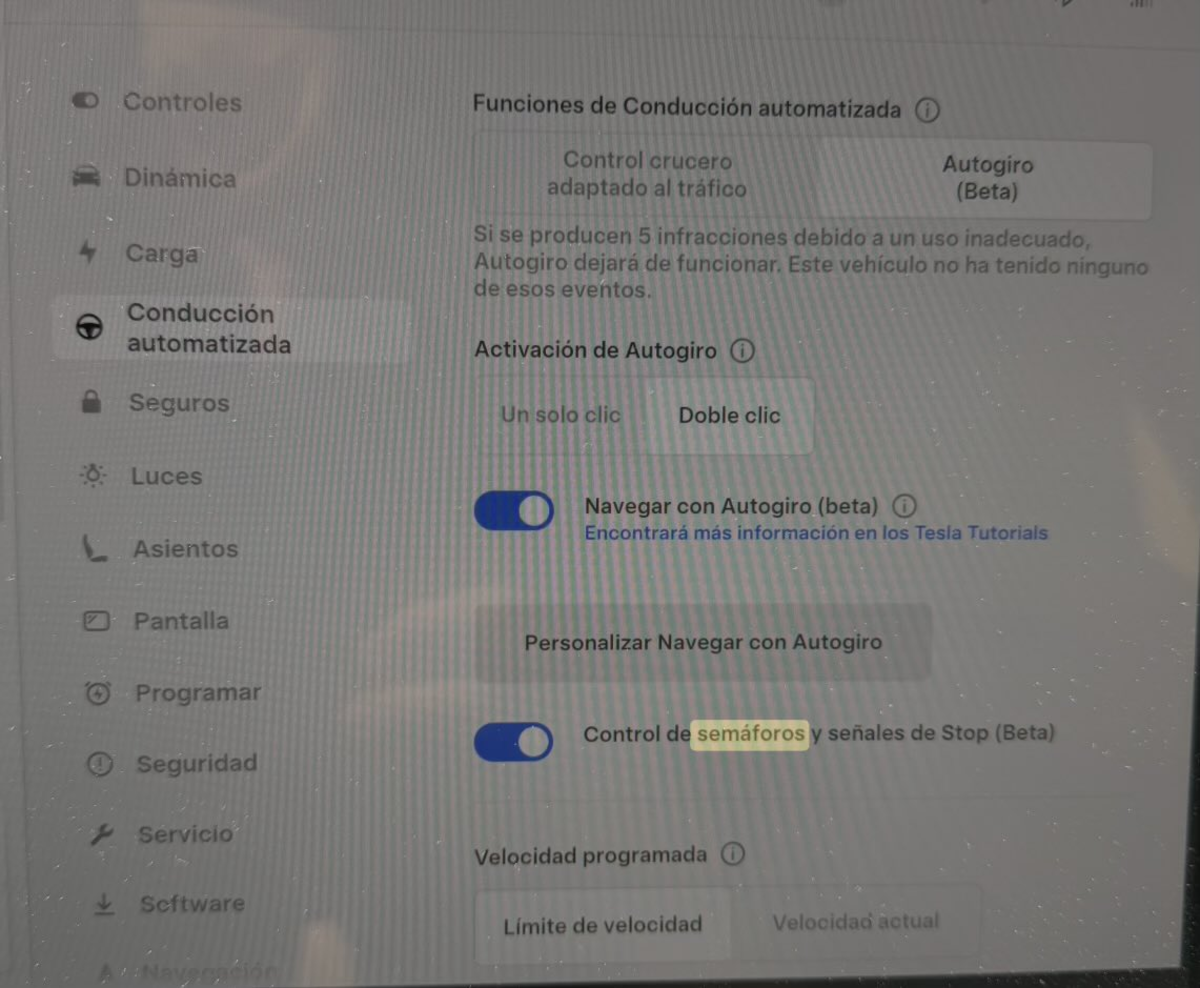 28 april 2026
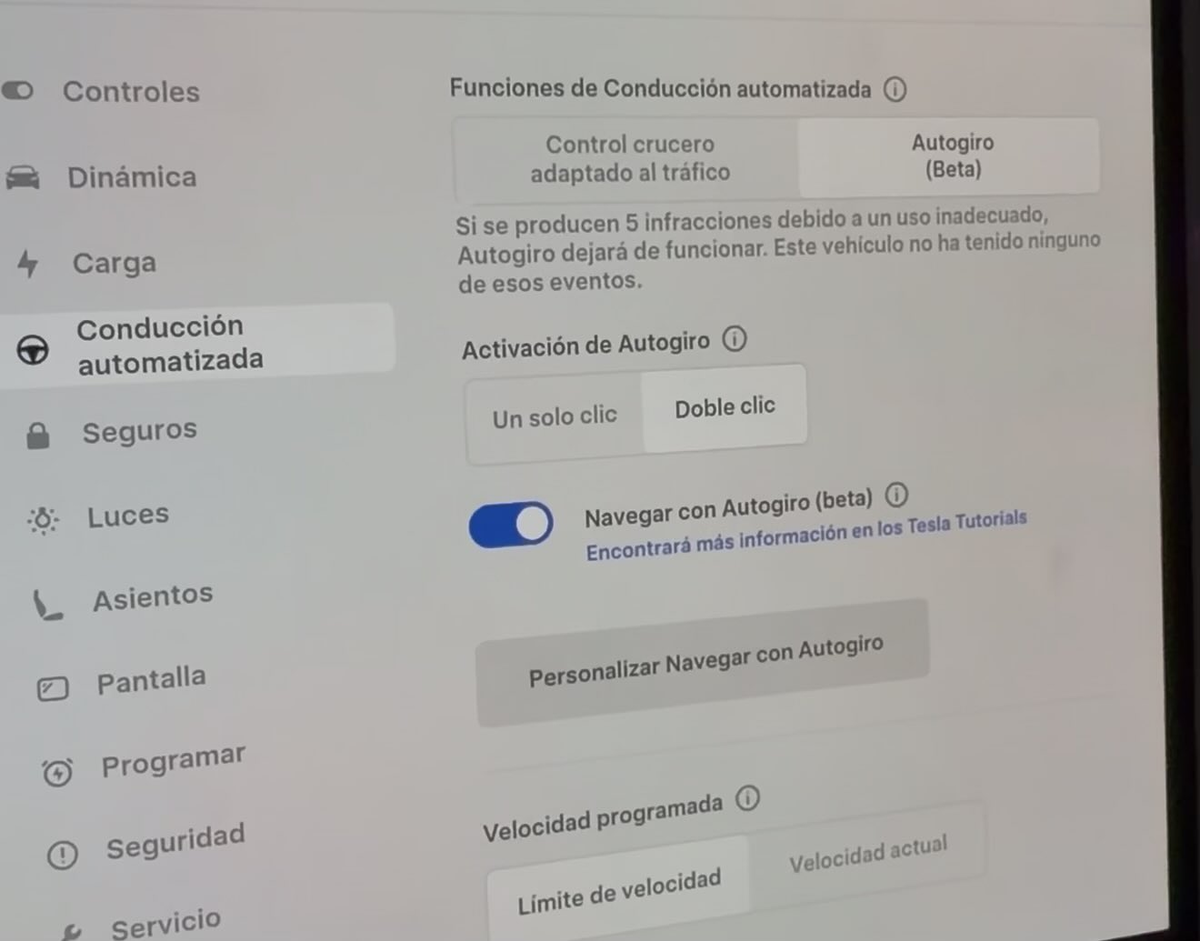 7 augustus 2026
„Ik heb geen mail, geen meldingen… niets. De functie is simpelweg verdwenen en dat is het, stilletjes."
Een tweede eigenaar, €7.500 aan levenslange FSD, weg zonder ook maar één e-mail. Tesla vroeg hem het op video te bewijzen, gaf het verkeerslicht de schuld — en sloot toen zijn klacht en wiste het ticket uit zijn account.Lees volledig
Drie dingen zijn hier erger dan in mijn geval. Een set stengels op een auto die zonder stengels wordt geleverd kan Full Self-Driving niet aanzetten — wat er ook gematcht is, een ontgrendeling was het niet. Hij kreeg geen enkele melding; ik kreeg tenminste om twee uur 's nachts een e-mail. En het gebeurde recent, niet in de aprilactie — wat betekent dat er geen oude episode wordt opgeruimd, maar dat een praktijk doorloopt. Hij heeft Tesla inmiddels een lange klacht gestuurd: over het stille verwijderen, over dat hij ervoor betaalde, en over de verschillende behandeling per klant; hij zegt dat hij restitutie zal eisen als er niets wordt opgelost. Zijn zorg gaat verder dan zijn auto: als betaalde functies stil kunnen worden verwijderd, wat weerhoudt hen ervan de automatische noodrem als volgende te nemen?
Wat daarna gebeurde is het waard om op volgorde te vertellen, want het duurde acht dagen en eindigde ergens waar ik het niet verwachtte. Eerst vroeg Tesla hem het verlies te bewijzen. De servicemanager wilde een video van de ontbrekende instellingen — „om het verder te kunnen escaleren”, kreeg hij te horen — dus filmde hij zijn scherm en stuurde die op. Dat was niet genoeg. Vervolgens werd hem gevraagd zichzelf rijdend te filmen, om het falen in het verkeer aan te tonen. En de uitleg die terugkwam veranderde: het probleem is niet de auto maar de omgeving — hij zou de functie inschakelen onder omstandigheden die te slecht zijn — en op enig moment, dat het verkeerslicht zelf het probleem kon zijn. Ondertussen bleef het servicecentrum vragen wat er nu precies verdwenen was, met de twee schermafbeeldingen hierboven in handen. Een van die berichten bereikte hem om 21:41, ruim vier uur na sluitingstijd.
Daarna deed hij hun werk zelf. Op 10 augustus ging hij naar de afspraak voor de rammelende achterklep — de oorspronkelijke afspraak. De technicus die hem hielp — en die uit zichzelf opmerkte dat hij tal van eigenaren kent met hetzelfde accessoire en zonder enig probleem — stelde de voor de hand liggende diagnose voor: zet de auto in servicemodus, herinstalleer de voertuigsoftware zonder dat er iets is aangesloten, en test opnieuw. Dat deed hij precies, en hij wachtte terwijl de auto zijn software opnieuw installeerde. Er veranderde niets. Geen verkeerslichten, geen stopborden. Wat hem daarna opviel is het detail waar ik steeds op terugkom: de functie ontbreekt inmiddels ook in het handboek van de auto zelf — terwijl datzelfde handboek in de Tesla-app op zijn telefoon haar nog gewoon beschrijft, en zijn account het Full Self-Driving-pakket nog steeds als het zijne vermeldt. In zijn woorden: alsof er een update is gemaakt voor alleen zijn auto, zodat de functie eruitziet alsof ze nooit heeft bestaan.
En toen, op 11 augustus, verdween de klacht zelf. Tesla sloot zijn serviceverzoek en verwijderde het uit de geschiedenis van zijn account — niet gearchiveerd, niet als opgelost gemarkeerd: weg uit de app, alsof het nooit was ingediend. Hij belde de service om zeker te weten dat het geen synchronisatiefout was, en kreeg ronduit te horen dat het verzoek was gesloten en, in het woord dat tegen hem werd gebruikt, „shadowed”, in de schaduw gezet. Hij had het gesprek opgenomen voordat het verdween.
„Ze hebben mijn ticket gesloten en uit de geschiedenis gehaald — het bestaat niet in mijn account.”
De schriftelijke reden was, toen die eindelijk kwam, een derde verhaal. Hij geeft haar zo weer: de werkplaats heeft het voertuig beoordeeld en kan geen verdere informatie geven; ook een gehomologeerd apparaat is onverenigbaar met de CAN-lijn van het voertuig, waardoor bepaalde functies beperkt kunnen zijn voor de veiligheid van Autopilot bij niet-originele apparatuur; toekomstige updates kunnen de functies herstellen; en het verzoek wordt gesloten omdat er aan hun kant geen aanpassing mogelijk is. Leg dat naast de reden van een week eerder — dat het monteren van S3XY stalks illegaal is en de garantie doet vervallen — en het is niet dezelfde bewering. Geen van beide versies noemt een functie, een apparaat, een datum of een regel. En beide eindigen in de zin die ik op 9 april kreeg en Koreaanse eigenaren op 30 juli: dat een toekomstige update het mogelijk terugbrengt. In Korea ging precies dat recht binnen twintig minuten uit en weer aan, zonder enige update — sectie 14. Hij heeft de zaak heropend en hun vijf punten voorgelegd: dat het contract dat hij tekende toestaat wat er op zijn auto zit; dat niemand hem ergens over heeft geïnformeerd, en dat hij nu een audit wil van alle verwijderde of mogelijk verwijderde functies; dat er aan de auto niets is veranderd tussen twee probleemloze jaren en enkele weken geleden, en dat alles wat erop zit gehomologeerd is; dat als dit werkelijk over veiligheid gaat, ze moeten zeggen wát er faalt — de accessoires zijn er weken geleden af gehaald, de software is opnieuw geïnstalleerd, en het werkt nog steeds niet; en ten slotte: de functies terug of het geld terug, €7.500. Hem werd gezegd dat ze zouden terugbellen.
The guy who was typing me said: Did I made any vehicle modifications? Have you got a third party app or monitoring? Did you made any intervention to install something to the car? Did you modified the wiring?
I was shock. They never asked me that and they was saying all the time. And just for a trunk noisy service.
I said the S3XY stalks (model 3 highland stalkless). And a modification to drive with hands only (reduced mobility). All registered and legal for over 2 years.
The summary is: Please remove everything if possible or not legal, to avoid warranty issues.
I have no mail, no notifications… nothing. The function just vanished and that’s it, silently. Even in the car manuals it’s not appearing, like never existed.
And it happened recently. Not months ago like the “wave”.
Basically he said that is it possible that, because installing s3xy stalks it’s illegal, voids my warranty and they disabled the autopilot, and soon in new updates they’ll give me that back.
My car is adapted to a reduced mobility person so it’s not a choice and was fully homologated over 2 years ago.
So angry right now, they are not giving me details, list of what is banned or not, what’s wrong or not, it’s a “secret” cherry pick and it happened. They don’t know anything, poor guys.
It’s so annoying, I’m worried about if they remove functions silently what’s next? Remove automatic brake collision?
Today the service manager asked me to share a video about my autopilot settings missing and I paid for it. He asked me the video in order to keep escalating it.
The Tesla service closes at 17:00. Well the manager wrote me at 21:41. What the hell? He only said: What options you miss.
That guy said the problem is not the car, it’s the environment. I’m trying to activate it without good conditions that’s why it fails. They asked me to record a video driving demonstrating that. Is not enough recording a video showing autopilot options were gone.
They said, maybe the problem is the traffic light which is so baaad.
They keep asking, but what disappeared? I don’t know if more functions disappeared because I had no more pictures from before.
He told me to try: service mode, reinstall car firmware without commander connected, test it. He knows a lot of commanders and no issues.
Nothing, still same. I’ve noticed the option also disappeared on the car manual. But in my iPhone i see the option in the manual and my car has fsd capability package. It’s like they did an update or modification only to my car making it seem like it does not exist.
They closed my ticket and removed it from the history — it does not exist in my account. I called the service and they told me directly that the ticket was closed and “shadowed” which is strange. We ensured it was not an app bug or sync — no, they DELETED the ticket in my app. Thankfully I recorded the whole chat.
Why 2 years ago no and some weeks ago yes? Nothing changed in the car and all features are HOMOLOGATED. Return me the money or the features.
Feels good, they are playing like it’s a video game. Again, not a big deal the features removed, because were shitty, but they opened the door and it’s super annoying while I didn’t sign for that.
Dit is het verhaal van een andere eigenaar over de auto van een andere eigenaar. Ik heb er niet in gezeten en ik ben niet de bron. Het wordt met zijn toestemming gepubliceerd, op zijn verzoek zonder identiteit en locatie, en zijn berichten zijn weergegeven zoals hij ze schreef. Tesla’s bericht van 11 augustus is zijn eigen Engelse weergave van een Spaans origineel en staat hier als indirecte rede, niet als citaat. Tesla zou dit alles in één zin kunnen bevestigen of ontkennen.
18Show me the contract
Every refusal I have had in four months rests on the same unstated thing: the terms. So on 11 August 2026 I asked Tesla one question, in writing — which Terms of Service does Tesla say I am bound by? Produce the document. Point at the clause.
It is worth seeing how much has been decided without a document ever being named. The car was reset to its “original configuration” — no clause. An “unauthorized third-party device” justified removing a package I had paid for — no clause. Two service centres called a fault under warranty “not serviceable” — no clause. Tesla Poland wrote that “vehicles acquired second-hand are always outside the scope of our standard processes” — no clause, and no scope, and no process. At no point in four months has anyone at Tesla quoted a single line of a single agreement to me.
And this is the part that sharpens it: I was never given anything to sign. The car reached me through an intermediary rather than across a Tesla counter — no order agreement, no terms of service, no FSD licence, nothing presented and nothing accepted. Whatever Tesla believes binds me, I have not read it, because nobody has ever shown it to me. So I asked for six things: the agreement Tesla says governs us; the legal basis on which it says that agreement reaches me; the version in force on the day the car was registered, with proof of how I was notified or deemed to have accepted it; whether different terms apply because an intermediary was involved; the clause relied on to switch off Full Self-Driving; and the clause relied on to decline to answer or to refund. The letter doubles as an Article 15 GDPR request, which puts a date on it: 11 September 2026.
I am not asking for anything beyond clarity on which specific terms Tesla is relying on: which Terms of Service are being invoked to remotely disable FSD I paid for, and to avoid responding to or refunding affected customers.
I asked Tesla to produce the Terms of Service it says I am bound by, and the clause it relies on. The letter doubles as an Article 15 GDPR request, which puts a date on the answer: 11 September 2026.Lees volledig
To Tesla Privacy, Resolutions, EU Customer Happiness, and Legal teams,
I am the registered first owner of a Tesla Model Y, VIN XP7YGCEK9SB621959, registered on 05.05.2025, equipped with Full Self-Driving (FSD).
My vehicle was purchased through an Estonian intermediary, rather than directly from Tesla or through a lease/financing arrangement with an Estonian bank. As a result, I have never been presented with, signed, or explicitly accepted any Tesla Motor Vehicle Order Agreement, Terms of Service, or FSD-specific purchase agreement. My understanding of any contractual relationship with Tesla is based solely on Tesla’s general assertion that use of the vehicle constitutes acceptance of unspecified terms.
Given that Tesla has disabled the FSD functionality on my vehicle, I am requesting that you provide me directly with:
- 1. The specific, complete Terms of Service, Motor Vehicle Order Agreement, and/or FSD Purchase/License Agreement that Tesla contends governs my relationship with Tesla as the first registered owner and end user of this vehicle;
- 2. Confirmation of the legal basis on which Tesla asserts these terms apply to me, given that I did not purchase the vehicle directly from Tesla nor sign any agreement with Tesla or a Tesla-affiliated financing entity;
- 3. The version of the FSD terms that was in effect at the time of vehicle registration (05.05.2025), together with any documentation showing how or when I was notified of, or deemed to have accepted, those terms;
- 4. Confirmation of whether any different or additional terms apply because the vehicle was acquired through a third-party intermediary rather than directly from Tesla;
- 5. The specific clause(s) of the Terms of Service Tesla is relying on to justify remotely disabling FSD functionality that I paid for and had active on my vehicle;
- 6. The specific clause(s) of the Terms of Service Tesla is relying on to decline to respond substantively to my prior contact attempts, and/or to decline a refund for the disabled FSD functionality.
This request also constitutes a request for personal data and related processing information concerning me under Article 15 of the GDPR, insofar as it relates to records of my account, my acceptance (or lack thereof) of any agreement, and any internal records associating me with specific contractual terms. Under Article 12(3) GDPR, I expect a substantive response without undue delay and in any event within one month of the date of this email — i.e., by 11 September 2026. If Tesla considers this request complex and intends to invoke the further two-month extension permitted under Article 12(3), please notify me of that fact, and the reasons for it, within the initial one-month period.
Please provide the actual requested documents rather than a general link to Tesla’s public website, since those pages are subject to change and do not establish what applied to me at the relevant time.
For context, I am documenting this dispute publicly at TeslaTookWhatIPaidFor.com, which covers the remote disablement of FSD functionality I purchased. This correspondence, including Tesla’s response or lack thereof, will be published there as part of that record. I am not asking for anything beyond clarity on which specific terms Tesla is relying on: I simply want to know which Terms of Service Tesla is invoking to (a) remotely disable FSD I paid for, and (b) avoid responding to or refunding affected customers.
I look forward to your response within the timeline set out above.
Regards, Bartosz Hernas — [email protected] · VIN XP7YGCEK9SB621959
One correction to my own letter. Its third paragraph is loose about the financing: the car was supplied through the intermediary and, in the end, leased through a partner. I am leaving the sentence as it was sent rather than quietly editing it, and correcting it here instead. It changes nothing about the request — the point is the chain the car travelled down, and that at no stage of it did Tesla present me with an agreement to read, sign or accept.
Reproduced verbatim, as sent, save that the intermediary is not named here.
19142 days later, the switch flips back
On 27 August 2026 my car installed software update 2026.27.100.1. A day later, on 28 August, Full Self-Driving was simply there again — the package restored, announced by nothing more than a notice on the car’s own screen.
That notice was the mirror of 8 April — the same kind of message on the screen that announced the ban — section 3. Except that this time, no email followed. The disablement at least produced one, at two in the morning, citing “safety reasons”; the restoration produced nothing in writing at all. Just the car’s software flags, updated. And note the timing, because it is the sequence Korea saw in July — section 14: the restoration did not arrive with the update, it arrived on its own, about a day after it. Between the update finishing and the package appearing, nothing on my side changed — no visit to a service centre, no inspection passed, no appeal granted. For four months, every refusal rested on the claim that this could not simply be undone — that it needed a firmware release, another department, a process. In the end it was undone the way it was done: a flag, flipped on a server, and 142 days of “not serviceable” ended without anyone having to do anything at all.
Here is what the restoration does not change. Tesla has still not answered a single one of the questions in section 7 — not which device it detected, not who decided, not under which clause, not why two service centres refused a repair under warranty. It has not explained why the package was taken on 8 April, and it has not explained why it came back on 28 August. And it has not offered a cent for the 142 days I was locked out of a safety feature I had paid for in full — the meter above stopped where it stood, at what the lockout cost priced at Tesla’s own subscription rate. Getting back what I already owned is not a resolution. It is the minimum, arriving 142 days late, with no explanation attached.
And the restoration did not reach everyone. As far as I can tell from other owners, the flag flipped back only for cars in regions where FSD is approved. Everywhere else, banned owners are still where I was for 142 days: locked out not just of FSD but of Traffic Light and Stop Sign Control — a feature that is fully legal on any road, that shipped working, and that they paid for. And Tesla has still not answered the question that matters most for them: how were owners informed that this part was being removed — or was it simply assumed they would notice? I was never told that stop-sign recognition was going along with the rest; the 9 April email named no feature at all — section 3. Other owners tell the same story, and some tell it the hard way: I have heard accounts of near-crashes from drivers taken by surprise when a car that had always braked for stop signs stopped recognising them out of the blue. A safety feature does not become less dangerous to remove because it was removed quietly.
One remote flag took the package away. One remote flag gave it back. Neither came with a single answer.
So nothing about the legal route changes. The Article 77 complaint with the Estonian Data Protection Inspectorate stands — section 16 — because the infringements it alleges are already complete, and switching the feature back on un-does none of them. Tesla still owes me the terms it says bind me and the clause it relied on, due 11 September — section 18. Its Data Protection Office still owes me the answers it granted itself until 1 October to produce — section 15; what it sent instead, three days after the restoration, is in section 20. And the question this site opened with is sharper now, not duller: if a feature you paid for can be switched off for 142 days and switched back on overnight — no process, no notice, no accountability in either direction — what exactly do any of us own?
20Install the update
On 31 August 2026, at 20:34, Tesla’s Data Protection Office answered — a month before the deadline it had granted itself. Four claims: no automated decision was made; my access request was “fulfilled” on 1 June and 3 August; the “appropriate software update” has already been made available; and unauthorized devices may, under “our Terms” and “local road authorities,” cost you FSD. Then a bulleted list of how to install the update.
Take the claims in turn. “No automated-decision processing was performed.” Good — then a person did it. Someone at Tesla looked at data linked to my VIN on 8 April, decided a diagnostic reader was “unauthorized,” and signed off on removing a package I had paid for. That rules out Article 22 and makes every other question sharper, not softer: who, on what data, by what criteria. “Fulfilled on 01/06/2026 and 03/08/2026.” The first is the day I made the request — Tesla already claimed that in June, section 11. The second is the day I answered its extension and lodged the complaint with the regulator — sections 15 and 16. On neither day did Tesla send me a byte of vehicle data. “The appropriate software update has already been made available.” It had been installed on 27 August, and the package had come back on 28 August — section 19. Tesla’s first written word on the restoration was a set of instructions for installing an update my car had already installed, arriving three days after the restoration it describes.
Then the terms. “As set out in our Terms and as required by local road authorities, such use may result in the restriction or disablement of certain features.” The word “Terms” is a link to a webpage. Three weeks earlier I had asked Tesla to name the document and the clause — section 18 — and asked, in so many words, not to be sent a general link to the public site, because that page can change and does not establish what applied to me. This is that general link, from the office that owes me the answer by 11 September. As for “local road authorities”: the road authority where my car is registered approved FSD, which is the only reason the package was usable at all, and no road authority I know of has required Tesla to switch off stop-sign recognition on a car with a diagnostic reader in the port. If one has, Tesla can name it. I asked it to.
Tesla’s first written word about the restoration was a set of instructions for installing an update my car had already installed.
Tesla’s Data Protection Office answered a month early: no automated decision, request “fulfilled,” install the update — three days after the package had already come back. I have asked for the 142 days back in money, for the clause, and, separately, for Tesla to stop using my car’s data to decide what I may use.Lees volledig
Thank you for contacting us. No automated-decision processing was performed on the matter with regard to your reference to Article 15. Our records show that your data subject access request was fulfilled on 01/06/2026 and 03/08/2026, and further show that the appropriate software update has already been made available to your vehicle in connection with the unauthorized third-party device detection dated 8 April 2026.
Please note that the use of unauthorized third-party devices can create a safety risk to the driver and other road users. As set out in our Terms and as required by local road authorities, such use may result in the restriction or disablement of certain features, including Full Self-Driving (FSD), for safety reasons.
Steps to install the software update:
- Connect your vehicle to Wi-Fi
- On the touchscreen, go to Controls > Software, download the available update, then select Install now or schedule installation for a convenient time
- After installation, go to Controls > Self-Driving and enable Full Self-Driving (Supervised)
We apologize for any inconvenience. Should you have any feedback about your experience, please do not hesitate to contact Customer Support.
I confirm that following your last message the Full Self-Driving Capability package has been restored to my vehicle. Thank you.
The restoration is welcome, but it also settles the central point of my complaint: the functionality was Tesla’s to restore at any time, by remote configuration, and was restored once challenged. That confirms it was withdrawn unilaterally and could have been reinstated at any point during the period it was withheld. Restoration therefore resolves the feature, but not the complaint. Two matters remain outstanding, and your last message addressed neither.
1. Reimbursement and compensation
From 8 April 2026 until its restoration — a period of over three months — I was deprived of functionality I had paid for in full. In particular, my vehicle lost Traffic Light and Stop Sign Control: it no longer recognised or stopped automatically at red lights and stop signs. This is a safety-relevant driver-assistance function that was working normally before Tesla’s intervention.
Crucially, I was never informed in advance that this feature would be removed. The remote change was applied first, on 8 April 2026 at 22:27, and only afterwards did I receive an email — which itself did not clearly state that stop-sign and traffic-light recognition specifically would cease to function. I was therefore driving a vehicle whose safety behaviour had been silently altered, without notice. That is the basis of my claim: not an abstract inconvenience, but the uncompensated loss of a paid safety function, removed without warning.
I therefore require:
- (a) Reimbursement for loss of use over the full period. Tesla’s own published subscription price for this functionality is approximately €99 per month, and I ask that reimbursement be calculated on that basis for the entire duration of the deprivation.
- (b) Compensation, separately, for the diminution in value of the vehicle caused by the demonstrated fact that paid features can be and were remotely revoked, and for the time and cost incurred in obtaining a restoration Tesla could have performed at any moment. I invite Tesla to propose a figure; failing agreement, it will be quantified with supporting evidence.
2. The “Terms” you rely upon
Your message states that such use “may result in the restriction or disablement of certain features... as set out in our Terms.” Before Tesla relies on any such Terms, I require you to establish that they bind me at all:
- (i) Identify the exact document and the exact clause relied upon.
- (ii) State when, and by what act, I am said to have agreed to those Terms. I did not agree to any term permitting Tesla to remotely disable a paid safety feature, and Tesla has not shown otherwise.
- (iii) State where, before purchase, it was disclosed that paid features could be remotely disabled over the presence of a third-party device.
A clause a customer never agreed to, and was never shown before purchase, cannot be the basis for removing something that customer paid for.
3. The questions that remain unanswered
My previous letter put eighteen specific questions to Tesla. Your reply answered none of them. The following in particular require a written answer, because they concern whether this will recur, to me or to others:
- (iv) Who authorised the disablement of the paid entitlement, and on what documented evidence? Your latest message states that no automated processing occurred — which means a person made this decision. I ask again who, and on what basis.
- (v) What specifically was the detected device (make and model), and what log or telemetry entry, with timestamp, led to its detection?
- (vi) Who at Tesla determines whether a device is “authorized” or “unauthorized,” by what published criteria, and is there a list an owner can consult in advance? Does Tesla regard a standard CANBUS diagnostic tool, used through the manufacturer’s own diagnostic port, as “unauthorized”?
- (vii) What process does Tesla follow to establish whether the registered owner installed or was even aware of a device before penalising that owner — given that a device may be fitted by a previous keeper, an intermediary, or a workshop without the owner’s knowledge?
Your reference to “our Terms” and to “local road authorities” in the abstract is not an answer. I ask you to identify the specific clause and the specific authority relied upon.
Please respond in writing within 14 days. In the absence of a substantive response on reimbursement, compensation, the basis of the Terms, and the questions above, I will treat the matter as unresolved and escalate to the competent consumer-protection authority. This correspondence forms part of a documented public record at TeslaTookWhatIPaidFor.com. — Bartosz Hernas
Further to my last message, I want to record one point that remains entirely unaddressed.
Tesla states that an “unauthorized third-party device” was detected on my vehicle on 8 April 2026, and that Full Self-Driving was disabled as a result. To this day I have not been given the data that detection was based on. Specifically, Tesla has not identified:
- what data was collected from my vehicle;
- what within that data was interpreted as indicating a device;
- the date, time, and source of that data; and
- the logic or criteria by which that data was judged to indicate an “unauthorized” device.
This is not a new request. I first requested this data on 1 June 2026, and reiterated it on 1 July 2026. The one-month period under Article 12(3) in respect of it expired on 1 July 2026, and no extension was validly notified within that period. It is therefore already overdue, independently of the two-month extension Tesla later purported to take for my other items.
Your reply of 31 August 2026 states that “no automated-decision processing was performed.” If that is correct, then a person reviewed specific data linked to my VIN and account and reached a decision — which makes the underlying data plainly my personal data and plainly disclosable under Article 15. If instead the detection was automated, then Article 15(1)(h) and Article 22 entitle me to meaningful information about the logic involved. Either way, the data and the basis for the decision must be disclosed. They have not been.
Tesla cannot both assert that a device was detected via vehicle data and decline to show me the vehicle data said to have detected it. I therefore repeat my request for the specific telemetry, diagnostic, and event data — with timestamps — that Tesla relied upon to conclude a device was present and to disable the feature I paid for. If Tesla maintains it holds no such data, I require a clear statement to that effect, given that Tesla’s own notification asserts the detection occurred.
This remains outstanding and forms part of the complaint already lodged with the Estonian Data Protection Inspectorate.
Following the remote disablement of paid functionality on my vehicle based on data Tesla collected from it, I am exercising my rights under the GDPR in respect of the personal data generated by my vehicle. This letter concerns the future processing of that data; my outstanding access request regarding the detection of 8 April 2026 remains separate and unanswered.
1. What I am asking
I do not consent to my vehicle transmitting to Tesla, or to Tesla processing, any data that identifies me or that can be linked to me, my account, or my vehicle (including by VIN), beyond what is strictly necessary. In particular, I object to the collection or use of any such data for the purpose of monitoring, detecting third-party equipment, or making decisions that restrict or disable features of my vehicle.
2. The rights I am relying on
- (a) Article 21 — I object to the processing of my personal data carried out on the basis of Tesla’s legitimate interests, including any profiling. This specifically includes processing used to detect “unauthorized third-party devices” and to determine whether to restrict or disable features.
- (b) Article 7(3) — to the extent any processing relies on my consent, I withdraw that consent with effect from the date of this letter.
- (c) Article 18 — I request restriction of processing of the relevant data pending your response to my objection and to my outstanding access request.
3. What I require Tesla to confirm in writing
- (i) A complete list of the categories of data transmitted from my vehicle to Tesla, and for each category, the specific legal basis relied upon (consent, contract, legal obligation, or legitimate interest).
- (ii) For each category relied upon as “legitimate interest” or “contract,” a specific explanation of why it is claimed to be strictly necessary, so that I may exercise my objection meaningfully.
- (iii) Which categories of transmission I am able to disable myself (for example via the vehicle’s data-sharing settings), and confirmation of the effect of disabling them.
- (iv) Confirmation that, following my objection, Tesla will cease any processing of my vehicle data for the purpose of detecting third-party equipment or of restricting or disabling paid features — or, if Tesla refuses, a clear statement of the specific lawful basis on which it intends to continue that processing over my objection.
- (v) Confirmation of whether disabling data transmission affects the vehicle’s functionality or any feature I have paid for, and if so, how.
4. Note
I understand that certain limited processing may be necessary for safety recalls, regulatory compliance, or the basic connected operation of the vehicle. I am not asking Tesla to breach a legal obligation. I am asking Tesla to identify precisely which processing it claims is necessary and on what basis, to stop everything that is not, and in particular to stop using my vehicle’s data to make decisions that take away what I have paid for. Where Tesla asserts a basis that overrides my objection, I require that assertion in writing so that it can be assessed by the supervisory authority.
Please respond within one month, as required by Article 12(3). This matter forms part of the complaint already lodged with the Estonian Data Protection Inspectorate. — Bartosz Hernas, owner, 2025 Tesla Model Y · VIN XP7YGCEK9SB621959
All four letters are reproduced verbatim; greetings and signature blocks have been removed. The correspondence is in English. In Tesla’s message, “Terms” and “Customer Support” are hyperlinks — the first to Tesla’s public terms page, the second to its support page; neither names a document or a clause.
I answered the same evening, and the answer starts from what the restoration proves. The package was Tesla’s to give back at any moment, by the same remote configuration that took it, and it was given back once challenged. So the feature is resolved; the complaint is not. I asked for two things. First, the 142 days back in money — loss of use priced at Tesla’s own subscription rate, the figure the meter above stopped at — and, separately, compensation for what it does to a car’s value when its paid features are shown to be revocable from a server, and for the months spent obtaining a restoration Tesla could have performed in an afternoon. Second, the clause: not a link, but the document, the provision, the act by which I am said to have agreed to it, and where, before purchase, anyone disclosed that a diagnostic reader could cost me a paid safety feature. And once more the questions Tesla has now, by its own account, a named human being able to answer: who decided, what device, what criteria, what process for checking the owner even knew. Fourteen days, so 14 September. A follow-up in the same thread records the item that is not merely unanswered but overdue: the data the detection was based on, first requested on 1 June, due 1 July, and still not produced. Tesla cannot say a device was detected through vehicle data and decline to show the vehicle data. If a person reviewed it, it is my personal data and Article 15 reaches it. If no person did, Article 22 does. There is no third option in which it stays in a drawer.
And on 1 September, in a separate letter, I turned to the mechanism rather than the incident. The package is back; the thing that took it is still running. So I objected under Article 21 to any processing of my car’s data on the basis of Tesla’s legitimate interests, withdrew under Article 7(3) whatever consent Tesla thinks it holds, and asked under Article 18 for the processing to be restricted while it answers. I am not asking Tesla to break a law. I am asking it to list what my car sends, name the legal basis for each item, say which of it I can switch off myself, and stop using the rest to decide what I am allowed to use. Under Article 12(3) that answer is due within a month — on 1 October, the day Tesla already owes me everything else.