Par ko šeit patiesībā ir runa
Aizmirstiet uz brīdi, vai tas, ko es darīju, bija pareizi. Aizmirstiet, vai FSD lietošana bija likumīga. Ne viens, ne otrs nav būtība.
Būtiski ir tas: Tesla nepatika, ka es modificēju automašīnu, kas pilnībā pieder man — tāpēc tā iejaucās un attālināti padarīja daļu no tās nelietojamu. Ne tikai to funkciju, ko daži uzskata par nelikumīgu (tā nav, uz privātiem ceļiem) — bet pilnībā likumīgas drošības funkcijas, ar kurām automašīna tika piegādāta jauna, kas bija daļa no tās pašas €6,200 + PVN paketes, par kuru es biju samaksājis.
Šis nav Kindle veikals. Tas nav Steam. Tā ir automašīna — fiziska lieta, kuru es nopirku un kura man pieder — pārdota man ar funkciju sarakstu, no kurām katru Tesla var izslēgt no servera. (Pajautājiet ikvienam, kurš atceras veco „Ziemas paketi".) Pārkāp Tesla noteikumus, un faktiski automašīna pati aizbrauc atpakaļ uz rūpnīcu. Bez naudas atmaksas. Desmitiem tūkstošu eiro — pazuduši.
Tesla klusē — taču izturas tā, it kā es nekad nebūtu nopircis automašīnu vispār. It kā es būtu tikai licencējis tiesības to lietot. Tātad īstais jautājums nav par mani. Tas ir par ikvienu, kurš brauc:
Cik tas man maksā
Es jau nopirku FSD pilnībā — €6,200 + PVN, samaksāts viss. 2026. gada 8. aprīlī Tesla to attālināti izslēdza — un kopš tā laika mana automašīna neapstājas ne pie sarkanajiem signāliem, ne pie stop zīmēm, funkcijas, par kurām es samaksāju un kuras vairs nevaru izmantot. Katrs mēnesis man izmaksā tās abonēšanas cenu, kura man pat nemaz nebūtu vajadzīga, — un nav nekāda abonementa, ko atcelt, lai to apturētu.
01Ko es nopirku
Tesla pasūtīšanas sistēmā Full Self-Driving Capability pakete bija norādīta par €6,200 (neto, pirms PVN). Es to samaksāju. Zemāk redzamais ekrānuzņēmums ir tieši tas, ko es nopirku.
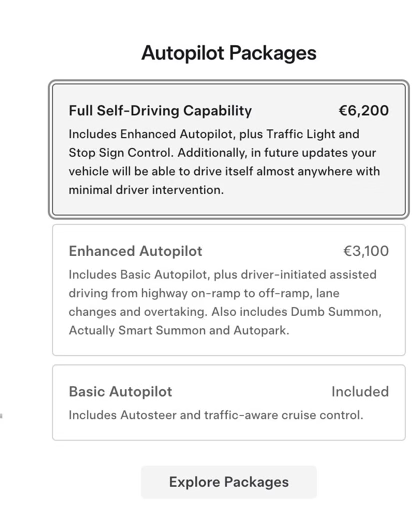
Šī pēdējā rinda ir svarīga. Luksoforu un stop zīmju vadība man bija īsta drošības funkcija: tā automātiski apstādina automašīnu pie sarkanā signāla un stop zīmēm. Vēl šodien oficiālā Tesla mobilā lietotne joprojām rāda Full Self-Driving Capability paketi kā iekļautu manā automašīnā.
02Tā strādāja — mēnešiem ilgi
Pēc piegādes es izmantoju paketes reklamētās funkcijas visā Eiropā. Luksoforu un stop zīmju vadība darbojās līdzās Autopilot, pilnībā un uzticami. Automašīna darbojās bez problēmām mēnešiem ilgi.
Automašīna pilnībā pieder man — es to neīrēju no Tesla. Es uzskatu, ka man ir tiesības modificēt automašīnu, kas man pieder, tāpat kā es varētu uzstādīt pielāgotus diskus, virsbūves komplektu vai jaunu balstiekārtu, bez tā, ka ražotājs mani par to sodītu.
„Modifikācijas" pilnībā
Es izmantoju divas CANBUS diagnostikas ierīces — „Commander" no enhauto.com un ierīci ar nosaukumu „Cybertool". Neviena no tām nemodificē automašīnu vai tās programmatūru. Tās pieslēdzas tikai standarta CANBUS diagnostikas portam — tai pašai saskarnei, ko ražotāji nodrošina diagnostikai — un nosūta komandas, ko automašīna jau atbalsta.
Piemēram, Commander liek salona LED kļūt zilām, kad ir ieslēgts Autopilot. Automašīna nolasa atbalstītu signālu, nosūta atbalstītu komandu, un krāsa mainās. Ja automašīna neatbalstītu šo komandu, nekas nenotiktu. Nekāda PCB izmainīšana. Nekādu komponentu maiņa. Nekāda oriģinālās detaļas modificēšana. Tesla pati publiski apgalvo, ka automašīnas programmatūru trešās puses nevar mainīt.
Cybertool darbojas tāpat. Tieši tāpat, kā Commander liek automašīnai padarīt salona LED zilas, Cybertool nosūtīja automašīnai komandu, ko tā jau atbalstīja — ieslēgt Full Self-Driving paketi reģionos, kur Tesla to vēl nebija aktivizējusi. Tā neatbloķēja neko jaunu: tā vienkārši ieslēdza funkciju, kurai mana automašīna bija būvēta un par kuru es jau biju samaksājis. Automašīna vai nu atbalsta komandu, vai neatbalsta; manai tā bija pieejama, jo pakete tai bija licencēta.
Tā ir tā paša veida darbība kā tad, kad Commander atspējo atpakaļgaitas pārnesuma signālu — kaut ko, ko Commander atklāti dara, lai gan šis signāls ES ir obligāts. Un, lai būtu pilnīgi godīgi: Full Self-Driving vēl nav apstiprināts publiskiem ceļiem katrā reģionā, tāpat kā skaļa izpūtēja sistēma vai sacīkšu riepas nav apstiprinātas izmantošanai uz ceļa. Tas nepadara pašu aprīkojumu nelikumīgu — sacīkšu riepas un skaļu izpūtēju var lietot trasē. Funkcijas ieslēgšana, kurai automašīna bija būvēta un par kuru ir samaksāts, nav tas pats, kas ar to pārkāpt likumu: kur un kā tā tiek lietota, ir vadītāja atbildība, nevis tas, ko izlemj diagnostikas komanda.
Neviena drošības sistēma — ne aparatūra, ne programmatūra — nekādā veidā nav modificēta.
03Kas notika
8. aprīlī plkst. 22:27 mana automašīna saņēma attālinātu paketes konfigurācijas atjauninājumu caur Tesla Cloud Config. Faktiski Tesla attālināti paziņoja manai automašīnai, ka €6,200 + PVN pakete nekad nav tikusi nopirkta.
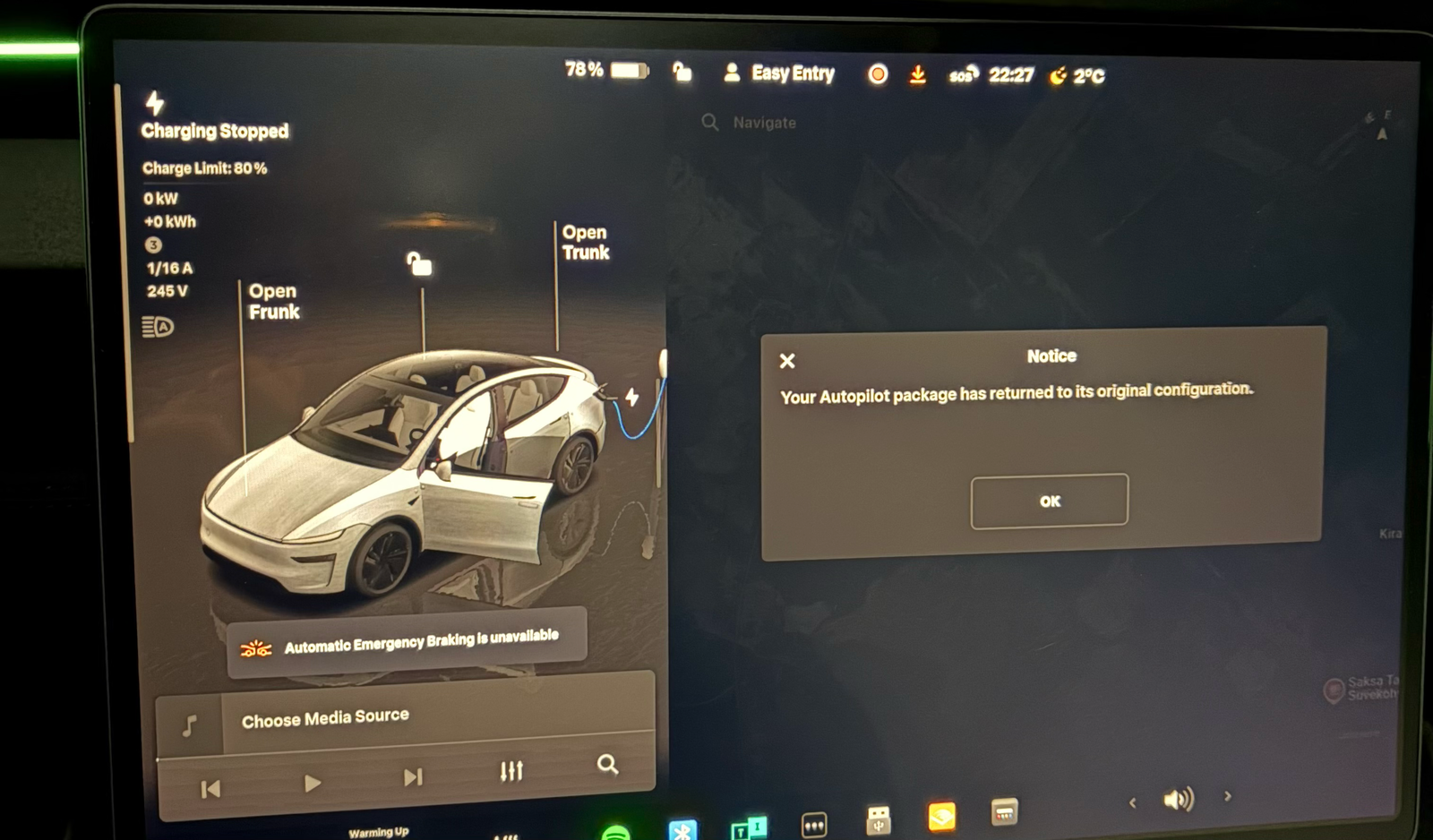
Aptuveni trīs stundas vēlāk, plkst. 02:00, pienāca šī e-pasta vēstule.
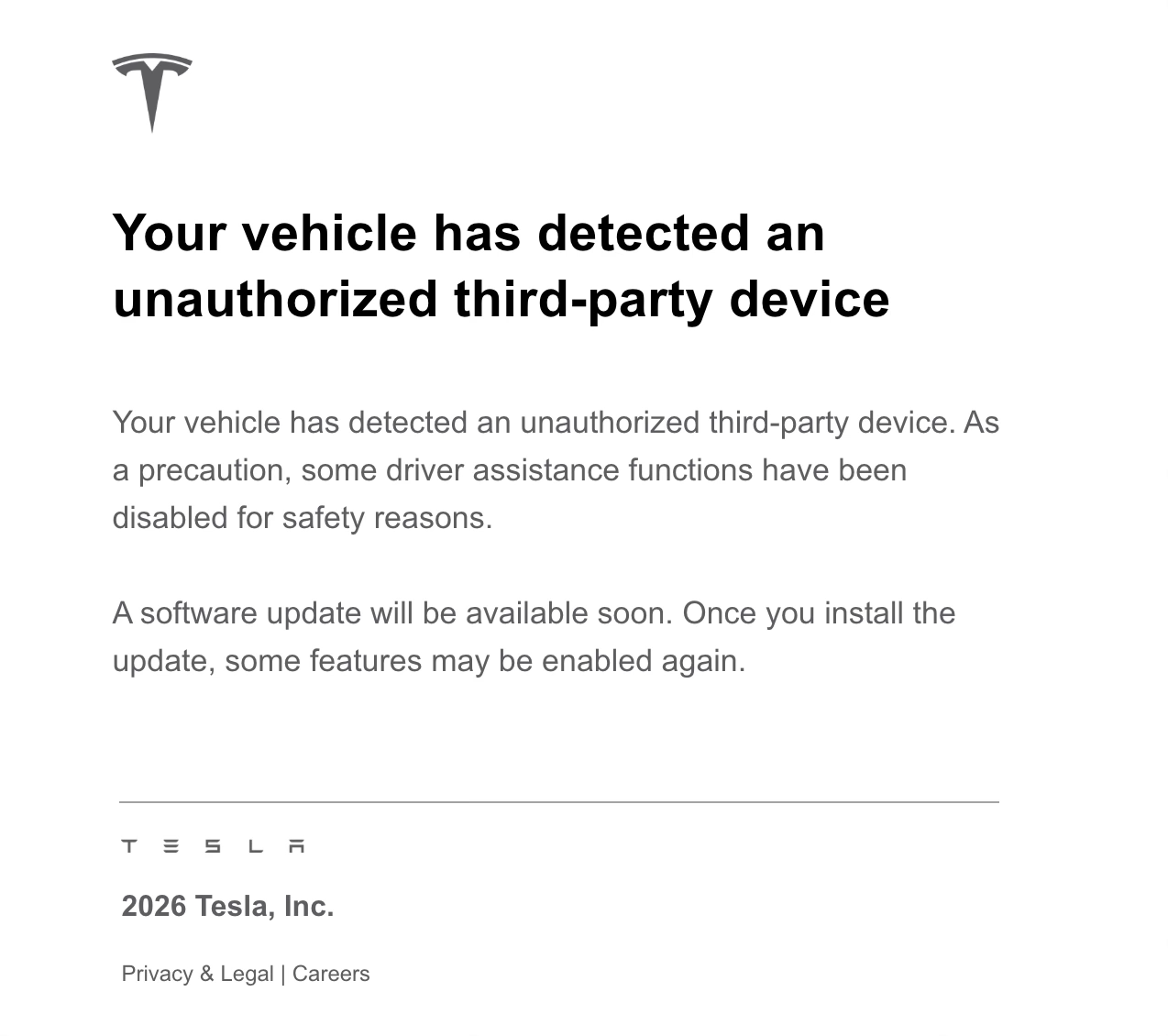
Tas ir uzkrītoši neskaidri. Tajā nav teikts, kura ierīce tika atklāta, kāds bija drošības risks, cik ilgi funkcijas būs atspējotas vai pat vai tās vispār atgriezīsies. Un šī frāze mani mulsina: neautorizēta trešās puses ierīce — neautorizēta no kā puses? Katra ierīce manā automašīnā bija autorizēta no tās īpašnieka puses. No manas puses.
04Pretruna
FSD apstiprinājums tika ieviests visā Eiropā — vispirms Nīderlandē, tad Lietuvā, tad Igaunijā 29. maijā (kur reģistrēta mana automašīna), un pēc tam Beļģijā. Mana automašīna saņēma atjauninājumu 2026.17.5, kas aktivizē jauno sistēmu. Šis bija brīdis, kad manam ieguldījumam beidzot vajadzēja atmaksāties.
Tā vietā automašīna piedāvā man „Abonēt" pogu — it kā es to nekad nebūtu nopircis.
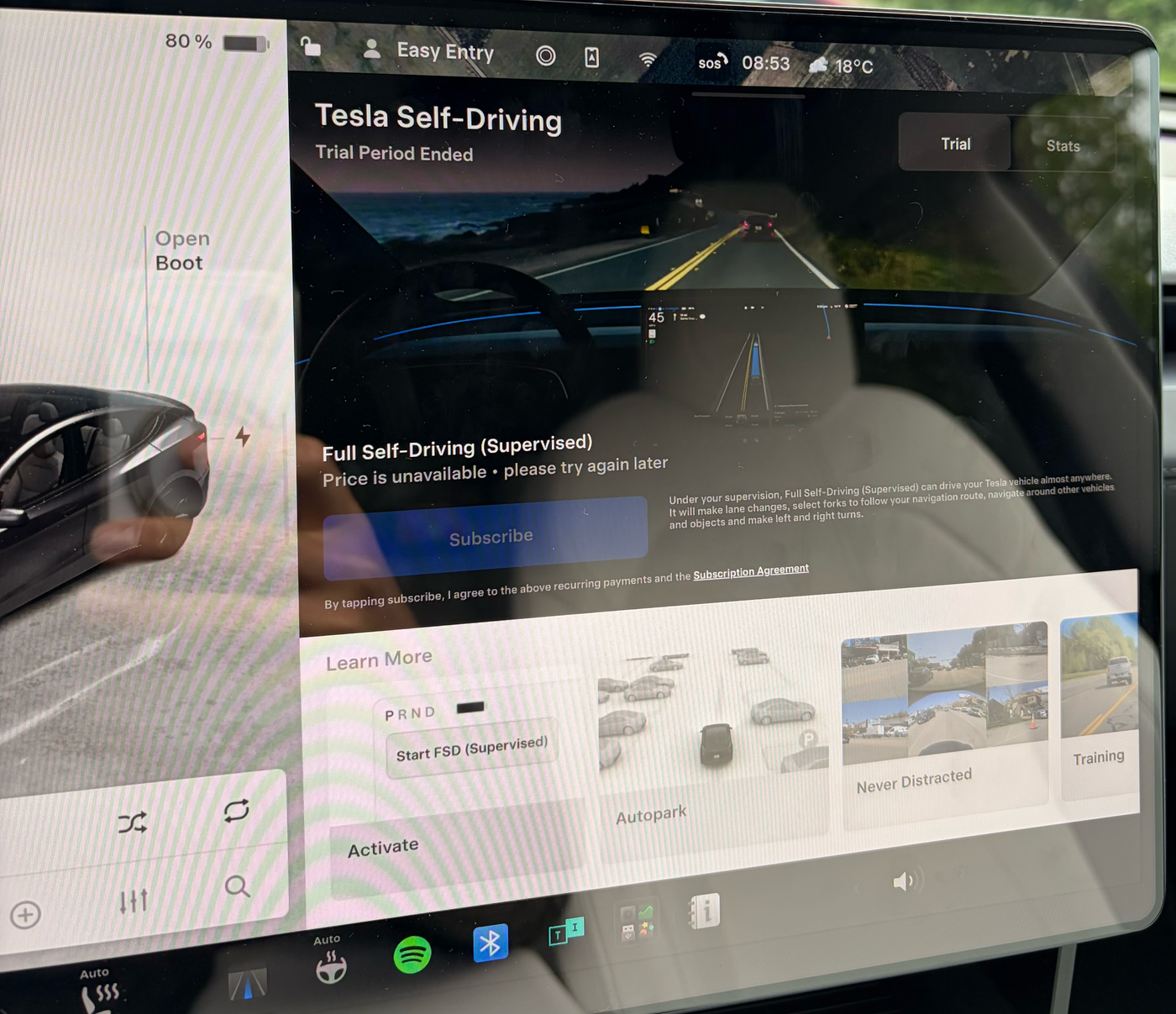
Es samaksāju €6,200 + PVN par paketi. Automašīna apstiprina, ka pakete ir „Iekļauta". Un tā pati automašīna izturas tā, it kā tā nekad nebūtu nopirkta.
05Kā automašīna zina, kas tai ir
Katra Tesla tiek piegādāta ar vienu un to pašu programmatūru un vienu un to pašu pilno funkciju kopumu. Atsevišķas funkcijas tiek ieslēgtas vai izslēgtas attālināti caur „Tesla Cloud Config", piesaistot tās tieši jūsu automašīnai. Tas ir tas pats mehānisms, kas savulaik ļāva Tesla pārdot automašīnas ar fiziski uzstādītu, bet atspējotu aparatūru aizmugurējo sēdekļu apsildei — un vēlāk ļāva īpašniekiem maksāt tiešsaistē, lai to atbloķētu.
Tas ir arī tas, kā Tesla atšķir Basic Autopilot no Enhanced Autopilot un no Full Self-Driving. Atšķirība ir tīri programmatūras noteikta. Tas nozīmē, ka funkciju, par kuru esi samaksājis, var atsaukt ar vienu attālinātu karodziņu — tieši tas, kas notika ar mani.
06Garantijas apkalpošana tika atteikta
Mana automašīna ir garantijā, tāpēc es sazinājos ar Tesla servisa centriem Turku, Somijā un Varšavā, Polijā. Abi apstiprināja, ka funkcionalitāte nestrādā. Abi apstiprināja, ka automašīna ir garantijā. Abi noraidīja pieprasījumu — sakot, ka tas „nav apkalpojams", jo automašīna tika apzināti atspējota „drošības apsvērumu dēļ".
Somijas centrs man teica, ka viņi nevar atkārtoti aktivizēt funkciju, lai gan ierīce ir noņemta, jo „jūs varat to uzstādīt atkal". Pēc šādas loģikas, kāpēc gan neatspējot funkciju katrā Tesla — jo jebkurai automašīnai varētu būt uzstādīta šāda ierīce?
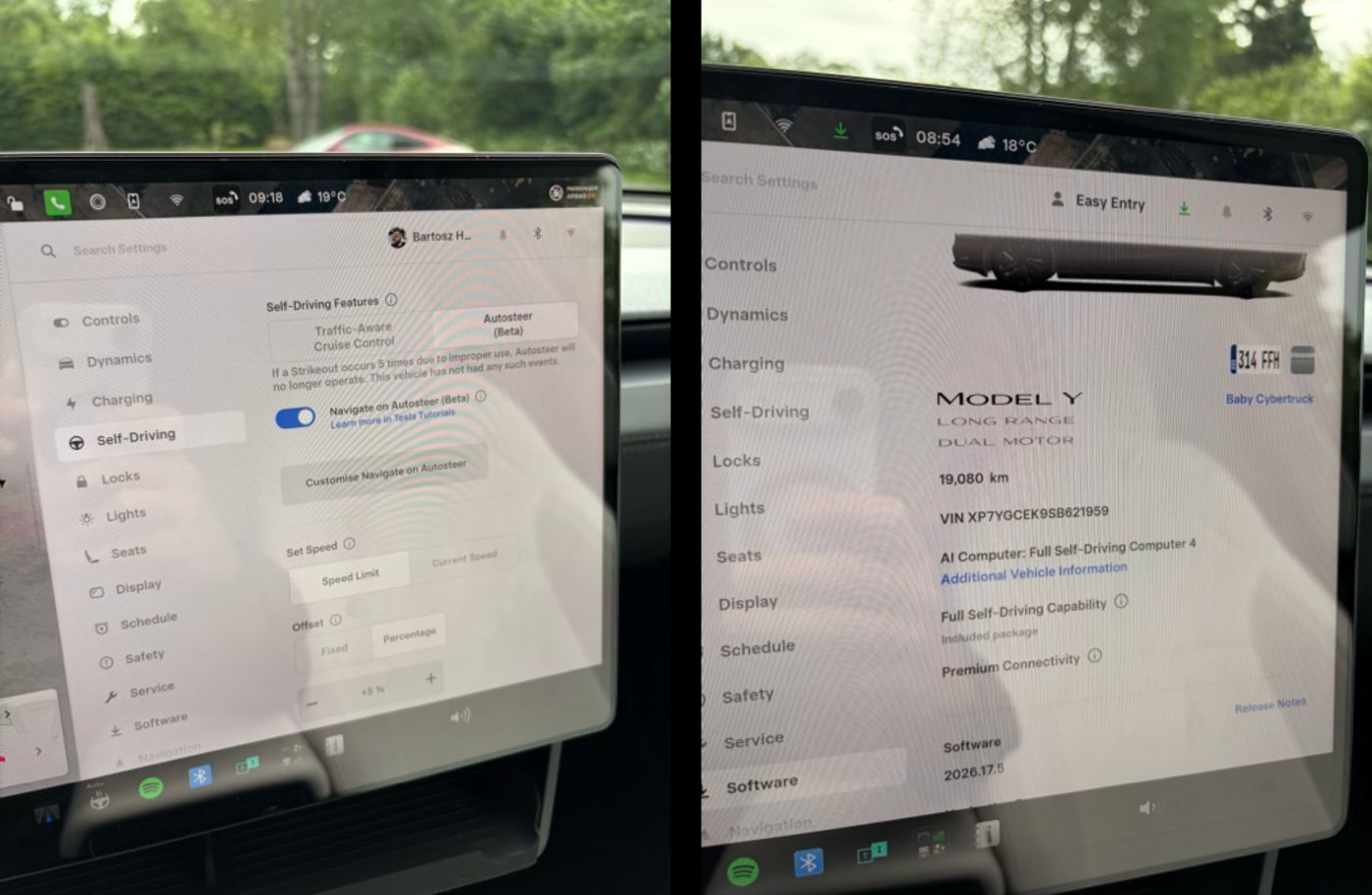
Man neatliek nekas cits kā secināt, ka tam nav cita izskaidrojuma: minētie „drošības apsvērumi" patiesībā mazina manu drošību. Astoņas nedēļas mana automašīna nevarēja atpazīt stop zīmes vai luksoforus — funkcionalitāti, uz kuru biju iemācījies paļauties.
07Jautājumi, uz kuriem Tesla neatbild
Es uzdevu šos jautājumus Tesla un tās servisa centriem. Tie joprojām ir bez atbildes. Esmu tos sagrupējis pēc tēmas.
A Garantijas atteikums
B Lēmums par atspējošanu
C Apgalvotie „drošības apsvērumi"
D Apmaksāto funkciju atjaunošana
E Kompensācija
F Politika attiecībā uz modifikācijām un trešās puses ierīcēm
Es lūdzu rakstisku atbildi 14 dienu laikā, atbildot uz katru punktu. Es joprojām gaidu.
08Es neesmu pret Tesla
Es patiesi ticu šai tehnoloģijai. Es nopirku divas Tesla un priekšapmaksā samaksāju kopumā €12,400 + PVN apmaiņā pret FSD solījumu. Šis solījums tik ilgi neīstenojās, ka es vienu no automašīnām pārdevu — zaudējot tās paketes vērtību.
Tagad man beidzot ir strādājoša automašīna ar nopirktu FSD, valstī, kas atļauj FSD. Un Tesla apzināti liedz man izmantot to, par ko samaksāju. Es vienkārši vēlos funkciju, ko nopirku, atbildi uz saviem jautājumiem un to, lai šis klusībā nenotiktu nevienam citam.
09Laika līnija
- 2025Nopērku 2025 Model Y kā pirmais īpašnieks ar FSD Capability — €6,200 + PVN.
- Mēnešus pēc piegādesFSD funkcijas, tostarp stop zīmju un luksoforu vadība, uzticami strādā visā Eiropā.
- 8 Apr 2026 · 22:27Attālināts Cloud Config atjauninājums: „Jūsu Autopilot pakete ir atgriezta sākotnējā konfigurācijā." Funkcijas zaudētas.
- 9 Apr 2026 · 02:00Tesla nosūta e-pastu par „neautorizētu trešās puses ierīci", kas atspējota „drošības apsvērumu dēļ".
- 8 nedēļasNekādas turpmākas informācijas. Diagnostikas ierīce ir noņemta; neviena trešās puses ierīce automašīnā vairs nav.
- 29 May 2026Igaunija — kur reģistrēta mana automašīna — apstiprina FSD uz publiskiem ceļiem (pēc Nīderlandes un Lietuvas, pirms Beļģijas). Pienāk atjauninājums 2026.17.5.
- 2026. g. 15. jūl.Uzstādu programmatūru 2026.21.100 — FSD joprojām nedarbojas. Nosūtu Tesla formālu sūdzību un prasību atjaunot funkcijas, atmaksāt un atlīdzināt zaudējumus.
- 2026. g. 30. jūl.Korejā bloķētās HW3 automašīnas atgūst visu paketi — un pēc divdesmit minūtēm to atkal pazaudē, attālināti un bez jebkāda atjauninājuma nevienā virzienā.
- 2026. g. 31. jūl.Sešas stundas pēc tam, kad paziņoju, ka vērsīšos datu aizsardzības uzraudzības iestādē, Tesla Datu aizsardzības birojs piešķir sev vēl divus mēnešus — sk. 15. sadaļu.
- 2026. g. 3. aug.Atbildu uz termiņa pagarinājumu un iesniedzu sūdzību saskaņā ar VDAR 77. pantu pret Tesla Igaunijas Datu aizsardzības inspekcijā. Pieņemta tajā pašā dienā — 16. sadaļa.
- 2026. g. 11. aug.Otra īpašnieka sūdzība par viņa klusi noņemto paketi tiek slēgta — un pieteikums izdzēsts no viņa Tesla konta — 17. sadaļa.
- TagadAutomašīna piedāvā „Abonēt" pogu FSD, ko tā pati rāda kā „Iekļautu". Divi servisa centri atsaka garantijas remontu.
10Tesla atbildēja. Lūk, mana atbilde.
2026. gada 30. jūnijā „Tesla Poland“ atbildēja uz manu sūdzību. Tā neatbildēja ne uz vienu no maniem jautājumiem, taču izvirzīja četrus apgalvojumus, uz kuriem ir vērts atbildēt. Šeit ir viņu vēstule un mana pilnā atbilde.
Tesla atbilde izvairījās no katra jautājuma. Mana atbilde punkts pa punktam un jautājumi, kas joprojām paliek bez atbildes.Lasīt pilnībā
Dear Mr. Hernas,
Thank you for your email and for the questions you have raised.
At the outset, we would like to note that, in the absence of any site visits carried out and any information on file regarding you, we do not see grounds to address the questions listed above.
The vehicle was purchased by you from a third party. In your message you stated that you are the first owner, which is not consistent with our records. Vehicles acquired second-hand are always outside the scope of our standard processes.
Given that the vehicle is registered in our system as being in Estonia, we ask that you await a response from the appropriate department.
Sincerely,
Tesla Poland
Thank you for your reply. With respect, it does not answer any of the questions I raised, and several of its statements are either factually incorrect or contradict Tesla’s own instructions to me. Let me address each point.
“In the absence of any site visits and any information on file regarding you, we do not see grounds to address the questions.”
That is exactly the problem: no site visit has taken place because Tesla has not carried one out. When I approached the service centres in Turku and Warsaw to have the car repaired under warranty, both confirmed the features do not work and that the car is under warranty — yet both declined to proceed, so no inspection ever happened. You cannot refuse to examine the car and then cite the absence of an examination as the reason you cannot answer my questions. I am asking for written answers to written questions; a site visit is not a precondition for that. And if you do require one, name the centre and the date, and I will attend.
“Given that the vehicle is registered as being in Estonia, await a response from the appropriate department.”
Estonia has no Tesla service centre. Tesla’s own guidance is to use any service centre in the EU — which is exactly what I did, having serviced this car in Finland several times. Please name the “appropriate department” and give me its direct contact details; I cannot await a response from a department no one will identify. Your phrasing also implies you are tracking the car’s current location. I have disabled data sharing — so I am formally requesting, under Article 15 GDPR, all location data Tesla holds on this vehicle and the legal basis for collecting it.
“You stated you are the first owner, which is not consistent with our records.”
I am the first registered owner. The car was acquired through an intermediary for leasing, but I am the first owner named on the official EU registration documents. Tesla’s internal records do not determine legal ownership — the registration does. If your records say otherwise, send me the record you are relying on so the discrepancy can be corrected.
“Vehicles acquired second-hand are always outside the scope of our standard processes.”
Please state, in writing, what this means. Are you saying that a change of ownership voids the warranty? If so, cite the exact clause. Under EU consumer law the warranty attaches to the car, not to the owner, and transfers with it on resale. A warranty that can be switched off because a car changed hands is not a warranty.
Un jautājumi, kas joprojām paliek bez atbildes:
- The exact warranty clause that excludes this fault from coverage.
- Who authorised the remote disablement, on what documented evidence, and on what legal basis.
- What the “unauthorized third-party device” was — make, model, log entry, and timestamp.
- The specific safety risk the device is alleged to have created, with documentation.
- The date by which the paid features will be restored, and the formal appeals process.
- The compensation Tesla will provide for the period the paid features were disabled.
I reiterate my request for a written response addressing each point within 14 days. Absent that, I will treat this as Tesla’s final refusal and escalate to the relevant consumer-protection and data-protection authorities. — Bartosz Hernas
Abas vēstules ir atveidotas burtiski. Sākotnējā sarakste ir angļu valodā; personas dati (dzīvesvietas adrese) ir aizklāti.
11Datu privātuma ceļš
Nav nekādas iespējas sazināties ne ar vienu Tesla augstāk par servisa centru — ne e-pasta, ne vārda, ne eskalācijas ceļa — un servisa centri man skaidri pateica, ka viņi neko nevar darīt. Tāpēc es izmantoju vienīgo kanālu, uz kuru Tesla ir spiesta atbildēt: datu aizsardzību. Saskaņā ar VDAR es iesniedzu datu subjekta piekļuves pieprasījumu par telemetriju, ko Tesla izmantoja, lai atspējotu paketi, par kuru es samaksāju. Šeit ir šī sarakste pilnībā. Ar to tas nebeidzās — 15. sadaļā ir tas, kas notika tālāk.
VDAR datu subjekta piekļuves pieprasījums par telemetriju, ko Tesla izmantoja FSD atspējošanai — un Tesla atbilde, kurā apgalvots, ka tai šādu datu nav.Lasīt pilnībā
I would like to reiterate that I would also like to have any telemetry data you used to deny my warranty claims.
My car has the Full Self-Driving package purchased, and this package has been illegally disabled by a remote configuration change — in effect tricking the car into thinking FSD had never been purchased.
I have lost legally available, previously working functionality: Traffic Light Awareness on Autopilot. This was part of a €6,200 extra payment. It was remotely disabled, with no refund.
Your reasoning was that your telemetry discovered a third-party device — even though on the day it was disabled I had telemetry opt-out enabled in my car. I would therefore like all the data associated with that telemetry.
I would also like to know whether the Tesla cars you sell are owned by their owners (me), or whether they are rented/subscribed to but owned by Tesla. If I own the car, I would like Tesla not to tell me what I can and cannot do with a car I paid full price for.
I want to ensure there are no future violations of my privacy: please remove all telemetry data sent from my cars to your servers, and ensure no future telemetry data is sent out, on all cars of which I am the owner.
I need this data to follow up on the loss of value of the car following the remote bricking of legal functionality, and Tesla’s full denial of my warranty claim to restore the car to full functionality.
Thank you for contacting us. Our records indicate that your access request was fulfilled on 01/06/2026. As described in our Privacy Notice, from the moment you take delivery, Tesla does not associate the vehicle data generated by your driving with your identity or account by default. As a result, no one – including Tesla – would have knowledge of your activities. In order for vehicle data to be linked to your account or VIN, a specific condition must be triggered such as the occurrence of a safety event (collision or airbag deployment), service or repair appointment, a raised hardware or software issue, or your consent – in which case it is provided as part of your data request.
Additionally, Tesla’s retention guidelines and data privacy practices implement techniques designed to minimize how much data we collect, use, or store.
When data isn’t provided, this is because it is either: in a form that is not personally identifiable or linked to your Tesla Account; stored in an end-to-end encrypted format that Tesla cannot decrypt; or not customer-related.
Note: Some data may have also been held only for a very short time and is no longer on our servers.
Thank you for your response of 25 June 2026. I am writing to dispute the completeness of my access request and to make a further, specific request under Articles 15 and 22 of the GDPR.
Your response states that Tesla does not associate vehicle data generated by driving with my identity or account “by default,” and that linkage only occurs when a specific condition is triggered — including “a raised hardware or software issue” or “your consent.”
This is directly contradicted by Tesla’s own prior written communication to me, in which Tesla stated that an unauthorised device was detected in my vehicle and that Full Self-Driving was consequently disabled. That detection and that decision necessarily relied on vehicle telemetry linked to my specific VIN and account. By your own framework, this is exactly the kind of “specific condition” that triggers linkage — meaning the underlying data exists, is associated with my identity, and falls squarely within the scope of my access request.
Dati, ko es pieprasīju un kas netika sniegti:
- All telemetry, diagnostic, and event data from my vehicle (VIN XP7YGCEK9SB621959) that Tesla used, referenced, or relied upon to detect the alleged unauthorised device and to disable functionality. This is personal data under Article 4(1).
- The specific date(s) and time(s) this data was collected and processed.
- Under Article 15(1)(h) and Article 22, meaningful information about the logic involved in the automated decision to disable functionality, including the criteria used to classify a device as “unauthorised.”
- Under Article 15(1)(c), the recipients or categories of recipients to whom this data has been or will be disclosed.
- Under Article 15(1)(d), the retention period applied to this category of data, and confirmation of whether it is still held.
Article 15 does not permit a controller to withhold data on the basis that it is “not provided by default.” Where data has in fact been linked to my identity and used to make a decision affecting me, it is personal data and must be disclosed. If Tesla maintains that any of the requested data is not held, I request a clear statement to that effect for each item, together with the legal basis. — Bartosz Hernas
Visas trīs vēstules ir atveidotas burtiski. Sarakste ir angļu valodā; personas dati (dzīvesvietas adrese) ir aizklāti.
12Kā atspējošana tiek izpildīta
Cits īpašnieks, kurš nonāca tādā pašā situācijā, sazinājās ar mani, sniedzot tehnisko informāciju par to, kā tas patiesībā tiek izdarīts ar automašīnu. Izmantojot savu paša FSD ieslēgšanas metodi, viņš spēja arī ierakstīt — kaut arī ne pārtvert — Tesla mijiedarbību ar automašīnu. 2026. gada 8. aprīlī, ap plkst. 11:00 PST, viņa automašīna saņēma pieprasījumu no teleforce atjaunināt tās vārtejas konfigurāciju. Tas ir atveidots zemāk ar paša autora veiktajiem aizklājumiem — katrs XXX ir viņa.
Neapstrādātā teleforce vārtejas konfigurācijas komanda, ko fiksēja cits īpašnieks — precīzie baiti, kas izslēdz FSD, ar kriptogrāfisku parakstu.Lasīt pilnībā
odin.core.engine.handlers.message_handler - INFO - received request, request_id: XXX, product_id: XXX, message_type: command, response_topic: vehicle_service.mothership-dub_worker.teleforce, request: {'command': 'execute', 'token': {'user': 'sa-teleforce', 'principals': ['authenticated', 'tbx-service', 'tbx-internal', 'tbx-mothership', 'tbx-service-engineering', 'tbx-technical-specialist', 'odin-service-repair-and-maintenance', 'odin-service-security-operations', 'odin-research-and-development-level1', 'odin-software-update-management-system', 'odin-service-robotaxi', 'tbx-robotaxi-data'], 'product_id': 'XXX', 'expires_at': '2026-04-XXX0'}, 'tokenv2': {'token': {'user': 'sa-teleforce', 'principals': ['authenticated', 'tbx-service', 'tbx-internal', 'tbx-mothership', 'tbx-service-engineering', 'tbx-technical-specialist', 'odin-service-repair-and-maintenance', 'odin-service-security-operations', 'odin-research-and-development-level1', 'odin-software-update-management-system', 'odin-service-robotaxi', 'tbx-robotaxi-data'], 'product_id': 'XXX', 'expires_at': '2026-04-XXX0'}, 'intermediate_certificate': '-----BEGIN CERTIFICATE-----\nMIICGjCCAb+gAwIBAgIIWE8E/tPO4rYwCgYIKoZIzj0EAwIwJDEiMCAGA1UEAwwZ\nVGVzbGEgU2VydmljZXMgQ29tbWFuZCBDQTAeFw0yNjA0MDgxMjUwMjhaFw0yNjA0\nMTgxMjUwMjhaMIGJMSowKAYDVQQDDCFpbnRlcm5hbC5vZGluLnByb2QudGVzbGEu\nc2VydmljZXMxFTATBgNVBAsMDFRlc2xhIE1vdG9yczEOMAwGA1UECgwFVGVzbGEx\nEjAQBgNVBAcMCVBhbG8gQWx0bzETMBEGA1UECAwKQ2FsaWZvcm5pYTELMAkGA1UE\nBhMCVVMwWTATBgcqhkjOPQIBBggqhkjOPQMBBwNCAARLEFIVmg4s93fAU9tFTuQy\nHiQYr9EBoIL8V7Pwhzg8TmBXtNucZkAT+VOJS9ua2NgXf2UL5bco9MXPoMn75gTo\no3UwczAdBgNVHQ4EFgQUEtro+JN4/jwURhxoYNqw4p9AOq0wDAYDVR0TAQH/BAIw\nADAfBgNVHSMEGDAWgBSEHWFVJ3GUwSiIrRJlO681Ad5DxTAOBgNVHQ8BAf8EBAMC\nBeAwEwYDVR0lBAwwCgYIKwYBBQUHAwMwCgYIKoZIzj0EAwIDSQAwRgIhAMOT6W/2\naOZri1Nebjaw6H8Blyjz/0YE2d54kiTyMlfEAiEA+hmbXXD2NDMdHnA+ABcT25dY\nZFGU6Ilvv/0eTms8GyQ=\n-----END CERTIFICATE-----\n'}, 'args': {'name': 'PROC_ICE_X_SAFE-SET-VEHICLE-CONFIGS', 'kw': {'configParams': [{'configid': 29, 'data': '02', 'signature': '50XXX07'}, {'configid': 88, 'data': '0200000000', 'signature': '50XXX0f'}], 'configs_require_ice_reboot': []}}, 'allow_concurrent': True, 'request_id': 'XXX', 'message_type': 'command', 'broadcast_permanent_topics': True}, hermes_req_txid: XXX command_type: 42Ko komanda dara:
Config IDs 29 and 88 are what tell Autopilot which package you have bought:
- Config autopilot —
id 29(02= EAP,03= FSD) - Config autopilotSubscription —
id 88 - The values set in this command mean “EAP” — i.e. Full Self-Driving switched off.
The car applied those configs and rebooted Autopilot — landing in exactly the state this whole site is about: the UI still shows FSD as “Included,” but the features are gone.
Autora doma: ar komandā esošo parakstu, viņš saka, viņš var kriptogrāfiski pierādīt, ka to izdeva pati Tesla. Marķiera lietotājs ir sa-teleforce — „sa“ nozīmē service account, t.i., automatizēta sistēma, nevis konkrēts darbinieks. Kad komandu izdod cilvēks, viņš saka, ka šajā laukā parādās īsts vārds. Kopīgots šeit gadījumam, ja tas palīdz citiem īpašniekiem; atveidots burtiski ar autora veiktajiem aizklājumiem.
13Oficiālā sūdzība
2026. gada 15. jūlijā es nosūtīju Tesla oficiālu sūdzību un juridisku prasību — par tūlītēju paketes atjaunošanu, par kuru es samaksāju, par lietošanas iespējas zaudējuma atlīdzināšanu, par zaudējumu kompensāciju un par rakstiskām atbildēm uz astoņpadsmit konkrētiem jautājumiem. Tā tika nosūtīta Tesla Resolutions / Tesla International B.V. un kopijā Tesla preses, juridiskajām, privātuma, investoru attiecību un vadības adresēm. Šeit tā ir pilnībā.
Oficiāla juridiska prasība: atjaunot paketi, atlīdzināt lietošanas iespējas zaudējumu, kompensēt zaudējumus un atbildēt uz astoņpadsmit jautājumiem 14 dienu laikā.Lasīt pilnībā
For the attention of Tesla Resolutions / Tesla International B.V.
Dear Sir or Madam,
I am writing to make a formal complaint and a formal demand for the restoration of functionality I paid for and own, together with reimbursement, compensation, and written answers to the specific questions set out below. This follows my earlier correspondence, which remains substantively unanswered.
1. What I paid for and what happened
I purchased a 2025 Model Y with the Full Self-Driving Capability package for €6,200 plus VAT, paid in full. That package — expressly including Traffic Light and Stop Sign Control — worked reliably for months after delivery. On 8 April 2026 at 22:27, a remote Tesla Cloud Config update reset my vehicle to its “original configuration,” removing features I had paid for, including the automatic stopping at red lights and stop signs. Roughly three hours later I received an email citing an “unauthorized third-party device,” naming no device, specifying no risk, and giving no timeframe for restoration. To this day, the Tesla app and the car’s own settings still list the Full Self-Driving package as “Included.”
2. Why the disablement is unlawful and unjustified
The use of third-party equipment for vehicle diagnostics and maintenance falls within the framework established by Article 61 of Regulation (EU) 2018/858. The concept of an “unauthorized third-party device” has no basis in that regulatory framework and cannot lawfully be used to determine what equipment an owner may connect to a vehicle they own outright. The devices I used are standard CANBUS diagnostic tools that modify no hardware, no component, and no software — they send only commands the vehicle already supports, through the manufacturer’s own diagnostic interface. No safety system, in hardware or software, was modified in any way.
The claim that such equipment could “potentially interfere with” Full Self-Driving does not justify remotely and unilaterally disabling features that were previously working normally. The result is paradoxical: since the intervention, my vehicle no longer stops automatically at red lights or stop signs, so presenting the removal of these features as a “safety measure” is untenable — the car is now demonstrably less safe than before. If Tesla had a genuine concern, I could simply have been asked to disconnect the device. I have now removed it. The features have still not been restored.
Since the features were disabled remotely, they can plainly be re-enabled remotely. Referring to “a future software update” under which features “may” be re-enabled guarantees neither full restoration nor any reasonable timeframe. Meanwhile, Full Self-Driving is now approved on public roads in Estonia, where my car is registered (from 29 May 2026), so I am now blocked from using a feature that is both paid for and legal.
3. Warranty
The vehicle is under warranty. Service centres in Turku (Finland) and Warsaw (Poland) each confirmed that the features do not work and that the car is under warranty, yet each refused to remedy the fault. Under EU consumer law the warranty attaches to the vehicle and transfers with it; it is not extinguished by a change of registered owner, and no site visit that Tesla itself declined to perform can be cited as a reason not to address this.
4. Questions requiring a written answer
The following questions have been put to Tesla and its service centres and remain unanswered. I require a specific written response to each.
The decision to disable:
- (i) Who authorised the remote disablement of the paid entitlement, by name or role, and on what documented evidence?
- (ii) Was the decision automatic or made manually by a person? If automatic, what specific trigger or rule caused it?
- (iii) On what legal basis does Tesla remotely disable functionality a customer has already paid for?
The detection:
- (iv) What exactly was the “unauthorized third-party device”? Provide its make and model.
- (v) Provide the specific log entries, telemetry, and timestamp that led to the detection.
- (vi) The vehicle had telemetry sharing disabled on the relevant date; explain how detection occurred and what data was transmitted, when, and under what legal basis.
The notification and the question of responsibility:
- (vii) How, and through what channel, was the owner contacted before — rather than after — the entitlement was removed?
- (viii) Tesla took no step to establish whether the registered owner installed or was even aware of any device. What process, if any, does Tesla follow to establish responsibility before penalising the owner, given that a device could be fitted by a previous keeper, an intermediary, a workshop, or a third party without the owner’s knowledge?
- (ix) On what basis does Tesla consider it proportionate to strip a paid entitlement rather than simply request that the device be removed — which I would have done, and have now done?
The “authorization” of devices:
- (x) Who at Tesla decides whether a third-party device is “authorized” or “unauthorized,” and by what published criteria?
- (xi) Is there a published list of approved and prohibited devices? If so, provide it; if not, explain how an owner is expected to know in advance.
- (xii) Does Tesla consider a standard CANBUS diagnostic device, used through the manufacturer’s own diagnostic port, “unauthorized”? If so, state that policy publicly.
The “safety reasons”:
- (xiii) Identify the specific safety risk the device is alleged to have created, with supporting documentation.
- (xiv) Explain how disabling stop-sign and traffic-light recognition — leaving the car unable to stop automatically at red lights — improves safety.
Warranty and restoration:
- (xv) State, in writing, the exact warranty clause relied upon to exclude this fault from coverage.
- (xvi) The device has been removed and no third-party device is now present — what is the remaining obstacle to restoration, and by what date will the features be restored?
- (xvii) What is the formal appeals process, and how do I begin it?
Scope of remote control:
- (xviii) What else can Tesla disable remotely on a vehicle an owner has paid for in full — could I lose app access, heated seats, charging, or other functions over a third-party part Tesla disapproves of? Where is this disclosed before purchase?
5. What I require
- (a) Immediate restoration of the full Full Self-Driving Capability package to my vehicle, given that the device concerned has been removed and no third-party device is now present.
- (b) A specific, dated commitment for that restoration — not a conditional reference to an unspecified future update.
- (c) Reimbursement for loss of use. Tesla’s own published subscription price for this functionality is approximately €99 per month. On that basis, the value of the functionality withheld from 8 April 2026 to the date of this letter (15 July 2026, 98 days) is approximately €319, increasing by approximately €99 for each further month until full restoration. I require reimbursement on this basis for the entire period of deprivation.
(d) Compensation for damages, in addition to (c). Separately from loss-of-use reimbursement, I require compensation for:
- (i) Diminution in value of the vehicle resulting from the remote removal of a paid, functioning package. The package was purchased for €6,200 + VAT; a vehicle whose paid features can be, and have been, remotely revoked is worth materially less than one where they cannot. I reserve the right to quantify this by independent valuation, but put its floor at the unamortised value of the package.
- (ii) Loss of a safety-relevant function — automatic stopping at red lights and stop signs — over a period now exceeding three months.
- (iii) Time, effort and costs incurred pursuing a matter Tesla can resolve with a single remote configuration change.
I invite Tesla to propose a figure for (d); failing agreement, it will be quantified with supporting evidence in any subsequent proceedings.
- (e) If the Service Centre does not have the means to resolve this, direct contact from a person at Tesla with the authority to re-enable the functionality, together with the identity of the department responsible.
6. Timeframe
Please provide a written response addressing each numbered question and each lettered requirement within 14 days of this email. Absent a substantive response, I will treat this as Tesla’s final refusal and escalate to the competent consumer-protection and data-protection authorities, and pursue the matter further as advised. To my knowledge, several hundred European owners are affected by the same practice.
This complaint, and Tesla’s responses to date, form part of a documented public record at TeslaTookWhatIPaidFor.com.
Yours faithfully, Bartosz Hernas — Tesla shareholder, Owner of 2025 Tesla Model Y · VIN XP7YGCEK9SB621959
Atveidota burtiski. Personas dati (dzīvesvietas adrese) ir aizklāti; saņēmēju adreses ir norādītas tā, kā nosūtīts.
14Koreja: atdeva un atkal atņēma
2026. gada 30. jūlijā Korejas īpašnieki, kuri aprīlī tika bloķēti — bloķēti pēc VIN, tieši tāpat kā es — redzēja, kā Tesla atkal ieslēdz Full Self-Driving. Un nepilnu divdesmit minūšu laikā redzēja, kā tas atkal tiek izslēgts. Bez programmatūras atjauninājuma nevienā virzienā. Viens karodziņš, vienā pēcpusdienā pārslēgts divreiz.
Ziņa nāca no cita īpašnieka, kurš savu paketi zaudēja tajā pašā mēnesī, kad es. Viņš norādīja man uz ev-open-can-tools Discord servera korejiešu kanālu, kur vairākām HW3 automašīnām ar Korejas tirgum paredzēto būvējumu 2026.20.6.3 — „v14 lite“ laidienu — bloķējums pēkšņi bija noņemts. Viņi bija lietojuši CAN dongles, tieši tāpat kā es. Un, kā viņš īpaši uzsvēra, apžēlošana nenāca no paša atjauninājuma: tā pienāca pēkšņi, kādu laiku pēc atjauninājuma — tieši tāpat, kā agrāk bija pienācis bloķējums. Kā cron uzdevums.
Šī detaļa ir svarīga, jo Korejas automašīnas ir tie grūtie gadījumi. Ķīnā šādu bloķējumu var noņemt, pārceļot automašīnu uz citu Tesla kontu. Korejā — tāpat kā Eiropā — tas ir piesaistīts VIN, un īpašnieka maiņa to nenoceļ. Tās bija tādas pašas slēdzenes kā tā manā automašīnā.
Kas notika tajā pēcpusdienā, Korejas laikā:
- 2026. g. 30. jūl. · 15:46Pirmais ziņojums: FSD vienkārši atkal ir klāt — lietotnē un automašīnā, un laidiena piezīmēs Full Self-Driving ir norādīts kārtīgi. Autopark un pilns funkciju kopums apstiprināti kā strādājoši.
- Pēc dažām minūtēmAtdzīvojas arī citas bloķētās automašīnas, tostarp tādas, kas bija saņēmušas būvējumu 2026.20.6.3 bez FSD. Īpašnieki pieņem, ka notiek oficiāla palaišana Korejā vai ka sūdzību apjoms ir licis atkāpties.
- ~16:00„다시 뺏어갔습니다“ — „viņi to atkal atņēma“. Pirmā īpašnieka FSD tiek attālināti atsaukts — gan lietotnē, gan automašīnā. Nekāda paziņojuma, nekāda brīdinājuma: tas vienkārši pazūd.
- 18:31Otrs īpašnieks īsi pabrauc ar atjaunoto FSD, novieto automašīnu, uzkāpj augšā. Pēc piecām minūtēm FSD versija ir pazudusi gan no lietotnes, gan no automašīnas. Atkal bez jebkāda brīdinājuma.
- Tajā pašā vakarāNeviens neziņo, ka būtu darījis kaut ko, kas to varētu izraisīt — nekāda atkal pievienota ierīce, nekāda ievietota SIM karte, nekādas nosūtītas komandas. Vienīgā redzamā likumsakarība: visātrāk to zaudē automašīnas, kurām vēsturē nav bijusi īpašnieka maiņa.
Tesla man teica, ka funkcijas „varētu tikt atkal iespējotas nākamajā programmatūras atjauninājumā“. Koreja redzēja, kā tās ieslēdzas un izslēdzas divdesmit minūšu laikā — pilnīgi bez jebkāda atjauninājuma.
Šī ir tā daļa, kas katram Eiropas īpašniekam būtu jāizlasa divreiz. Četri mēneši atteikumu balstās uz vienu apgalvojumu: ka no tās vietas, kur sēž man pretī esošais cilvēks, to nevar atgriezt — ka vajag programmaparatūras laidienu, citu nodaļu, apskati, procedūru. 30. jūlijā Korejā tiesības tika piešķirtas attālināti un attālināti atņemtas vienas un tās pašas stundas laikā. Tas ir karodziņš servera pusē. Tā atjaunošana ir viens konfigurācijas ieraksts — 12. sadaļā ir precīza komanda, baits pa baitam.
Otrais, ko tas parāda: šī nav aizmirsta aprīļa akcija. Bloķējums tiek aktīvi uzturēts. Kaut kas divdesmit minūšu laikā pamanīja, ka automašīnām, kurām FSD nebūtu jābūt, tas ir — un atgrieza visu atpakaļ. Tas, kas seko līdzi tik cieši, pilnībā spēj atbildēt arī uz manām e-pasta vēstulēm.
Bloķētās HW3 automašīnas Korejā 30. jūlijā atguva visu paketi — un pēc divdesmit minūtēm to atkal zaudēja. Pierādījums, ka slēdzis darbojas abos virzienos, bez jebkāda atjauninājuma.Lasīt pilnībā
Hi Bartek — I’m in much the same situation as you. I was banned in April too.
On the ev-open-can-tools Discord, in the Koreans’ channel, several people with HW3 cars on update v14 lite 2026.20.6.3 — from what I can see, an update for the Korean market — have been un-banned. They had been using CAN dongles, the same as us. Not un-banned by the software update itself, even though it happened after the update, but presumably by some cron job — the same way we got banned, i.e. suddenly.
The Koreans were blocked in the same way we were, by VIN — not like the Chinese, where changing the owner of the Tesla account helps.
So, as you can see, “it can be done.” But I wouldn’t count on European concrete: they’ll probably go on saying that no such possibility exists.
Ko novēroja Korejas īpašnieki:
- Šīs tiesības ir tīrs attālināts slēdzis. FSD tika ieslēgts un izslēgts, starplaikā nenosūtot nekādu programmaparatūru — tieši pretēji tam, ko klientu atbalsts stāsta īpašniekiem: ka esot nepieciešams programmatūras atjauninājums.
- Neviens neizdarīja pārkāpumu atkārtoti. Neviens neziņoja, ka pirms funkciju atkārtotas atņemšanas būtu atkal pievienojis ierīci, ievietojis SIM karti vai sūtījis kādas CAN komandas.
- Automašīnas bez nesenas īpašnieka vai konta maiņas FSD zaudēja visātrāk.
- Automašīnas, kuru vēsturē bija īpašnieka maiņa, to noturēja ilgāk — tostarp viena, kas kādu laiku bija Kanādas kontā, pirms atgriezās Korejas kontā — vismaz tik ilgi, kamēr saruna tika fiksēta.
- Pašu īpašnieku skaidrojums: ka Tesla uz brīdi noņēma karodziņu — pārbaude, atbilde uz lietoto automašīnu tirgus sūdzībām vai iekšēja kļūda — un uzlika to atpakaļ pēc tam, kad atbloķēšanas tika pamanītas telemetrijā vai lasot pašas kopienas ierakstus. Iespējams, pietika vienkārši braukt ar atjaunoto paketi, lai atkal tiktu atzīmēts.
Dažus vārdus par to, kas šis ir: kopienas stāstījums no sarunas žurnāla korejiešu valodā par automašīnām, kas nav manas; es tajās neesmu sēdējis un neesmu šīs informācijas avots. Publicēju to tāpēc, ka pirmo reizi redzu mehānismu demonstrētu abos virzienos vienā dienā, un to neatkarīgi apliecina vairāki cilvēki — un tāpēc, ka Tesla to varētu apstiprināt vai noliegt ar vienu teikumu.
Avots: ev-open-can-tools Discord servera korejiešu kanāls, 2026. gada 30. jūlijs (tieša saite uz kanālu). Ziņa ir atveidota angliski, tulkota no poļu valodas, bez sūtītāja vārda un bez vienas piezīmes malā; Korejas īpašnieku segvārdi ir izlaisti.
15Termiņš, kas pārvietojās
2026. gada 31. jūlijā — trīsdesmit dienas pēc tam, kad uzdevu piecus konkrētus jautājumus, un sešas stundas pēc tam, kad paziņoju Tesla, ka vērsīšos uzraudzības iestādē — atbildēja Tesla Datu aizsardzības birojs. Nevis ar atbildēm: ar termiņa pagarinājumu. Pieprasījums ir atvērts kopš 1. jūnija. Tagad tas jāizpilda līdz 1. oktobrim.
Secība ir svarīga, tāpēc lūk tā bez izskaistinājumiem. 1. jūnijā es pieprasīju telemetriju, ko Tesla izmantoja, lai atspējotu paketi, par kuru samaksāju. 25. jūnijā Tesla atbildēja, ka pieprasījums esot „izpildīts" tajā pašā dienā, kad to iesniedzu, un atkārtoja savu privātuma paziņojumu — visa šī vēstule ir 11. sadaļā. 1. jūlijā es to apstrīdēju un uzdevu piecus konkrētus jautājumus saskaņā ar 15. un 22. pantu, tādējādi viena mēneša termiņš sākās no jauna: atbildes bija jāsniedz līdz 1. augustam. Pēc tam trīsdesmit dienas nekā. 31. jūlijā plkst. 11:44 es rakstīju, ka par nekādu pagarinājumu man nav paziņots un ka iesniegšu sūdzību Igaunijas Datu aizsardzības inspekcijā. Tās pašas dienas plkst. 18:30 Tesla paņēma divus papildu mēnešus.
Termiņa pagarinājums nav formalitāte, ko uzņēmums piešķir sev pats. Saskaņā ar 12. panta 3. punktu tas ir pieejams, ja pieprasījums ir sarežģīts vai ja pieprasījumu ir daudz; par to jāpaziņo viena mēneša laikā; un jānorāda kavēšanās iemesli. Tesla norādītais iemesls ir tas, ka mans jautājums „ir iesniegts vairākās nodaļās" un ka tā „saskaņo šos pieprasījumus". Tas apraksta Tesla iekšējo lietvedību, nevis mana pieprasījuma sarežģītību. Es uzdevu piecus jautājumus par vienu automatizētu lēmumu, kas pieņemts par vienu VIN, vienā pēcpusdienā. 3. augustā es atbildēju, un mana nostāja ir šāda: divus no šiem pieciem punktiem es jau biju pieprasījis 1. jūnijā, un tiem viena mēneša termiņš beidzās 1. jūlijā, un par nekādu pagarinājumu man netika paziņots. Pagarinājumu nevar piemērot ar atpakaļejošu spēku termiņam, kas jau ir beidzies. Šie divi punkti ir jāizpilda tagad.
Trīsdesmit dienas klusuma, un tad — sešas stundas pēc tam, kad nosaucu uzraudzības iestādi — Tesla piešķīra sev vēl divus mēnešus. Pieprasījumam tagad ir četri mēneši.Lasīt pilnībā
I refer to my email of 1 July 2026 (your reference J27NGDL), to which I have received no response.
That email set out five specific items requested under Articles 15 and 22 GDPR, none of which have been answered. Under Article 12(3) your response was due within one month, i.e. by 1 August 2026. No extension has been notified to me at any point, so no extension under Article 12(3) is available to Tesla.
I also note that your reply of 25 June 2026 did not inform me of my right to lodge a complaint with a supervisory authority or to seek a judicial remedy, as required by Article 12(4).
If I do not receive a substantive response to each of the five items by 1 August 2026, I will lodge a complaint with the Estonian Data Protection Inspectorate (Andmekaitse Inspektsioon) under Article 77 GDPR, for onward handling with the Autoriteit Persoonsgegevens as Tesla’s lead supervisory authority.
For the avoidance of doubt, a restatement of your general Privacy Notice will not be treated as a response. If Tesla holds none of the requested data, I require a clear statement to that effect for each of the five items individually, together with the legal basis relied upon.
Thank you for your follow-up and for providing the additional information.
Please be assured that we are actively working on your request. We have identified that your inquiry has been submitted across several departments, and we are currently reconciling those requests to ensure that we provide you with a complete and accurate response.
Given the scope of your request, we require additional time to complete our review. We will get back to you as soon as possible and, in any event, within the legally prescribed time period of two additional months permitted under local regulations.
We appreciate your patience and understanding. If we require any further information to process your request, we will promptly contact you.
Thank you for your email of 31 July 2026. I note that you now require two further months under Article 12(3) GDPR. My position on that is as follows.
1. Scope of the extension
Items 1 and 2 of my email of 1 July 2026 — the telemetry, diagnostic and event data relied upon to detect the alleged unauthorised device and to disable Full Self-Driving, and the dates and times on which that data was collected and processed — were already expressly requested in my email of 1 June 2026. In respect of those items the one-month period under Article 12(3) expired on 1 July 2026 and no extension was notified within it. An extension cannot be applied retrospectively to a period that has already expired. I therefore do not accept that the extension operates in respect of items 1 and 2, and I require those items now. As to items 3 to 5, which were first raised on 1 July 2026, I accept that your notice of 31 July 2026 was given in time.
2. A specific date
Your email gives no date. Please confirm in writing the precise date by which you will respond, and the date of receipt from which you are calculating the extension.
3. Reasons for the delay
Article 12(3) requires you to inform me of the reasons for the delay. That my inquiry “has been submitted across several departments” and that you are “reconciling those requests” describes Tesla’s internal routing, not the complexity or number of my requests. If Tesla maintains that the request is complex within the meaning of Article 12(3), please state the specific reasons.
4. Applicable law
For the avoidance of doubt, the applicable instrument is Regulation (EU) 2016/679, not “local regulations”. Tesla International B.V. is the controller and the extension available is that in the second sentence of Article 12(3).
5. Your position of 25 June 2026
You informed me on 25 June 2026 that my access request “was fulfilled on 01/06/2026”. That is inconsistent with now requiring three months in total to answer it. Please confirm whether Tesla withdraws the statement that the request was fulfilled.
6. Right to complain
Your response of 25 June 2026 declined to provide the data requested but did not inform me of the reasons for not acting, of my right to lodge a complaint with a supervisory authority, or of my right to seek a judicial remedy, as Article 12(4) requires. I note that failure.
I reserve all rights, including the right to lodge a complaint under Article 77 GDPR and to seek a judicial remedy under Article 79, and I am proceeding on that basis in parallel with this correspondence. — Bartosz Hernas
Visas trīs vēstules ir atveidotas burtiski (oriģinālā, angļu valodā), bez sveicieniem, parakstu blokiem, atkārtotajiem transportlīdzekļa un konta identifikatoriem un citētās vēstures. „J27NGDL" ir pašas Tesla atsauces numurs šim pieprasījumam.
Pieci jautājumi par vienu automatizētu lēmumu. Ja atbilde pastāvētu un būtu pierakstīta, tā prasītu vienu pēcpusdienu.
Lūk, ko es no tā saprotu — un tā ir mana interpretācija, nevis kaut kas, ko varu pierādīt. Uzņēmumam, kas izslēdz funkciju ar attālinātu komandu, kaut kur ir ieraksts par to, kāpēc: telemetrija, ko tas saskaņoja, noteikums, ko tas piemēroja, konts, kas parakstīja komandu. 12. sadaļā redzams, kā šī komanda izskatās pārraidē. Ja šis ieraksts būtu pa rokai, atbildēt man būtu vienas pēcpusdienas darbs. Četri mēneši un pagarinājums neizskatās kā atbildes esamība; tie izskatās kā atbildes izlemšana. Es labprātāk kļūdītos — un publicēšu to, kas pienāks 1. oktobrī. Taču to negaidīju: tajā pašā dienā iesniedzu sūdzību Igaunijas datu aizsardzības iestādē, un 16. sadaļā ir izklāstīts, kas tajā ir.
16Sūdzība uzraudzības iestādei
Es negaidīju līdz 1. oktobrim. 2026. gada 3. augustā iesniedzu sūdzību pret Tesla International B.V. saskaņā ar VDAR 77. pantu Igaunijas Datu aizsardzības inspekcijā — Andmekaitse Inspektsioon. Tā tika pieņemta tajā pašā dienā.
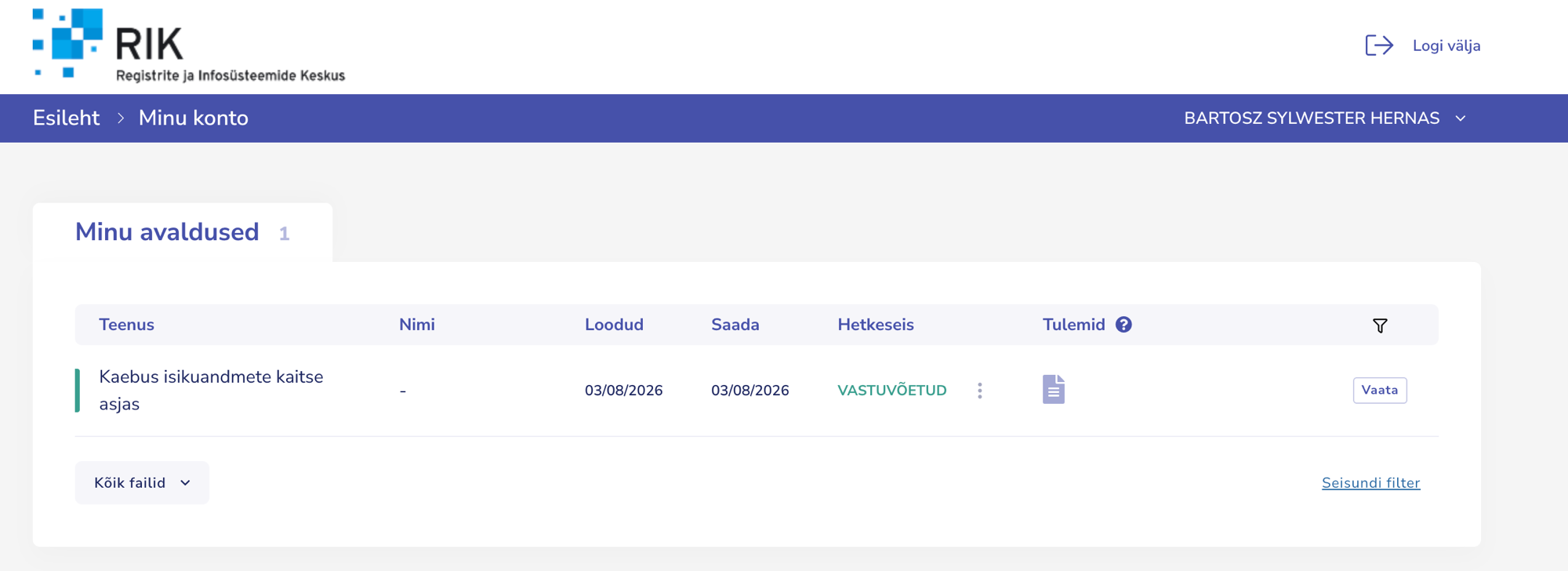
Sūdzībā norādīti septiņi pārkāpumi: neinformēšana par maniem tiesiskās aizsardzības līdzekļiem, nepilnīga piekļuve un neaizstāvama atteikuma pamatojums, viena mēneša termiņa neievērošana attiecībā uz diviem punktiem, ko pieprasīju 1. jūnijā, saņēmēju, glabāšanas termiņa un lēmuma loģikas nesniegšana, automatizēts lēmums 22. panta nozīmē, kas pieņemts bez cilvēka izvērtējuma, manu tiesību īstenošanas neveicināšana un pilnīgs atbildes trūkums uz manu dzēšanas pieprasījumu. Tajā lūgts, lai Inspekcija sadarbotos ar Nīderlandes Autoriteit Persoonsgegevens — Tesla vadošo uzraudzības iestādi ES — 60. panta procedūrā. Iesniedzu to tagad, nevis oktobrī, jo šie pārkāpumi jau ir pabeigti: lai ko Tesla nosūtītu pēc diviem mēnešiem, tas neatcels to, ka mani neinformēja par tiesībām iesniegt sūdzību.
Iesniegta Igaunijas datu aizsardzības iestādē 3. augustā un pieņemta tajā pašā dienā: septiņi apgalvotie pārkāpumi un lūgums iesaistīt Nīderlandes vadošo iestādi. 3. septembrī Inspekcija pagarināja izskatīšanu līdz 5. oktobrim.Lasīt pilnībā
Summary of the complaint
On 1 June 2026 the complainant made a request under Article 15 GDPR for, among other things, the telemetry, diagnostic and event data that Tesla relied upon when it remotely disabled Full Self-Driving functionality on the complainant’s vehicle — functionality purchased for EUR 6,200 — on the stated ground that an unauthorised third-party device had been detected. Tesla supplied only a standard account-data export, which contained none of that data.
On 25 June 2026 Tesla asserted that the request had been “fulfilled on 01/06/2026” and that vehicle data is not associated with the complainant’s identity “by default”. That position is irreconcilable with Tesla’s own conduct. A remote decision to disable a specific feature on a specific VIN, taken because of what Tesla says its systems detected in that vehicle, necessarily involved personal data linked to the complainant. Tesla’s own reply lists “a raised hardware or software issue” as a condition that triggers precisely such linkage. That reply also declined the request without informing the complainant of his right to complain to a supervisory authority or to seek a judicial remedy.
On 1 July 2026 the complainant set out five specific items under Articles 15 and 22 GDPR. On 31 July 2026 Tesla stated that it requires two further months. This complaint is nevertheless lodged now, because the infringements are already complete and do not depend on the outcome of the extension.
The controller’s own notifications
The notification is itself proof of linkage. Tesla could not have generated and sent the email of 8 April 2026 unless the detection event had been transmitted from the vehicle to Tesla and associated there with the complainant’s account and email address. Tesla’s statement of 25 June 2026 that “no one – including Tesla – would have knowledge of your activities” cannot stand alongside a notification that Tesla itself sent to him about an event in his vehicle.
A second Tesla department describes a centrally imposed decision. On 25 June 2026, the same day as the privacy response, Tesla’s Warsaw service centre wrote to the complainant in Polish that “Blokada została nałożona odgórnie i jest software’owa, z powodów bezpieczeństwa po wykryciu modyfikacji systemów FSD” — “the block was imposed centrally and is software-based, for safety reasons, after detection of modification of FSD systems”. A block imposed centrally by Tesla following detection is a decision taken by the controller on the basis of vehicle data attributed to this vehicle and this account. It is not an autonomous act of the car, as the wording “your vehicle has detected” implies.
The notifications were dispatched in bulk. An identical notification was sent twenty-three seconds later, at 23:00:23 UTC on 8 April 2026, in respect of a different vehicle, to a further email address controlled by the complainant. The complainant advances no claim in respect of that vehicle or its owner and refers to it only as evidence that these notifications, and the disablements they announced, were dispatched as an automated bulk action rather than following any individual assessment of the vehicle concerned.
Infringements alleged
Article 12(4) — failure to inform of remedies. Tesla’s reply of 25 June 2026 declined to provide the data requested but did not inform the complainant of the reasons for not acting, of the possibility of lodging a complaint with a supervisory authority, or of seeking a judicial remedy. This infringement is complete and is unaffected by the extension of 31 July 2026.
Article 15(1) and 15(3) — incomplete access, and an untenable ground for withholding. A generic account-data export was supplied in place of the personal data actually identified in the request, and Tesla declared the request “fulfilled”. Data that has in fact been linked to the complainant and used to take a decision affecting him is personal data within Article 4(1) and cannot be withheld on the ground that linkage does not occur “by default”.
Article 12(3) — failure to respond within one month as to items 1 and 2. The telemetry data and the dates and times of its processing fell due on 1 July 2026. No extension was notified within that period. These items remain outstanding.
Article 15(1)(c), (d) and (h) — failure to supply required accompanying information. Recipients, retention period, and information on the logic of the automated decision were all requested and none has been provided.
Article 22 — automated decision-making. The disablement appears to have been an automated decision producing a significant effect on the complainant (loss of paid functionality valued at EUR 6,200, with no refund and no restoration under warranty). Tesla has provided no information about the logic applied and no meaningful route to human intervention or to contest the decision. The bulk dispatch of identical notifications seconds apart in respect of different vehicles indicates that no individual human assessment preceded the decision.
Article 12(1) and 12(2) — failure to facilitate the exercise of rights. Tesla’s substantive reply restated its general Privacy Notice and redirected the complainant to Customer Support rather than answering the request. Tesla has since attributed the delay to the request having been spread across its own departments, having itself directed the complainant to a further department.
Article 17 — no response to the erasure request. The request of 1 June 2026 for erasure of telemetry data and cessation of further transmission has never been addressed in any reply.
Action requested
- That the Inspectorate register this complaint and investigate it, in cooperation with the Autoriteit Persoonsgegevens under Article 60 GDPR.
- That the Inspectorate find the infringement of Article 12(4) in respect of the response of 25 June 2026, which does not depend on the extension.
- That the Inspectorate order Tesla under Article 58(2)(c) to comply forthwith as to items 1 and 2, which fell due on 1 July 2026.
- That the Inspectorate require Tesla to state, in writing and to the complainant, the specific date by which it will respond and the reasons for the delay required by Article 12(3).
- That, if Tesla has not fully answered items 3 to 5 by the expiry of the extended period, the Inspectorate proceed on those items without requiring a fresh complaint.
- That the Inspectorate require Tesla to provide the information owed under Article 15(1)(h) and Article 22 concerning the logic and criteria of the automated decision to disable purchased functionality.
- That the Inspectorate examine whether Tesla processed vehicle telemetry from the complainant’s vehicle at a time when telemetry sharing was set to opt-out, and on what legal basis under Article 6.
- That the Inspectorate consider whether the practice complained of extends beyond the complainant, Tesla having reportedly applied the same remote entitlement change to a substantial number of other vehicles.
- That the complainant be informed of the progress and outcome of the complaint under Article 77(2).
I confirm that the information given in this complaint is true and complete to the best of my knowledge, and that I have attempted to resolve the matter directly with the controller. — Bartosz Hernas, 3 August 2026, signed digitally (ID-card / Mobiil-ID)
Atveidota burtiski (oriģinālā, angļu valodā) atbilstoši iesniegtajai sūdzībai. Šeit izlaistas daļas ar manu kontaktinformāciju, hronoloģiju, pieciem pieprasītajiem punktiem un pielikumu sarakstu — mājas adrese un tālruņa numurs ir dzēsti visā tekstā, bet pārējais jau ir izklāstīts <a href="#privacy">11. sadaļā</a> un <a href="#deadline">15. sadaļā</a>. Kopā ar to iesniegti divpadsmit pielikumi, tostarp visa e-pasta sarakste.
Divas lietas no šīs sūdzības šajā lapā iepriekš nebija parādījušās, un abas atklājās, vācot pierādījumus. Pirmkārt: paziņojums, ko saņēmu 8. aprīlī plkst. 23:00 UTC, netika nosūtīts tikai man. Identisks aizgāja divdesmit trīs sekundes vēlāk par citu automašīnu uz vēl vienu manu adresi. Lai kas arī pieņēma šo lēmumu, tas gāja pēc saraksta. Otrkārt: 25. jūnijā — tajā pašā dienā, kad privātuma komanda man rakstīja, ka transportlīdzekļa dati nav saistīti ar manu identitāti — Tesla Varšavas servisa centrs man rakstīja, ka „bloķēšana tika uzlikta centralizēti un ir programmatūras līmenī, drošības apsvērumu dēļ, pēc FSD sistēmu modifikācijas atklāšanas." Viena Tesla nodaļa tieši apraksta to, ko otra noliedza.
Inspekcija kopš tā laika ir atbildējusi — ne ar atzinumu, bet ar pašas noteiktu termiņu. 2026. gada 3. septembrī AKI pagarināja manas sūdzības izskatīšanas termiņu saskaņā ar Igaunijas Personas datu aizsardzības likuma 61. panta 2. daļu līdz 2026. gada 5. oktobrim, lai — tās pašas vārdiem — papildus noskaidrotu un izanalizētu lietas izlemšanai nepieciešamos apstākļus. Vēstuli parakstījis vārdā nosaukts iestādes jurists ģenerāldirektora uzdevumā. Tas ir pagarinājums, un es esmu uzrakstījis veselu sadaļu par to, ko nozīmē tādu saņemt, tāpēc ir vērts precīzi nosaukt atšķirību. Šis nosauc normu, uz kuru balstās, min iemeslu, kas attiecas uz lietu, nevis uz iekšējo lietvedības sistēmu, nosaka vienu datumu, un tam ir vārds. Tesla pagarinājums, kas pienāca sešas stundas pēc tam, kad pirmo reizi pieminēju uzraudzības iestādi, neizdarīja neko no tā — 15. sadaļa. Nekas vēstulē neskar sūdzībā lūgto sadarbību ar Nīderlandes iestādi 60. panta kārtībā; uz šo jautājumu, ja vispār, atbilde nāks vēlāk. Tā sarakstam pievienojas ceturtais datums: 11. septembris — noteikumiem, 14. septembris — naudai, 1. oktobris — Tesla atbildei uz iebildumu, un 5. oktobris — uzraudzības iestādes atbildei.
17Spānija: ne e-pasta, ne paziņojuma, mēnešus pēc viļņa
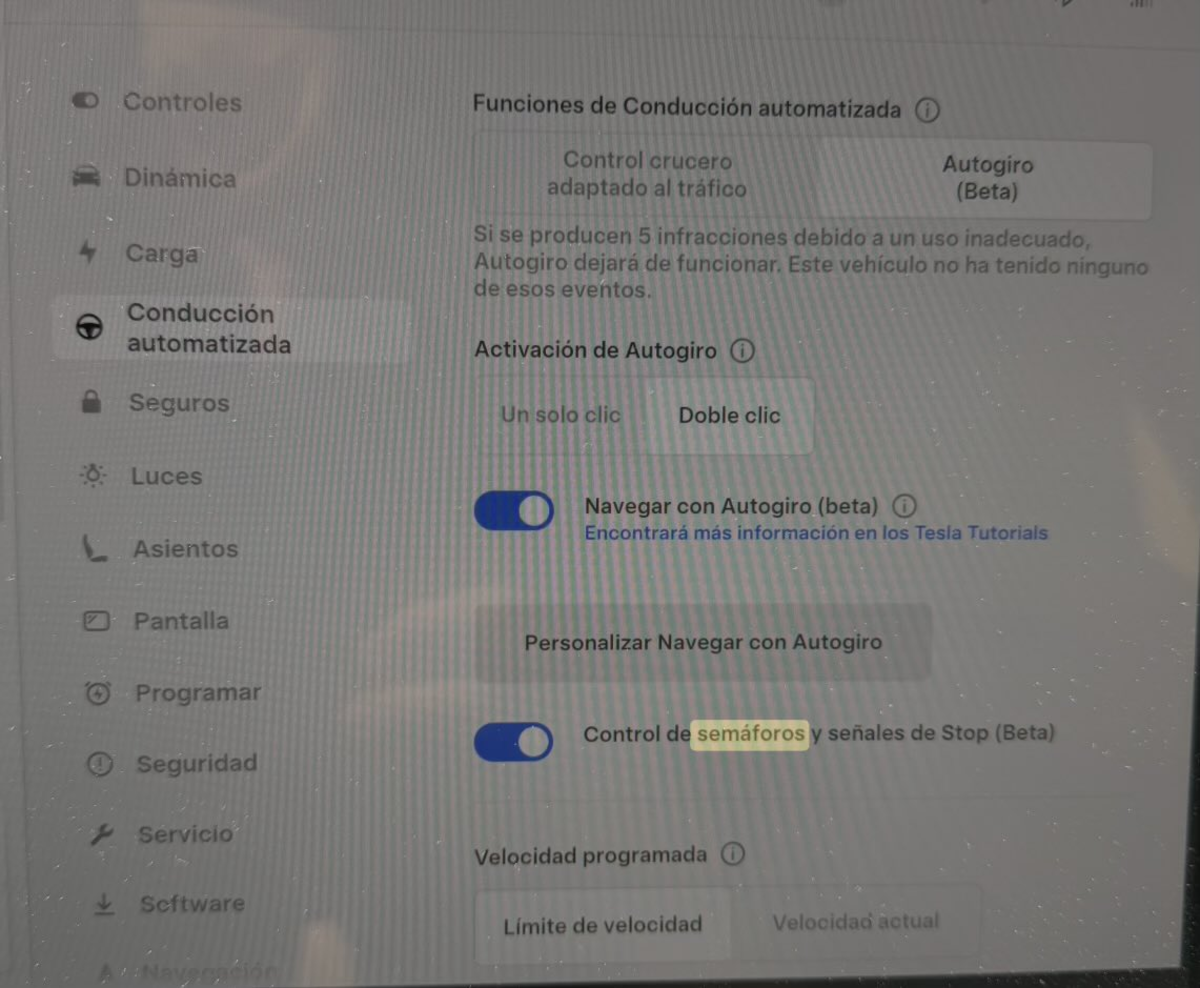
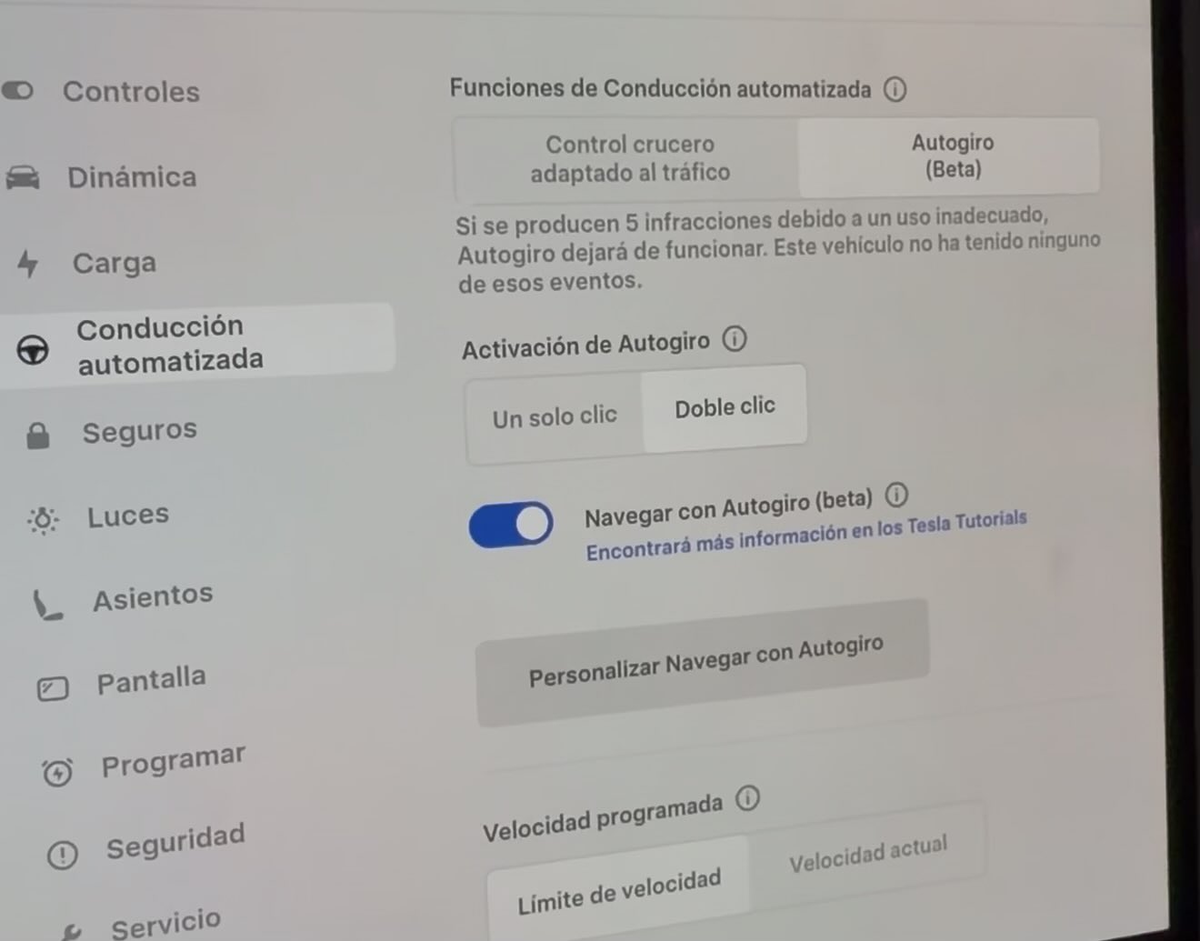
Otrs īpašnieks Spānijā, kurš iegādājās Full Self-Driving pilnā īpašumā — €7,500, uz mūžu. Arī viņa automašīna vairs nebremzē pie sarkanās gaismas un stop zīmēm. Atšķirība ir tajā, kā viņš to uzzināja: viņam vispār netika pateikts. Ne e-pasta, ne paziņojuma automašīnā. Viņš pamanīja, ka mašīna izbrauc pa sarkano, sāka meklēt un atklāja, ka opcija pazudusi no Autopilot iestatījumiem un vispār nav atrodama automašīnas rokasgrāmatās — „it kā nekad nebūtu bijusi". Un tas nenotika aprīlī: viņa vārdiem, „tas notika nesen, nevis mēnešus atpakaļ kā tas „vilnis"".
Pie tā viņu noveda klabošs bagāžnieks. Viņš pieteica servisa apmeklējumu, un darbinieks, kas viņam rakstīja, pajautāja — bez jebkādas saistības, bagāžnieka remonta dēļ — vai viņš ir veicis kādas transportlīdzekļa modifikācijas, uzstādījis trešo pušu lietotni vai novērošanu, iejaucies, lai kaut ko iebūvētu automašīnā, vai mainījis vadojumu. Viņš, pēc paša vārdiem, bija šokā: neviens viņam to nekad nebija vaicājis. Viņš atbildēja godīgi. Viņa automašīnā ir divas lietas: S3XY stalks komplekts — viņa Model 3 Highland tiek piegādāts bez svirām — un pārbūve, lai vadītu tikai ar rokām, ierobežotas kustības dēļ. Abas reģistrētas un legālas jau vairāk nekā divus gadus. Tesla atbildes kopsavilkums bija: „Lūdzu, noņemiet visu, ko iespējams vai kas nav legāls, lai izvairītos no garantijas problēmām."
Pēc tam vairāk nekā stunda telefonsarunas ar viņa reģiona servisa vadītāju, kas deva „nezinu" un „man nav šādas informācijas" — lai gan viņam bija skaidrs, ka vadītājs zina vairāk un nevēlas to teikt. Viņam nosūtīja saiti uz Tesla lapu bez nekā būtiska, pēc tam atzvanīja un pierakstīja citā servisa centrā. Beigās piedāvātā teorija: tā kā S3XY stalks uzstādīšana ir nelikumīga, tā anulē garantiju, un tāpēc Autopilot tika atspējots — bet nākamais atjauninājums to atdos. Šis solījums ir tas pats teikums, ko aprīlī saņēmu es un ko saņēma Korejas īpašnieki, pirms karodziņš divdesmit minūšu laikā nodzisa un atkal iedegās — 14. sadaļa. Bet ko neviens viņam nedod, ir saraksts. Viņa vārds tam: „slepena" izlasīšana pēc patikas.
 2026. gada 28. aprīlis
 2026. gada 7. augusts
„Man nav neviena e-pasta, neviena paziņojuma… nekā. Funkcija vienkārši pazuda, un tas arī viss, klusi."
Otrs īpašnieks, €7,500 par mūža FSD, pazuduši bez neviena e-pasta. Tesla lūdza to pierādīt video, vainoja luksoforu — un tad slēdza viņa sūdzību un izdzēsa pieteikumu no viņa konta.Lasīt pilnībā
Trīs lietas šeit ir sliktākas nekā manā gadījumā. Sviru komplekts, kas uzstādīts automašīnā, kura tiek piegādāta bez svirām, nevar ieslēgt Full Self-Driving — lai kas arī tiktu atklāts, tā nebija atbloķēšana. Viņš nesaņēma nekādu paziņojumu; man vismaz pienāca e-pasts divos naktī. Un tas notika nesen, nevis aprīļa akcijā — kas nozīmē, ka netiek sakārtota kāda sena epizode, bet gan turpinās prakse. Viņš jau ir nosūtījis Tesla garu sūdzību: par kluso funkcijas noņemšanu, par to, ka viņš par to samaksāja, un par atšķirīgu attieksmi pret katru klientu; viņš saka, ka pieprasīs naudas atmaksu, ja nekas netiks atrisināts. Viņa bažas iet tālāk par viņa automašīnu: ja apmaksātas funkcijas var noņemt klusi, kas neļaus nākamajai būt automātiskajai avārijas bremzēšanai?
Tas, kas notika pēc tam, ir vērts izstāstīt pēc kārtas, jo tas vilkās astoņas dienas un beidzās tur, kur negaidīju. Vispirms Tesla lūdza viņam pierādīt zaudējumu. Servisa vadītājs vēlējās video ar trūkstošajiem iestatījumiem — „lai varētu virzīt jautājumu tālāk", viņam teica — tāpēc viņš nofilmēja ekrānu un nosūtīja. Ar to nepietika. Tad viņam lūdza nofilmēt sevi braucot, lai demonstrētu kļūmi satiksmē. Un atpakaļ nākošais skaidrojums mainījās: problēma neesot automašīna, bet vide — viņš mēģinot ieslēgt funkciju apstākļos, kas tai ir pārāk slikti — un vienā brīdī, ka problēma varētu būt pats luksofors. Visu šo laiku serviss turpināja jautāt, kas tieši ir pazudis, lai gan viņu rīcībā bija abi augšā redzamie ekrānattēli. Viena no šīm ziņām viņu sasniedza 21:41, vairāk nekā četras stundas pēc centra darba beigām.
Tad viņš izdarīja viņu darbu pats. 10. augustā viņš devās uz pieteikto vizīti par klabošo bagāžnieku — to pašu sākotnējo. Tehniķis, kas viņu apkalpoja un kas pats no sevis pieminēja, ka pazīst daudzus īpašniekus ar to pašu aksesuāru un bez jebkādām problēmām, ieteica acīmredzamo diagnostiku: ieslēgt servisa režīmu, pārinstalēt automašīnas programmatūru bez jebkā pievienota un pārbaudīt vēlreiz. Viņš tieši tā arī izdarīja un nogaidīja, kamēr automašīna pārinstalē savu programmatūru. Nekas nemainījās. Ne luksofori, ne stop zīmes. Tas, ko viņš pamanīja pēc tam, ir detaļa, pie kuras es atgriežos atkal un atkal: funkcijas vairs nav arī pašas automašīnas rokasgrāmatā — kamēr tā pati rokasgrāmata Tesla lietotnē viņa telefonā to joprojām apraksta, un viņa kontā Full Self-Driving pakete joprojām skaitās viņa. Viņa vārdiem: it kā atjauninājums būtu veikts tikai viņa automašīnai, lai funkcija izskatītos tā, it kā nekad nebūtu bijusi.
Un tad, 11. augustā, pazuda pati sūdzība. Tesla slēdza viņa servisa pieprasījumu un izņēma to no konta vēstures — ne arhivēja, ne atzīmēja kā atrisinātu: lietotnē tā vienkārši vairs nav, it kā nekad nebūtu iesniegta. Viņš piezvanīja servisam, lai pārliecinātos, ka tā nav sinhronizācijas kļūme, un viņam skaidri pateica, ka pieprasījums ir slēgts un, ar viņam sacīto vārdu, „shadowed", noēnots. Sarunu viņš bija ierakstījis, pirms tā pazuda.
„Viņi slēdza manu pieteikumu un izņēma to no vēstures — manā kontā tā nav."
Rakstiskais pamatojums, kad tas beidzot pienāca, bija trešais stāsts. Viņš to atstāsta šādi: darbnīca ir pārbaudījusi transportlīdzekli un vairāk informācijas sniegt nevar; pat homologēta ierīce nav savietojama ar transportlīdzekļa CAN līniju, tādēļ atsevišķas funkcijas varēja tikt ierobežotas Autopilot drošības dēļ, ja uzstādīts neoriģināls aprīkojums; nākamie atjauninājumi funkcijas varētu atjaunot; un pieprasījums tiek slēgts, jo no viņu puses nekādus pielāgojumus veikt nav iespējams. Nolieciet to blakus pamatojumam, kas dots nedēļu iepriekš — ka S3XY stalks uzstādīšana ir nelikumīga un anulē garantiju — un tie nav viens un tas pats apgalvojums. Nevienā no versijām nav nosaukta ne funkcija, ne ierīce, ne datums, ne noteikums. Un abas beidzas ar to pašu teikumu, ko es saņēmu 9. aprīlī un Korejas īpašnieki 30. jūlijā: ka nākotnes atjauninājums to varētu atgriezt. Korejā tieši šī pati tiesība divdesmit minūšu laikā nodzisa un atkal iedegās bez jebkāda atjauninājuma — 14. sadaļa. Viņš ir atkārtoti atvēris lietu un izvirzījis piecus punktus: ka viņa parakstītais līgums pieļauj to, kas viņa automašīnā ir uzstādīts; ka neviens viņu ne par ko nav informējis un tagad viņš pieprasa auditu par visām noņemtajām vai iespējami noņemtajām funkcijām; ka automašīnā nekas nav mainījies starp diviem gadiem bez problēmām un notikumu pirms dažām nedēļām, un ka viss uzstādītais ir homologēts; ka, ja te patiešām runa ir par drošību, lai pasaka, kas tieši nedarbojas — aksesuāri ir noņemti pirms nedēļām, programmatūra pārinstalēta, un tas joprojām nestrādā; un visbeidzot — vai nu funkcijas atpakaļ, vai €7,500 atpakaļ. Viņam teica, ka atzvanīs.
The guy who was typing me said: Did I made any vehicle modifications? Have you got a third party app or monitoring? Did you made any intervention to install something to the car? Did you modified the wiring?
I was shock. They never asked me that and they was saying all the time. And just for a trunk noisy service.
I said the S3XY stalks (model 3 highland stalkless). And a modification to drive with hands only (reduced mobility). All registered and legal for over 2 years.
The summary is: Please remove everything if possible or not legal, to avoid warranty issues.
I have no mail, no notifications… nothing. The function just vanished and that’s it, silently. Even in the car manuals it’s not appearing, like never existed.
And it happened recently. Not months ago like the “wave”.
Basically he said that is it possible that, because installing s3xy stalks it’s illegal, voids my warranty and they disabled the autopilot, and soon in new updates they’ll give me that back.
My car is adapted to a reduced mobility person so it’s not a choice and was fully homologated over 2 years ago.
So angry right now, they are not giving me details, list of what is banned or not, what’s wrong or not, it’s a “secret” cherry pick and it happened. They don’t know anything, poor guys.
It’s so annoying, I’m worried about if they remove functions silently what’s next? Remove automatic brake collision?
Today the service manager asked me to share a video about my autopilot settings missing and I paid for it. He asked me the video in order to keep escalating it.
The Tesla service closes at 17:00. Well the manager wrote me at 21:41. What the hell? He only said: What options you miss.
That guy said the problem is not the car, it’s the environment. I’m trying to activate it without good conditions that’s why it fails. They asked me to record a video driving demonstrating that. Is not enough recording a video showing autopilot options were gone.
They said, maybe the problem is the traffic light which is so baaad.
They keep asking, but what disappeared? I don’t know if more functions disappeared because I had no more pictures from before.
He told me to try: service mode, reinstall car firmware without commander connected, test it. He knows a lot of commanders and no issues.
Nothing, still same. I’ve noticed the option also disappeared on the car manual. But in my iPhone i see the option in the manual and my car has fsd capability package. It’s like they did an update or modification only to my car making it seem like it does not exist.
They closed my ticket and removed it from the history — it does not exist in my account. I called the service and they told me directly that the ticket was closed and “shadowed” which is strange. We ensured it was not an app bug or sync — no, they DELETED the ticket in my app. Thankfully I recorded the whole chat.
Why 2 years ago no and some weeks ago yes? Nothing changed in the car and all features are HOMOLOGATED. Return me the money or the features.
Feels good, they are playing like it’s a video game. Again, not a big deal the features removed, because were shitty, but they opened the door and it’s super annoying while I didn’t sign for that.
Šis ir cita īpašnieka stāstījums par cita īpašnieka automašīnu. Es tajā neesmu sēdējis un neesmu avots. Tas tiek publicēts ar viņa atļauju, pēc viņa lūguma bez identitātes un atrašanās vietas, un viņa ziņas ir atveidotas tā, kā viņš tās rakstīja. Tesla 11. augusta ziņa ir viņa paša angliskais atstāstījums spāņu oriģinālam un šeit sniegta kā netiešā runa, nevis kā citāts. Tesla to visu vienā teikumā varētu apstiprināt vai noliegt.
18Show me the contract
Every refusal I have had in four months rests on the same unstated thing: the terms. So on 11 August 2026 I asked Tesla one question, in writing — which Terms of Service does Tesla say I am bound by? Produce the document. Point at the clause.
It is worth seeing how much has been decided without a document ever being named. The car was reset to its “original configuration” — no clause. An “unauthorized third-party device” justified removing a package I had paid for — no clause. Two service centres called a fault under warranty “not serviceable” — no clause. Tesla Poland wrote that “vehicles acquired second-hand are always outside the scope of our standard processes” — no clause, and no scope, and no process. At no point in four months has anyone at Tesla quoted a single line of a single agreement to me.
And this is the part that sharpens it: I was never given anything to sign. The car reached me through an intermediary rather than across a Tesla counter — no order agreement, no terms of service, no FSD licence, nothing presented and nothing accepted. Whatever Tesla believes binds me, I have not read it, because nobody has ever shown it to me. So I asked for six things: the agreement Tesla says governs us; the legal basis on which it says that agreement reaches me; the version in force on the day the car was registered, with proof of how I was notified or deemed to have accepted it; whether different terms apply because an intermediary was involved; the clause relied on to switch off Full Self-Driving; and the clause relied on to decline to answer or to refund. The letter doubles as an Article 15 GDPR request, which puts a date on it: 11 September 2026.
I am not asking for anything beyond clarity on which specific terms Tesla is relying on: which Terms of Service are being invoked to remotely disable FSD I paid for, and to avoid responding to or refunding affected customers.
I asked Tesla to produce the Terms of Service it says I am bound by, and the clause it relies on. The letter doubles as an Article 15 GDPR request, which puts a date on the answer: 11 September 2026.Lasīt pilnībā
To Tesla Privacy, Resolutions, EU Customer Happiness, and Legal teams,
I am the registered first owner of a Tesla Model Y, VIN XP7YGCEK9SB621959, registered on 05.05.2025, equipped with Full Self-Driving (FSD).
My vehicle was purchased through an Estonian intermediary, rather than directly from Tesla or through a lease/financing arrangement with an Estonian bank. As a result, I have never been presented with, signed, or explicitly accepted any Tesla Motor Vehicle Order Agreement, Terms of Service, or FSD-specific purchase agreement. My understanding of any contractual relationship with Tesla is based solely on Tesla’s general assertion that use of the vehicle constitutes acceptance of unspecified terms.
Given that Tesla has disabled the FSD functionality on my vehicle, I am requesting that you provide me directly with:
- 1. The specific, complete Terms of Service, Motor Vehicle Order Agreement, and/or FSD Purchase/License Agreement that Tesla contends governs my relationship with Tesla as the first registered owner and end user of this vehicle;
- 2. Confirmation of the legal basis on which Tesla asserts these terms apply to me, given that I did not purchase the vehicle directly from Tesla nor sign any agreement with Tesla or a Tesla-affiliated financing entity;
- 3. The version of the FSD terms that was in effect at the time of vehicle registration (05.05.2025), together with any documentation showing how or when I was notified of, or deemed to have accepted, those terms;
- 4. Confirmation of whether any different or additional terms apply because the vehicle was acquired through a third-party intermediary rather than directly from Tesla;
- 5. The specific clause(s) of the Terms of Service Tesla is relying on to justify remotely disabling FSD functionality that I paid for and had active on my vehicle;
- 6. The specific clause(s) of the Terms of Service Tesla is relying on to decline to respond substantively to my prior contact attempts, and/or to decline a refund for the disabled FSD functionality.
This request also constitutes a request for personal data and related processing information concerning me under Article 15 of the GDPR, insofar as it relates to records of my account, my acceptance (or lack thereof) of any agreement, and any internal records associating me with specific contractual terms. Under Article 12(3) GDPR, I expect a substantive response without undue delay and in any event within one month of the date of this email — i.e., by 11 September 2026. If Tesla considers this request complex and intends to invoke the further two-month extension permitted under Article 12(3), please notify me of that fact, and the reasons for it, within the initial one-month period.
Please provide the actual requested documents rather than a general link to Tesla’s public website, since those pages are subject to change and do not establish what applied to me at the relevant time.
For context, I am documenting this dispute publicly at TeslaTookWhatIPaidFor.com, which covers the remote disablement of FSD functionality I purchased. This correspondence, including Tesla’s response or lack thereof, will be published there as part of that record. I am not asking for anything beyond clarity on which specific terms Tesla is relying on: I simply want to know which Terms of Service Tesla is invoking to (a) remotely disable FSD I paid for, and (b) avoid responding to or refunding affected customers.
I look forward to your response within the timeline set out above.
Regards, Bartosz Hernas — [email protected] · VIN XP7YGCEK9SB621959
One correction to my own letter. Its third paragraph is loose about the financing: the car was supplied through the intermediary and, in the end, leased through a partner. I am leaving the sentence as it was sent rather than quietly editing it, and correcting it here instead. It changes nothing about the request — the point is the chain the car travelled down, and that at no stage of it did Tesla present me with an agreement to read, sign or accept.
Reproduced verbatim, as sent, save that the intermediary is not named here.
19142 days later, the switch flips back
On 27 August 2026 my car installed software update 2026.27.100.1. A day later, on 28 August, Full Self-Driving was simply there again — the package restored, announced by nothing more than a notice on the car’s own screen.
That notice was the mirror of 8 April — the same kind of message on the screen that announced the ban — section 3. Except that this time, no email followed. The disablement at least produced one, at two in the morning, citing “safety reasons”; the restoration produced nothing in writing at all. Just the car’s software flags, updated. And note the timing, because it is the sequence Korea saw in July — section 14: the restoration did not arrive with the update, it arrived on its own, about a day after it. Between the update finishing and the package appearing, nothing on my side changed — no visit to a service centre, no inspection passed, no appeal granted. For four months, every refusal rested on the claim that this could not simply be undone — that it needed a firmware release, another department, a process. In the end it was undone the way it was done: a flag, flipped on a server, and 142 days of “not serviceable” ended without anyone having to do anything at all.
Here is what the restoration does not change. Tesla has still not answered a single one of the questions in section 7 — not which device it detected, not who decided, not under which clause, not why two service centres refused a repair under warranty. It has not explained why the package was taken on 8 April, and it has not explained why it came back on 28 August. And it has not offered a cent for the 142 days I was locked out of a safety feature I had paid for in full — the meter above stopped where it stood, at what the lockout cost priced at Tesla’s own subscription rate. Getting back what I already owned is not a resolution. It is the minimum, arriving 142 days late, with no explanation attached.
And the restoration did not reach everyone. As far as I can tell from other owners, the flag flipped back only for cars in regions where FSD is approved. Everywhere else, banned owners are still where I was for 142 days: locked out not just of FSD but of Traffic Light and Stop Sign Control — a feature that is fully legal on any road, that shipped working, and that they paid for. And Tesla has still not answered the question that matters most for them: how were owners informed that this part was being removed — or was it simply assumed they would notice? I was never told that stop-sign recognition was going along with the rest; the 9 April email named no feature at all — section 3. Other owners tell the same story, and some tell it the hard way: I have heard accounts of near-crashes from drivers taken by surprise when a car that had always braked for stop signs stopped recognising them out of the blue. A safety feature does not become less dangerous to remove because it was removed quietly.
One remote flag took the package away. One remote flag gave it back. Neither came with a single answer.
So nothing about the legal route changes. The Article 77 complaint with the Estonian Data Protection Inspectorate stands — section 16 — because the infringements it alleges are already complete, and switching the feature back on un-does none of them. Tesla still owes me the terms it says bind me and the clause it relied on, due 11 September — section 18. Its Data Protection Office still owes me the answers it granted itself until 1 October to produce — section 15; what it sent instead, three days after the restoration, is in section 20. And the question this site opened with is sharper now, not duller: if a feature you paid for can be switched off for 142 days and switched back on overnight — no process, no notice, no accountability in either direction — what exactly do any of us own?
20Install the update
On 31 August 2026, at 20:34, Tesla’s Data Protection Office answered — a month before the deadline it had granted itself. Four claims: no automated decision was made; my access request was “fulfilled” on 1 June and 3 August; the “appropriate software update” has already been made available; and unauthorized devices may, under “our Terms” and “local road authorities,” cost you FSD. Then a bulleted list of how to install the update.
Take the claims in turn. “No automated-decision processing was performed.” Good — then a person did it. Someone at Tesla looked at data linked to my VIN on 8 April, decided a diagnostic reader was “unauthorized,” and signed off on removing a package I had paid for. That rules out Article 22 and makes every other question sharper, not softer: who, on what data, by what criteria. “Fulfilled on 01/06/2026 and 03/08/2026.” The first is the day I made the request — Tesla already claimed that in June, section 11. The second is the day I answered its extension and lodged the complaint with the regulator — sections 15 and 16. On neither day did Tesla send me a byte of vehicle data. “The appropriate software update has already been made available.” It had been installed on 27 August, and the package had come back on 28 August — section 19. Tesla’s first written word on the restoration was a set of instructions for installing an update my car had already installed, arriving three days after the restoration it describes.
Then the terms. “As set out in our Terms and as required by local road authorities, such use may result in the restriction or disablement of certain features.” The word “Terms” is a link to a webpage. Three weeks earlier I had asked Tesla to name the document and the clause — section 18 — and asked, in so many words, not to be sent a general link to the public site, because that page can change and does not establish what applied to me. This is that general link, from the office that owes me the answer by 11 September. As for “local road authorities”: the road authority where my car is registered approved FSD, which is the only reason the package was usable at all, and no road authority I know of has required Tesla to switch off stop-sign recognition on a car with a diagnostic reader in the port. If one has, Tesla can name it. I asked it to.
Tesla’s first written word about the restoration was a set of instructions for installing an update my car had already installed.
Tesla’s Data Protection Office answered a month early: no automated decision, request “fulfilled,” install the update — three days after the package had already come back. I have asked for the 142 days back in money, for the clause, and, separately, for Tesla to stop using my car’s data to decide what I may use.Lasīt pilnībā
Thank you for contacting us. No automated-decision processing was performed on the matter with regard to your reference to Article 15. Our records show that your data subject access request was fulfilled on 01/06/2026 and 03/08/2026, and further show that the appropriate software update has already been made available to your vehicle in connection with the unauthorized third-party device detection dated 8 April 2026.
Please note that the use of unauthorized third-party devices can create a safety risk to the driver and other road users. As set out in our Terms and as required by local road authorities, such use may result in the restriction or disablement of certain features, including Full Self-Driving (FSD), for safety reasons.
Steps to install the software update:
- Connect your vehicle to Wi-Fi
- On the touchscreen, go to Controls > Software, download the available update, then select Install now or schedule installation for a convenient time
- After installation, go to Controls > Self-Driving and enable Full Self-Driving (Supervised)
We apologize for any inconvenience. Should you have any feedback about your experience, please do not hesitate to contact Customer Support.
I confirm that following your last message the Full Self-Driving Capability package has been restored to my vehicle. Thank you.
The restoration is welcome, but it also settles the central point of my complaint: the functionality was Tesla’s to restore at any time, by remote configuration, and was restored once challenged. That confirms it was withdrawn unilaterally and could have been reinstated at any point during the period it was withheld. Restoration therefore resolves the feature, but not the complaint. Two matters remain outstanding, and your last message addressed neither.
1. Reimbursement and compensation
From 8 April 2026 until its restoration — a period of over three months — I was deprived of functionality I had paid for in full. In particular, my vehicle lost Traffic Light and Stop Sign Control: it no longer recognised or stopped automatically at red lights and stop signs. This is a safety-relevant driver-assistance function that was working normally before Tesla’s intervention.
Crucially, I was never informed in advance that this feature would be removed. The remote change was applied first, on 8 April 2026 at 22:27, and only afterwards did I receive an email — which itself did not clearly state that stop-sign and traffic-light recognition specifically would cease to function. I was therefore driving a vehicle whose safety behaviour had been silently altered, without notice. That is the basis of my claim: not an abstract inconvenience, but the uncompensated loss of a paid safety function, removed without warning.
I therefore require:
- (a) Reimbursement for loss of use over the full period. Tesla’s own published subscription price for this functionality is approximately €99 per month, and I ask that reimbursement be calculated on that basis for the entire duration of the deprivation.
- (b) Compensation, separately, for the diminution in value of the vehicle caused by the demonstrated fact that paid features can be and were remotely revoked, and for the time and cost incurred in obtaining a restoration Tesla could have performed at any moment. I invite Tesla to propose a figure; failing agreement, it will be quantified with supporting evidence.
2. The “Terms” you rely upon
Your message states that such use “may result in the restriction or disablement of certain features... as set out in our Terms.” Before Tesla relies on any such Terms, I require you to establish that they bind me at all:
- (i) Identify the exact document and the exact clause relied upon.
- (ii) State when, and by what act, I am said to have agreed to those Terms. I did not agree to any term permitting Tesla to remotely disable a paid safety feature, and Tesla has not shown otherwise.
- (iii) State where, before purchase, it was disclosed that paid features could be remotely disabled over the presence of a third-party device.
A clause a customer never agreed to, and was never shown before purchase, cannot be the basis for removing something that customer paid for.
3. The questions that remain unanswered
My previous letter put eighteen specific questions to Tesla. Your reply answered none of them. The following in particular require a written answer, because they concern whether this will recur, to me or to others:
- (iv) Who authorised the disablement of the paid entitlement, and on what documented evidence? Your latest message states that no automated processing occurred — which means a person made this decision. I ask again who, and on what basis.
- (v) What specifically was the detected device (make and model), and what log or telemetry entry, with timestamp, led to its detection?
- (vi) Who at Tesla determines whether a device is “authorized” or “unauthorized,” by what published criteria, and is there a list an owner can consult in advance? Does Tesla regard a standard CANBUS diagnostic tool, used through the manufacturer’s own diagnostic port, as “unauthorized”?
- (vii) What process does Tesla follow to establish whether the registered owner installed or was even aware of a device before penalising that owner — given that a device may be fitted by a previous keeper, an intermediary, or a workshop without the owner’s knowledge?
Your reference to “our Terms” and to “local road authorities” in the abstract is not an answer. I ask you to identify the specific clause and the specific authority relied upon.
Please respond in writing within 14 days. In the absence of a substantive response on reimbursement, compensation, the basis of the Terms, and the questions above, I will treat the matter as unresolved and escalate to the competent consumer-protection authority. This correspondence forms part of a documented public record at TeslaTookWhatIPaidFor.com. — Bartosz Hernas
Further to my last message, I want to record one point that remains entirely unaddressed.
Tesla states that an “unauthorized third-party device” was detected on my vehicle on 8 April 2026, and that Full Self-Driving was disabled as a result. To this day I have not been given the data that detection was based on. Specifically, Tesla has not identified:
- what data was collected from my vehicle;
- what within that data was interpreted as indicating a device;
- the date, time, and source of that data; and
- the logic or criteria by which that data was judged to indicate an “unauthorized” device.
This is not a new request. I first requested this data on 1 June 2026, and reiterated it on 1 July 2026. The one-month period under Article 12(3) in respect of it expired on 1 July 2026, and no extension was validly notified within that period. It is therefore already overdue, independently of the two-month extension Tesla later purported to take for my other items.
Your reply of 31 August 2026 states that “no automated-decision processing was performed.” If that is correct, then a person reviewed specific data linked to my VIN and account and reached a decision — which makes the underlying data plainly my personal data and plainly disclosable under Article 15. If instead the detection was automated, then Article 15(1)(h) and Article 22 entitle me to meaningful information about the logic involved. Either way, the data and the basis for the decision must be disclosed. They have not been.
Tesla cannot both assert that a device was detected via vehicle data and decline to show me the vehicle data said to have detected it. I therefore repeat my request for the specific telemetry, diagnostic, and event data — with timestamps — that Tesla relied upon to conclude a device was present and to disable the feature I paid for. If Tesla maintains it holds no such data, I require a clear statement to that effect, given that Tesla’s own notification asserts the detection occurred.
This remains outstanding and forms part of the complaint already lodged with the Estonian Data Protection Inspectorate.
Following the remote disablement of paid functionality on my vehicle based on data Tesla collected from it, I am exercising my rights under the GDPR in respect of the personal data generated by my vehicle. This letter concerns the future processing of that data; my outstanding access request regarding the detection of 8 April 2026 remains separate and unanswered.
1. What I am asking
I do not consent to my vehicle transmitting to Tesla, or to Tesla processing, any data that identifies me or that can be linked to me, my account, or my vehicle (including by VIN), beyond what is strictly necessary. In particular, I object to the collection or use of any such data for the purpose of monitoring, detecting third-party equipment, or making decisions that restrict or disable features of my vehicle.
2. The rights I am relying on
- (a) Article 21 — I object to the processing of my personal data carried out on the basis of Tesla’s legitimate interests, including any profiling. This specifically includes processing used to detect “unauthorized third-party devices” and to determine whether to restrict or disable features.
- (b) Article 7(3) — to the extent any processing relies on my consent, I withdraw that consent with effect from the date of this letter.
- (c) Article 18 — I request restriction of processing of the relevant data pending your response to my objection and to my outstanding access request.
3. What I require Tesla to confirm in writing
- (i) A complete list of the categories of data transmitted from my vehicle to Tesla, and for each category, the specific legal basis relied upon (consent, contract, legal obligation, or legitimate interest).
- (ii) For each category relied upon as “legitimate interest” or “contract,” a specific explanation of why it is claimed to be strictly necessary, so that I may exercise my objection meaningfully.
- (iii) Which categories of transmission I am able to disable myself (for example via the vehicle’s data-sharing settings), and confirmation of the effect of disabling them.
- (iv) Confirmation that, following my objection, Tesla will cease any processing of my vehicle data for the purpose of detecting third-party equipment or of restricting or disabling paid features — or, if Tesla refuses, a clear statement of the specific lawful basis on which it intends to continue that processing over my objection.
- (v) Confirmation of whether disabling data transmission affects the vehicle’s functionality or any feature I have paid for, and if so, how.
4. Note
I understand that certain limited processing may be necessary for safety recalls, regulatory compliance, or the basic connected operation of the vehicle. I am not asking Tesla to breach a legal obligation. I am asking Tesla to identify precisely which processing it claims is necessary and on what basis, to stop everything that is not, and in particular to stop using my vehicle’s data to make decisions that take away what I have paid for. Where Tesla asserts a basis that overrides my objection, I require that assertion in writing so that it can be assessed by the supervisory authority.
Please respond within one month, as required by Article 12(3). This matter forms part of the complaint already lodged with the Estonian Data Protection Inspectorate. — Bartosz Hernas, owner, 2025 Tesla Model Y · VIN XP7YGCEK9SB621959
All four letters are reproduced verbatim; greetings and signature blocks have been removed. The correspondence is in English. In Tesla’s message, “Terms” and “Customer Support” are hyperlinks — the first to Tesla’s public terms page, the second to its support page; neither names a document or a clause.
I answered the same evening, and the answer starts from what the restoration proves. The package was Tesla’s to give back at any moment, by the same remote configuration that took it, and it was given back once challenged. So the feature is resolved; the complaint is not. I asked for two things. First, the 142 days back in money — loss of use priced at Tesla’s own subscription rate, the figure the meter above stopped at — and, separately, compensation for what it does to a car’s value when its paid features are shown to be revocable from a server, and for the months spent obtaining a restoration Tesla could have performed in an afternoon. Second, the clause: not a link, but the document, the provision, the act by which I am said to have agreed to it, and where, before purchase, anyone disclosed that a diagnostic reader could cost me a paid safety feature. And once more the questions Tesla has now, by its own account, a named human being able to answer: who decided, what device, what criteria, what process for checking the owner even knew. Fourteen days, so 14 September. A follow-up in the same thread records the item that is not merely unanswered but overdue: the data the detection was based on, first requested on 1 June, due 1 July, and still not produced. Tesla cannot say a device was detected through vehicle data and decline to show the vehicle data. If a person reviewed it, it is my personal data and Article 15 reaches it. If no person did, Article 22 does. There is no third option in which it stays in a drawer.
And on 1 September, in a separate letter, I turned to the mechanism rather than the incident. The package is back; the thing that took it is still running. So I objected under Article 21 to any processing of my car’s data on the basis of Tesla’s legitimate interests, withdrew under Article 7(3) whatever consent Tesla thinks it holds, and asked under Article 18 for the processing to be restricted while it answers. I am not asking Tesla to break a law. I am asking it to list what my car sends, name the legal basis for each item, say which of it I can switch off myself, and stop using the rest to decide what I am allowed to use. Under Article 12(3) that answer is due within a month — on 1 October, the day Tesla already owes me everything else.