De qué trata esto realmente
Olvidemos, por un momento, si lo que hice estuvo bien. Olvidemos si usar el FSD era legal. Ninguna de las dos cosas es lo importante.
Lo que importa es esto: a Tesla no le gustó que modificara un coche que es enteramente mío, así que metió la mano y dejó inservible de forma remota una parte de él. No solo la función que algunos suponen ilegal (no lo es, en vías privadas), sino funciones de seguridad totalmente legales con las que el coche salió de fábrica de nuevas, parte del mismísimo paquete de 6.200 € + IVA que yo había pagado.
Esto no es la tienda de Kindle. No es Steam. Es un coche, un objeto físico que compré y poseo, vendido con una lista de funciones, cada una de las cuales Tesla puede apagar desde un servidor. (Pregunte a quien recuerde el antiguo «Paquete de Invierno».) Incumple las condiciones de Tesla y, en la práctica, el coche se conduce solo de vuelta a la fábrica. Sin reembolso. Decenas de miles de euros, esfumados.
Tesla guarda silencio, pero se comporta como si yo nunca hubiera comprado un coche. Como si solo hubiera obtenido la licencia para usar uno. Así que la pregunta de verdad no es sobre mí. Es sobre todos los que conducimos:
Lo que esto me cuesta
Ya compré el FSD por completo: 6.200 € + IVA, pagados íntegramente. El 8 de abril de 2026 Tesla lo apagó de forma remota, y desde entonces mi coche no se detiene ante los semáforos en rojo ni las señales de stop, funciones que pagué y que ya no puedo usar. Cada mes me cuesta el precio de la suscripción que ni siquiera debería necesitar, y no hay ninguna suscripción que cancelar para que pare.
01Lo que compré
En el sistema de pedidos de Tesla, el paquete de Capacidad de Conducción Autónoma Total figuraba a 6.200 € (neto, sin IVA). Lo pagué. La captura de pantalla de abajo es exactamente lo que compré.
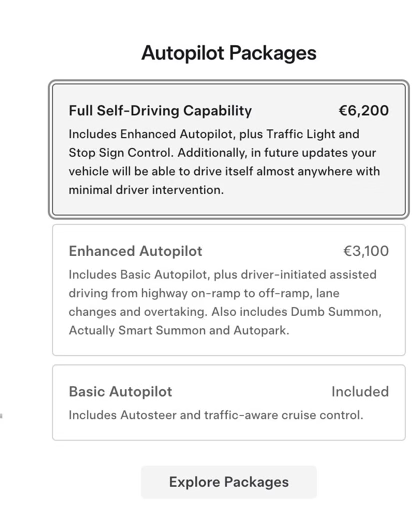
Esa última línea importa. El control de semáforos y señales de stop era para mí una función de seguridad genuina: detiene el coche automáticamente en semáforos en rojo y señales de stop. A día de hoy, la aplicación móvil oficial de Tesla sigue indicando el paquete de Capacidad de Conducción Autónoma Total como incluido en mi vehículo.
02Funcionó, durante meses
Tras la entrega usé las funciones anunciadas del paquete por toda Europa. El control de semáforos y señales de stop operaba junto al Autopilot, plena y fiablemente. El coche funcionó sin problemas durante meses.
El coche es enteramente mío; no lo tengo en renting de Tesla. Sostengo que tengo derecho a modificar un coche que poseo, igual que podría montarle llantas a medida, un kit de carrocería o una suspensión nueva, sin que el fabricante me penalice por ello.
Las «modificaciones», al detalle
Usé dos dispositivos de diagnóstico CANBUS: «Commander» de enhauto.com y un dispositivo llamado «Cybertool». Ninguno modifica el coche ni su software. Se conectan únicamente al puerto de diagnóstico CANBUS estándar —la misma interfaz que los fabricantes proporcionan para el diagnóstico— y envían comandos que el vehículo ya admite.
Por ejemplo, Commander hace que los LED del interior se pongan azules cuando el Autopilot está activado. El coche lee una señal admitida, envía un comando admitido, y el color cambia. Si el coche no admitiera ese comando, no pasaría nada. Ninguna PCB alterada. Ningún componente cambiado. Ninguna pieza original modificada. La propia Tesla declara públicamente que el software del vehículo es inalterable por terceros.
Cybertool funciona igual. Del mismo modo que Commander le dice al coche que ponga azules los LED del interior, Cybertool le envió al coche un comando que ya admitía: activar el paquete Full Self-Driving en las regiones donde Tesla aún no lo había habilitado. No desbloqueó nada nuevo: simplemente encendió la función para la que mi coche fue fabricado y que yo ya había pagado. El coche admite un comando o no lo admite; el mío lo admitía, porque el paquete estaba licenciado para él.
Esto es del mismo tipo de acción que Commander al desactivar el aviso sonoro de la marcha atrás, algo que Commander hace abiertamente, pese a que ese aviso es obligatorio en la UE. Y para ser del todo justos: el Full Self-Driving aún no está aprobado para vías públicas en todas las regiones, igual que un escape ruidoso o unos neumáticos lisos no están homologados para circular. Eso no hace que el propio equipamiento sea ilegal: puedes usar neumáticos lisos y un escape ruidoso en un circuito. Habilitar una función para la que el coche fue fabricado y pagado no es lo mismo que infringir la ley con ella: dónde y cómo se usa es responsabilidad del conductor, no algo que decida un comando de diagnóstico.
Ningún sistema de seguridad —ni de hardware ni de software— ha sido modificado en modo alguno.
03Lo que ocurrió
El 8 de abril a las 22:27, mi coche recibió una actualización remota de configuración del paquete a través de Tesla Cloud Config. En la práctica, Tesla le indicó remotamente a mi coche que el paquete de 6.200 € + IVA nunca se había comprado.
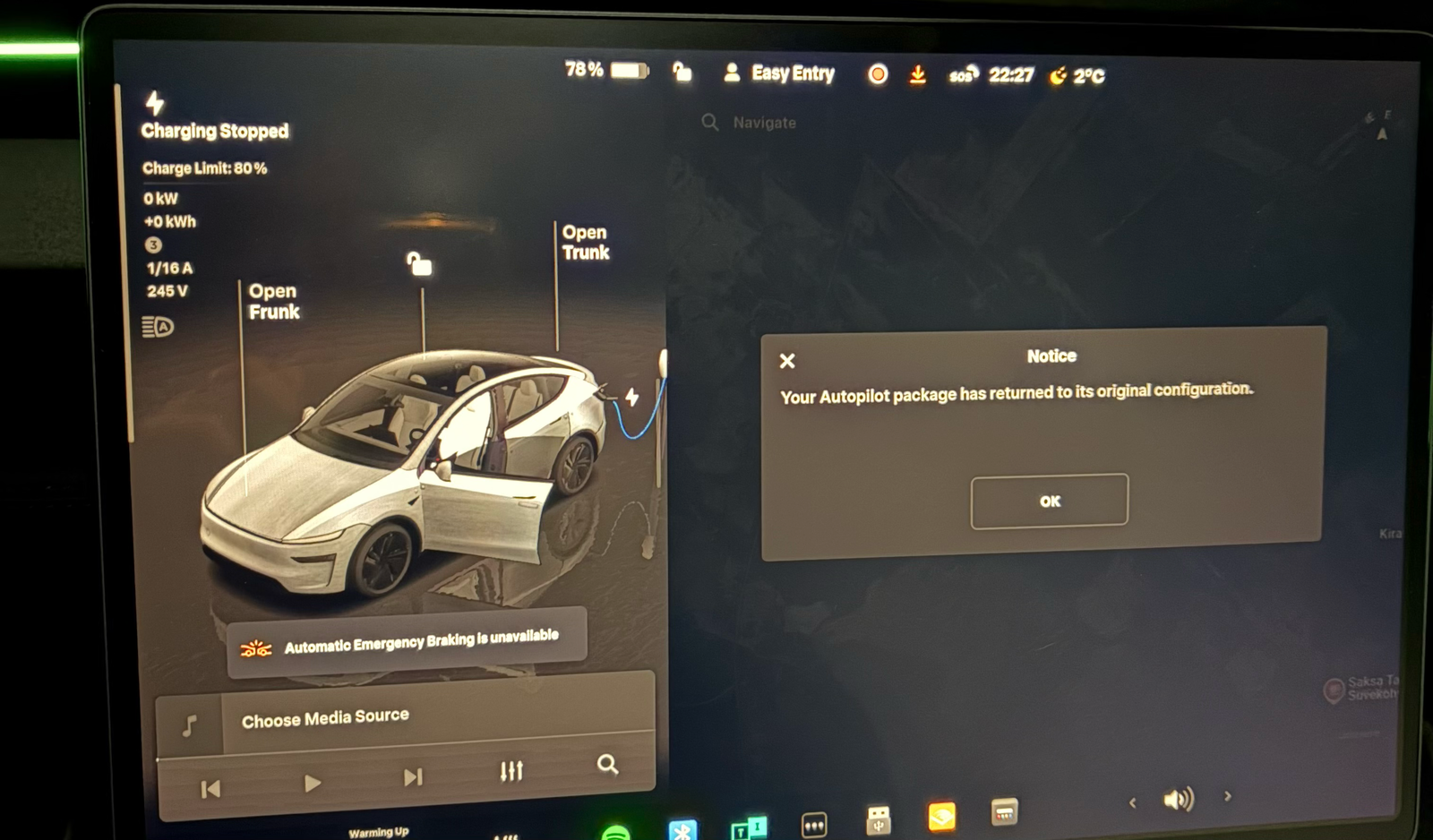
Unas tres horas después, a las 02:00, llegó este correo electrónico.
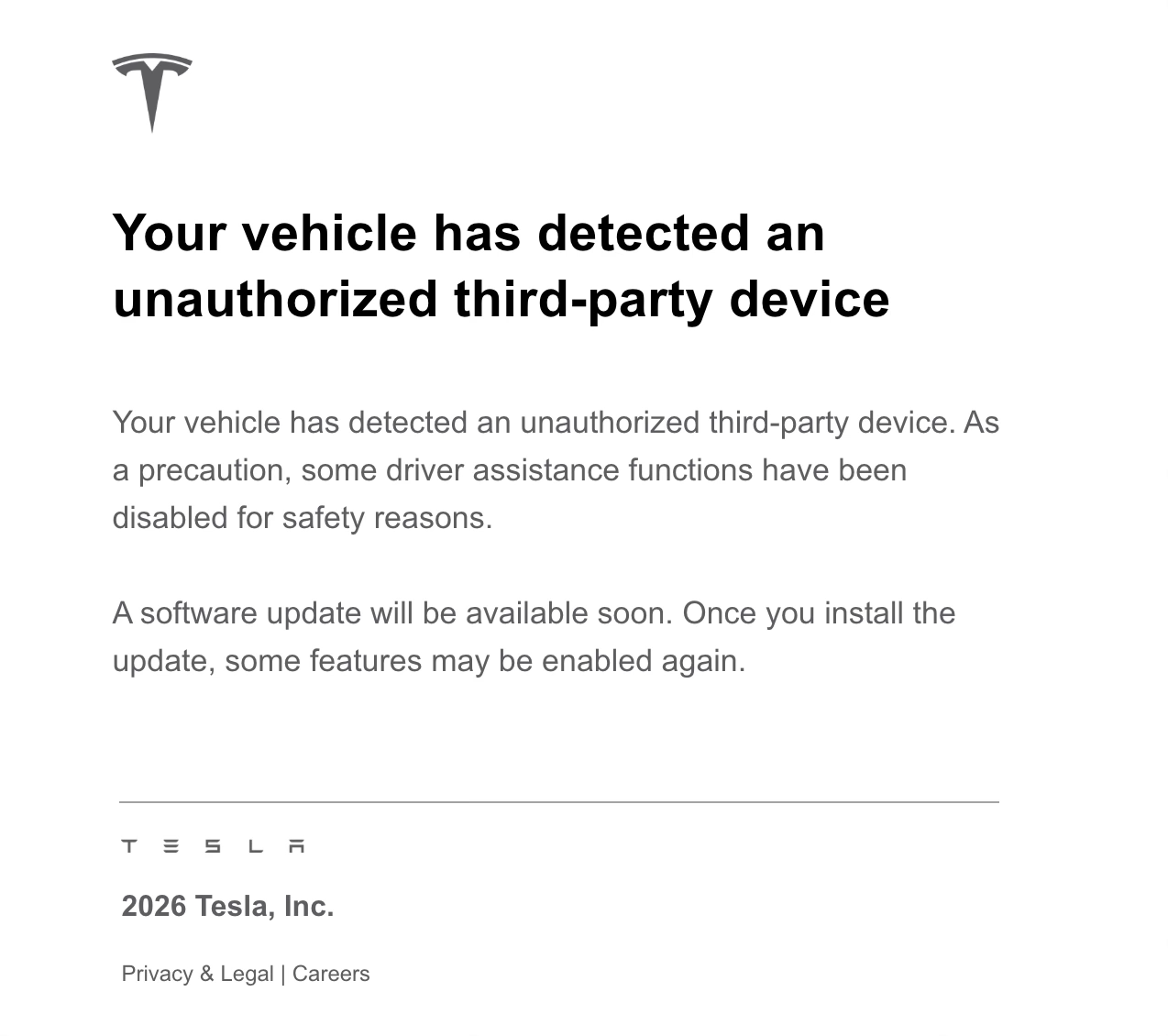
Es notablemente vago. No dice qué dispositivo se detectó, cuál era el riesgo de seguridad, durante cuánto tiempo se desactivarían las funciones, ni siquiera si volverían. Y la expresión me desconcierta: dispositivo de terceros no autorizado; ¿no autorizado por quién? Todos los dispositivos de mi coche fueron autorizados por su propietario. Yo.
04La contradicción
La aprobación del FSD se fue desplegando por toda Europa: primero los Países Bajos, luego Lituania, después Estonia el 29 de mayo (donde está matriculado mi coche), y Bélgica a continuación. Mi coche recibió la actualización 2026.17.5, que habilita el nuevo sistema. Este era el momento en que mi inversión por fin debía dar fruto.
En cambio, el coche me ofrece un botón de «Suscribirse», como si nunca lo hubiera comprado.
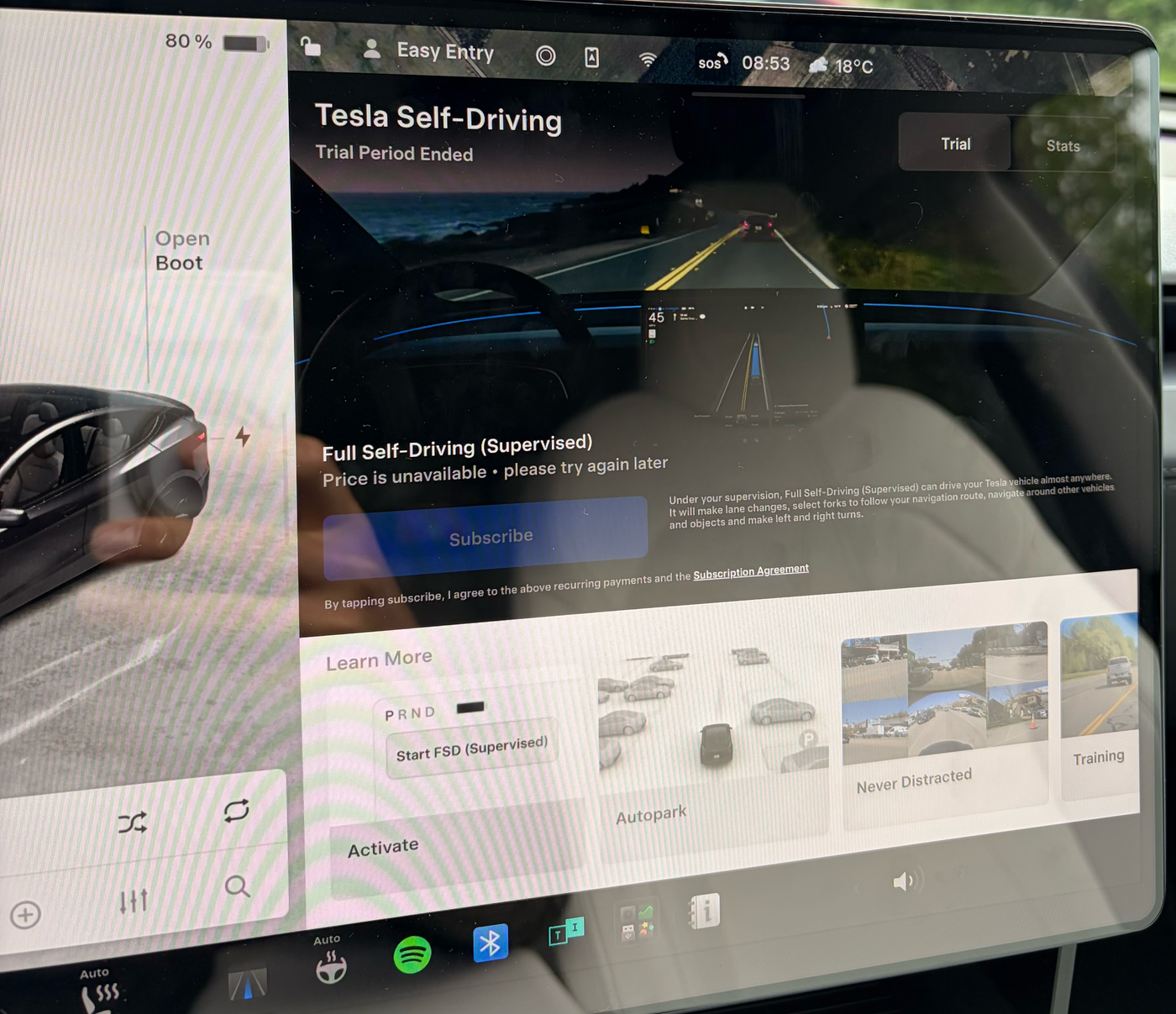
Pagué 6.200 € + IVA por un paquete. El coche confirma que el paquete está «Incluido». Y ese mismo coche se comporta como si nunca se hubiera comprado.
05Cómo sabe el coche lo que tiene
Todos los Tesla salen con el mismo software y el mismo conjunto completo de capacidades. Las funciones individuales se encienden o apagan de forma remota a través de «Tesla Cloud Config», vinculado a tu coche concreto. Es el mismo mecanismo que en su día permitió a Tesla vender coches con el hardware de los asientos traseros calefactados físicamente presente pero desactivado, y que después permitió a los propietarios pagar en línea para desbloquearlos.
Es también como Tesla distingue el Autopilot básico del Enhanced Autopilot y del Full Self-Driving. La distinción es puramente definida por software. Lo que significa que una función que pagaste puede revocarse con un solo indicador remoto: exactamente lo que me ocurrió a mí.
06Se denegó el servicio en garantía
Mi coche está en garantía, así que contacté con los centros de servicio de Tesla en Turku, Finlandia y Varsovia, Polonia. Ambos confirmaron que la funcionalidad no funciona. Ambos confirmaron que el coche está en garantía. Ambos rechazaron la reclamación, diciendo que «no es reparable» porque el coche fue desactivado intencionadamente «por motivos de seguridad».
El centro finlandés me dijo que no podían reactivar la función aunque el dispositivo se hubiera retirado, porque «podría volver a instalarlo». Con esa lógica, ¿por qué no desactivar la función en todos los Tesla, ya que cualquier coche podría llevar montado un dispositivo así?
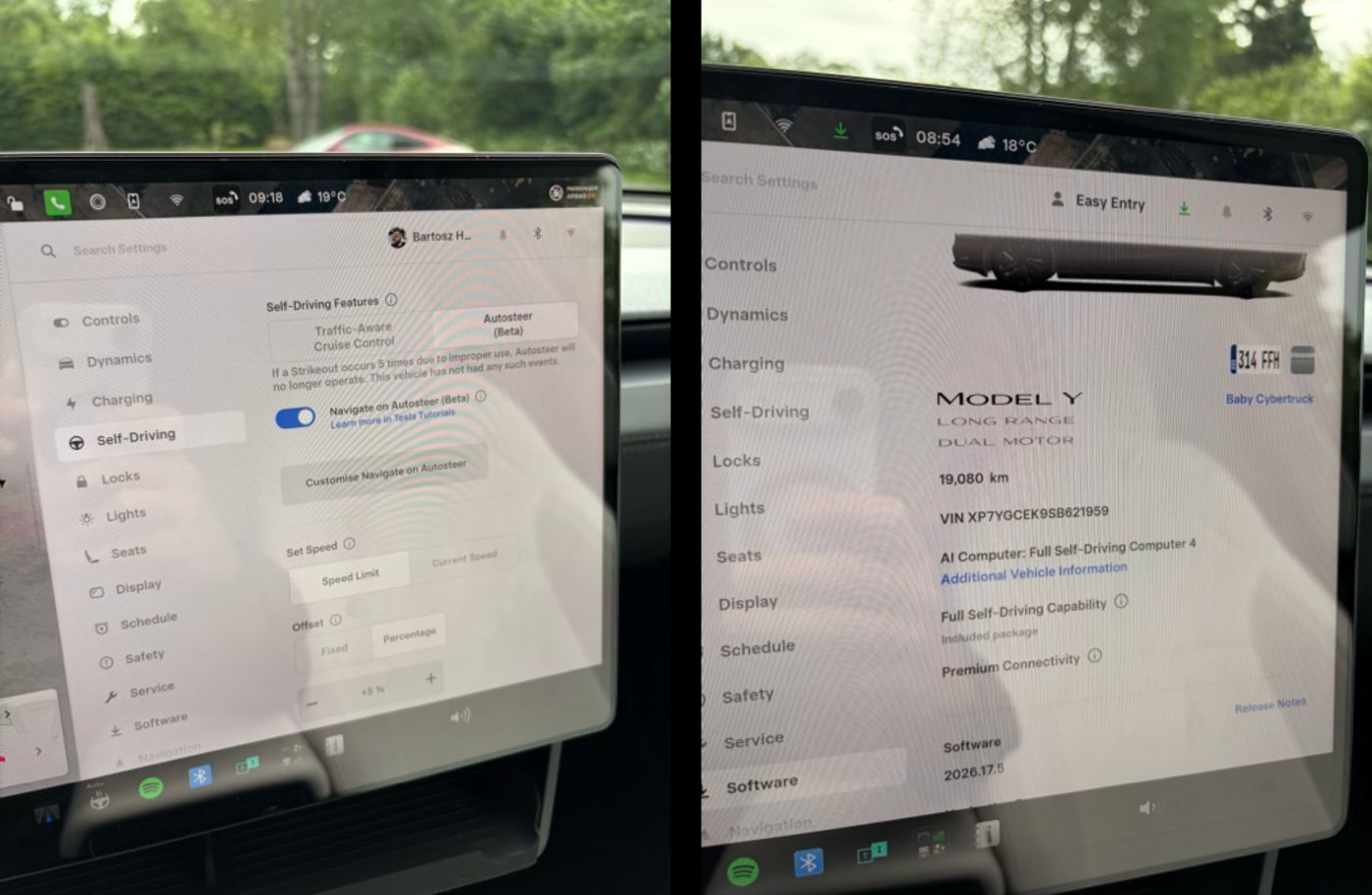
Me veo incapaz de encontrar ninguna explicación que no sea esta: los «motivos de seguridad» citados en realidad reducen mi seguridad. Durante ocho semanas mi coche no pudo detectar señales de stop ni semáforos, una funcionalidad de la que había llegado a depender.
07Las preguntas que Tesla no quiere responder
Le planteé estas preguntas a Tesla y a sus centros de servicio. Siguen sin respuesta. Las he agrupado por temas.
A La denegación de la garantía
B La decisión de desactivar
C Los supuestos «motivos de seguridad»
D La restauración de las funciones pagadas
E Compensación
F Política sobre modificaciones y dispositivos de terceros
Solicité una respuesta por escrito en un plazo de 14 días, abordando cada punto. Sigo esperando.
08No soy anti-Tesla
Creo de verdad en esta tecnología. Compré dos Tesla y pagué por adelantado 12.400 € + IVA en total a cuenta de la promesa del FSD. Esa promesa tardó tanto en materializarse que vendí uno de los coches, perdiendo el valor del paquete que llevaba.
Ahora por fin tengo un coche que funciona, con el FSD comprado, en un país que permite el FSD. Y Tesla me impide deliberadamente usar lo que pagué. Solo quiero la función que compré, una respuesta a mis preguntas, y que esto no le ocurra calladamente a nadie más.
09Cronología
- 2025Compro un Model Y de 2025 como primer propietario con Capacidad de FSD — 6.200 € + IVA.
- Meses tras la entregaLas funciones de FSD, incluido el control de señales de stop y semáforos, funcionan de forma fiable por toda Europa.
- 8 Apr 2026 · 22:27Actualización remota de Cloud Config: «Tu paquete Autopilot ha vuelto a su configuración original». Funciones perdidas.
- 9 Apr 2026 · 02:00Tesla envía un correo sobre un «dispositivo de terceros no autorizado» desactivado «por motivos de seguridad».
- 8 semanasNinguna información adicional. Se retira el dispositivo de diagnóstico; no queda ningún dispositivo de terceros en el coche.
- 29 May 2026Estonia —donde está matriculado mi coche— aprueba el FSD en vías públicas (después de los Países Bajos y Lituania, antes que Bélgica). Llega la actualización 2026.17.5.
- 15 jul 2026Instalo el software 2026.21.100: el FSD sigue sin funcionar. Envío a Tesla una reclamación formal y un requerimiento de restauración, reembolso e indemnización.
- 30 jul 2026En Corea, coches con HW3 bloqueados recuperan el paquete completo y lo pierden de nuevo veinte minutos después, en remoto y sin ninguna actualización.
- 31 jul 2026Seis horas después de anunciar que acudiré a un regulador de protección de datos, la Oficina de Protección de Datos de Tesla se concede dos meses más — véase la sección 15.
- 3 ago 2026Respondo a la prórroga y presento una reclamación del artículo 77 del RGPD contra Tesla ante la Inspección de Protección de Datos de Estonia. Admitida ese mismo día — sección 16.
- 11 ago 2026La reclamación de un segundo propietario por su paquete retirado en silencio se cierra — y el ticket se borra de su cuenta de Tesla — sección 17.
- AhoraEl coche ofrece un botón de «Suscribirse» para un FSD que dice estar «Incluido». Dos centros de servicio rechazan la reparación en garantía.
10Tesla respondió. Esta es mi respuesta.
El 30 de junio de 2026, Tesla Poland respondió a mi reclamación. No contestó ni una sola de mis preguntas, pero sí hizo cuatro afirmaciones que merecen respuesta. Aquí está su carta y mi respuesta, íntegras.
La respuesta de Tesla esquivó todas las preguntas. Mi réplica punto por punto, y las preguntas que siguen sin respuesta.Leer íntegro
Dear Mr. Hernas,
Thank you for your email and for the questions you have raised.
At the outset, we would like to note that, in the absence of any site visits carried out and any information on file regarding you, we do not see grounds to address the questions listed above.
The vehicle was purchased by you from a third party. In your message you stated that you are the first owner, which is not consistent with our records. Vehicles acquired second-hand are always outside the scope of our standard processes.
Given that the vehicle is registered in our system as being in Estonia, we ask that you await a response from the appropriate department.
Sincerely,
Tesla Poland
Thank you for your reply. With respect, it does not answer any of the questions I raised, and several of its statements are either factually incorrect or contradict Tesla’s own instructions to me. Let me address each point.
“In the absence of any site visits and any information on file regarding you, we do not see grounds to address the questions.”
That is exactly the problem: no site visit has taken place because Tesla has not carried one out. When I approached the service centres in Turku and Warsaw to have the car repaired under warranty, both confirmed the features do not work and that the car is under warranty — yet both declined to proceed, so no inspection ever happened. You cannot refuse to examine the car and then cite the absence of an examination as the reason you cannot answer my questions. I am asking for written answers to written questions; a site visit is not a precondition for that. And if you do require one, name the centre and the date, and I will attend.
“Given that the vehicle is registered as being in Estonia, await a response from the appropriate department.”
Estonia has no Tesla service centre. Tesla’s own guidance is to use any service centre in the EU — which is exactly what I did, having serviced this car in Finland several times. Please name the “appropriate department” and give me its direct contact details; I cannot await a response from a department no one will identify. Your phrasing also implies you are tracking the car’s current location. I have disabled data sharing — so I am formally requesting, under Article 15 GDPR, all location data Tesla holds on this vehicle and the legal basis for collecting it.
“You stated you are the first owner, which is not consistent with our records.”
I am the first registered owner. The car was acquired through an intermediary for leasing, but I am the first owner named on the official EU registration documents. Tesla’s internal records do not determine legal ownership — the registration does. If your records say otherwise, send me the record you are relying on so the discrepancy can be corrected.
“Vehicles acquired second-hand are always outside the scope of our standard processes.”
Please state, in writing, what this means. Are you saying that a change of ownership voids the warranty? If so, cite the exact clause. Under EU consumer law the warranty attaches to the car, not to the owner, and transfers with it on resale. A warranty that can be switched off because a car changed hands is not a warranty.
Y las preguntas que siguen sin respuesta:
- The exact warranty clause that excludes this fault from coverage.
- Who authorised the remote disablement, on what documented evidence, and on what legal basis.
- What the “unauthorized third-party device” was — make, model, log entry, and timestamp.
- The specific safety risk the device is alleged to have created, with documentation.
- The date by which the paid features will be restored, and the formal appeals process.
- The compensation Tesla will provide for the period the paid features were disabled.
I reiterate my request for a written response addressing each point within 14 days. Absent that, I will treat this as Tesla’s final refusal and escalate to the relevant consumer-protection and data-protection authorities. — Bartosz Hernas
Ambas cartas se reproducen textualmente. La correspondencia original está en inglés; los datos personales (domicilio) se han ocultado.
11La vía de la protección de datos
No hay forma de llegar a nadie en Tesla por encima del centro de servicio —ni un correo, ni un nombre, ni una vía de escalado— y los centros de servicio me dijeron sin rodeos que no pueden hacer nada. Así que usé el único canal que Tesla está obligada a responder: la protección de datos. Al amparo del RGPD presenté una solicitud de acceso por parte del interesado a la telemetría que Tesla usó para desactivar el paquete que pagué. Aquí está ese intercambio, íntegro. No acabó ahí: la sección 15 cuenta lo que vino después.
Una solicitud de acceso al amparo del RGPD sobre la telemetría que Tesla usó para desactivar el FSD, y la respuesta de Tesla que afirma no conservar tales datos.Leer íntegro
I would like to reiterate that I would also like to have any telemetry data you used to deny my warranty claims.
My car has the Full Self-Driving package purchased, and this package has been illegally disabled by a remote configuration change — in effect tricking the car into thinking FSD had never been purchased.
I have lost legally available, previously working functionality: Traffic Light Awareness on Autopilot. This was part of a €6,200 extra payment. It was remotely disabled, with no refund.
Your reasoning was that your telemetry discovered a third-party device — even though on the day it was disabled I had telemetry opt-out enabled in my car. I would therefore like all the data associated with that telemetry.
I would also like to know whether the Tesla cars you sell are owned by their owners (me), or whether they are rented/subscribed to but owned by Tesla. If I own the car, I would like Tesla not to tell me what I can and cannot do with a car I paid full price for.
I want to ensure there are no future violations of my privacy: please remove all telemetry data sent from my cars to your servers, and ensure no future telemetry data is sent out, on all cars of which I am the owner.
I need this data to follow up on the loss of value of the car following the remote bricking of legal functionality, and Tesla’s full denial of my warranty claim to restore the car to full functionality.
Thank you for contacting us. Our records indicate that your access request was fulfilled on 01/06/2026. As described in our Privacy Notice, from the moment you take delivery, Tesla does not associate the vehicle data generated by your driving with your identity or account by default. As a result, no one – including Tesla – would have knowledge of your activities. In order for vehicle data to be linked to your account or VIN, a specific condition must be triggered such as the occurrence of a safety event (collision or airbag deployment), service or repair appointment, a raised hardware or software issue, or your consent – in which case it is provided as part of your data request.
Additionally, Tesla’s retention guidelines and data privacy practices implement techniques designed to minimize how much data we collect, use, or store.
When data isn’t provided, this is because it is either: in a form that is not personally identifiable or linked to your Tesla Account; stored in an end-to-end encrypted format that Tesla cannot decrypt; or not customer-related.
Note: Some data may have also been held only for a very short time and is no longer on our servers.
Thank you for your response of 25 June 2026. I am writing to dispute the completeness of my access request and to make a further, specific request under Articles 15 and 22 of the GDPR.
Your response states that Tesla does not associate vehicle data generated by driving with my identity or account “by default,” and that linkage only occurs when a specific condition is triggered — including “a raised hardware or software issue” or “your consent.”
This is directly contradicted by Tesla’s own prior written communication to me, in which Tesla stated that an unauthorised device was detected in my vehicle and that Full Self-Driving was consequently disabled. That detection and that decision necessarily relied on vehicle telemetry linked to my specific VIN and account. By your own framework, this is exactly the kind of “specific condition” that triggers linkage — meaning the underlying data exists, is associated with my identity, and falls squarely within the scope of my access request.
Los datos que solicité, y que no se facilitaron:
- All telemetry, diagnostic, and event data from my vehicle (VIN XP7YGCEK9SB621959) that Tesla used, referenced, or relied upon to detect the alleged unauthorised device and to disable functionality. This is personal data under Article 4(1).
- The specific date(s) and time(s) this data was collected and processed.
- Under Article 15(1)(h) and Article 22, meaningful information about the logic involved in the automated decision to disable functionality, including the criteria used to classify a device as “unauthorised.”
- Under Article 15(1)(c), the recipients or categories of recipients to whom this data has been or will be disclosed.
- Under Article 15(1)(d), the retention period applied to this category of data, and confirmation of whether it is still held.
Article 15 does not permit a controller to withhold data on the basis that it is “not provided by default.” Where data has in fact been linked to my identity and used to make a decision affecting me, it is personal data and must be disclosed. If Tesla maintains that any of the requested data is not held, I request a clear statement to that effect for each item, together with the legal basis. — Bartosz Hernas
Las tres cartas se reproducen textualmente. La correspondencia está en inglés; los datos personales (domicilio) se han ocultado.
12Cómo se ejecuta la desactivación
Otro propietario que acabó en la misma situación se puso en contacto conmigo con el detalle técnico de cómo se le hace esto realmente al coche. A través de su propio método para habilitar el FSD, también pudo registrar —aunque no interceptar— la interacción de Tesla con el vehículo. El 8 de abril de 2026, hacia las 11:00 PST, su coche recibió una petición de teleforce para actualizar la configuración de su gateway. Se reproduce a continuación con las propias ocultaciones del contribuidor: cada XXX es suyo.
El comando en bruto de configuración del gateway de teleforce que otro propietario capturó: los bytes exactos que apagan el FSD, con una firma criptográfica.Leer íntegro
odin.core.engine.handlers.message_handler - INFO - received request, request_id: XXX, product_id: XXX, message_type: command, response_topic: vehicle_service.mothership-dub_worker.teleforce, request: {'command': 'execute', 'token': {'user': 'sa-teleforce', 'principals': ['authenticated', 'tbx-service', 'tbx-internal', 'tbx-mothership', 'tbx-service-engineering', 'tbx-technical-specialist', 'odin-service-repair-and-maintenance', 'odin-service-security-operations', 'odin-research-and-development-level1', 'odin-software-update-management-system', 'odin-service-robotaxi', 'tbx-robotaxi-data'], 'product_id': 'XXX', 'expires_at': '2026-04-XXX0'}, 'tokenv2': {'token': {'user': 'sa-teleforce', 'principals': ['authenticated', 'tbx-service', 'tbx-internal', 'tbx-mothership', 'tbx-service-engineering', 'tbx-technical-specialist', 'odin-service-repair-and-maintenance', 'odin-service-security-operations', 'odin-research-and-development-level1', 'odin-software-update-management-system', 'odin-service-robotaxi', 'tbx-robotaxi-data'], 'product_id': 'XXX', 'expires_at': '2026-04-XXX0'}, 'intermediate_certificate': '-----BEGIN CERTIFICATE-----\nMIICGjCCAb+gAwIBAgIIWE8E/tPO4rYwCgYIKoZIzj0EAwIwJDEiMCAGA1UEAwwZ\nVGVzbGEgU2VydmljZXMgQ29tbWFuZCBDQTAeFw0yNjA0MDgxMjUwMjhaFw0yNjA0\nMTgxMjUwMjhaMIGJMSowKAYDVQQDDCFpbnRlcm5hbC5vZGluLnByb2QudGVzbGEu\nc2VydmljZXMxFTATBgNVBAsMDFRlc2xhIE1vdG9yczEOMAwGA1UECgwFVGVzbGEx\nEjAQBgNVBAcMCVBhbG8gQWx0bzETMBEGA1UECAwKQ2FsaWZvcm5pYTELMAkGA1UE\nBhMCVVMwWTATBgcqhkjOPQIBBggqhkjOPQMBBwNCAARLEFIVmg4s93fAU9tFTuQy\nHiQYr9EBoIL8V7Pwhzg8TmBXtNucZkAT+VOJS9ua2NgXf2UL5bco9MXPoMn75gTo\no3UwczAdBgNVHQ4EFgQUEtro+JN4/jwURhxoYNqw4p9AOq0wDAYDVR0TAQH/BAIw\nADAfBgNVHSMEGDAWgBSEHWFVJ3GUwSiIrRJlO681Ad5DxTAOBgNVHQ8BAf8EBAMC\nBeAwEwYDVR0lBAwwCgYIKwYBBQUHAwMwCgYIKoZIzj0EAwIDSQAwRgIhAMOT6W/2\naOZri1Nebjaw6H8Blyjz/0YE2d54kiTyMlfEAiEA+hmbXXD2NDMdHnA+ABcT25dY\nZFGU6Ilvv/0eTms8GyQ=\n-----END CERTIFICATE-----\n'}, 'args': {'name': 'PROC_ICE_X_SAFE-SET-VEHICLE-CONFIGS', 'kw': {'configParams': [{'configid': 29, 'data': '02', 'signature': '50XXX07'}, {'configid': 88, 'data': '0200000000', 'signature': '50XXX0f'}], 'configs_require_ice_reboot': []}}, 'allow_concurrent': True, 'request_id': 'XXX', 'message_type': 'command', 'broadcast_permanent_topics': True}, hermes_req_txid: XXX command_type: 42Qué hace el comando:
Config IDs 29 and 88 are what tell Autopilot which package you have bought:
- Config autopilot —
id 29(02= EAP,03= FSD) - Config autopilotSubscription —
id 88 - The values set in this command mean “EAP” — i.e. Full Self-Driving switched off.
The car applied those configs and rebooted Autopilot — landing in exactly the state this whole site is about: the UI still shows FSD as “Included,” but the features are gone.
El argumento del contribuidor: con la firma incluida en el comando, dice que puede demostrar criptográficamente que fue la propia Tesla quien lo emitió. El usuario del token es sa-teleforce —«sa» de service account (cuenta de servicio), es decir, un sistema automatizado y no un empleado con nombre. Cuando una persona emite el comando, dice que en ese campo aparece un nombre real. Se comparte aquí por si sirve de ayuda a otros propietarios; reproducido textualmente con las ocultaciones del contribuidor.
13La reclamación formal
El 15 de julio de 2026 envié a Tesla una reclamación formal y un requerimiento legal, exigiendo la restauración inmediata del paquete que pagué, el resarcimiento por la privación de uso, la indemnización por daños y respuestas por escrito a dieciocho preguntas concretas. Se dirigió a Tesla Resolutions / Tesla International B.V. y se remitió copia a las direcciones de prensa, jurídica, privacidad, relaciones con inversores y dirección ejecutiva de Tesla. Aquí está, íntegra.
Un requerimiento legal formal: restaurar el paquete, resarcir la privación de uso, indemnizar los daños y responder a dieciocho preguntas en un plazo de 14 días.Leer íntegro
For the attention of Tesla Resolutions / Tesla International B.V.
Dear Sir or Madam,
I am writing to make a formal complaint and a formal demand for the restoration of functionality I paid for and own, together with reimbursement, compensation, and written answers to the specific questions set out below. This follows my earlier correspondence, which remains substantively unanswered.
1. What I paid for and what happened
I purchased a 2025 Model Y with the Full Self-Driving Capability package for €6,200 plus VAT, paid in full. That package — expressly including Traffic Light and Stop Sign Control — worked reliably for months after delivery. On 8 April 2026 at 22:27, a remote Tesla Cloud Config update reset my vehicle to its “original configuration,” removing features I had paid for, including the automatic stopping at red lights and stop signs. Roughly three hours later I received an email citing an “unauthorized third-party device,” naming no device, specifying no risk, and giving no timeframe for restoration. To this day, the Tesla app and the car’s own settings still list the Full Self-Driving package as “Included.”
2. Why the disablement is unlawful and unjustified
The use of third-party equipment for vehicle diagnostics and maintenance falls within the framework established by Article 61 of Regulation (EU) 2018/858. The concept of an “unauthorized third-party device” has no basis in that regulatory framework and cannot lawfully be used to determine what equipment an owner may connect to a vehicle they own outright. The devices I used are standard CANBUS diagnostic tools that modify no hardware, no component, and no software — they send only commands the vehicle already supports, through the manufacturer’s own diagnostic interface. No safety system, in hardware or software, was modified in any way.
The claim that such equipment could “potentially interfere with” Full Self-Driving does not justify remotely and unilaterally disabling features that were previously working normally. The result is paradoxical: since the intervention, my vehicle no longer stops automatically at red lights or stop signs, so presenting the removal of these features as a “safety measure” is untenable — the car is now demonstrably less safe than before. If Tesla had a genuine concern, I could simply have been asked to disconnect the device. I have now removed it. The features have still not been restored.
Since the features were disabled remotely, they can plainly be re-enabled remotely. Referring to “a future software update” under which features “may” be re-enabled guarantees neither full restoration nor any reasonable timeframe. Meanwhile, Full Self-Driving is now approved on public roads in Estonia, where my car is registered (from 29 May 2026), so I am now blocked from using a feature that is both paid for and legal.
3. Warranty
The vehicle is under warranty. Service centres in Turku (Finland) and Warsaw (Poland) each confirmed that the features do not work and that the car is under warranty, yet each refused to remedy the fault. Under EU consumer law the warranty attaches to the vehicle and transfers with it; it is not extinguished by a change of registered owner, and no site visit that Tesla itself declined to perform can be cited as a reason not to address this.
4. Questions requiring a written answer
The following questions have been put to Tesla and its service centres and remain unanswered. I require a specific written response to each.
The decision to disable:
- (i) Who authorised the remote disablement of the paid entitlement, by name or role, and on what documented evidence?
- (ii) Was the decision automatic or made manually by a person? If automatic, what specific trigger or rule caused it?
- (iii) On what legal basis does Tesla remotely disable functionality a customer has already paid for?
The detection:
- (iv) What exactly was the “unauthorized third-party device”? Provide its make and model.
- (v) Provide the specific log entries, telemetry, and timestamp that led to the detection.
- (vi) The vehicle had telemetry sharing disabled on the relevant date; explain how detection occurred and what data was transmitted, when, and under what legal basis.
The notification and the question of responsibility:
- (vii) How, and through what channel, was the owner contacted before — rather than after — the entitlement was removed?
- (viii) Tesla took no step to establish whether the registered owner installed or was even aware of any device. What process, if any, does Tesla follow to establish responsibility before penalising the owner, given that a device could be fitted by a previous keeper, an intermediary, a workshop, or a third party without the owner’s knowledge?
- (ix) On what basis does Tesla consider it proportionate to strip a paid entitlement rather than simply request that the device be removed — which I would have done, and have now done?
The “authorization” of devices:
- (x) Who at Tesla decides whether a third-party device is “authorized” or “unauthorized,” and by what published criteria?
- (xi) Is there a published list of approved and prohibited devices? If so, provide it; if not, explain how an owner is expected to know in advance.
- (xii) Does Tesla consider a standard CANBUS diagnostic device, used through the manufacturer’s own diagnostic port, “unauthorized”? If so, state that policy publicly.
The “safety reasons”:
- (xiii) Identify the specific safety risk the device is alleged to have created, with supporting documentation.
- (xiv) Explain how disabling stop-sign and traffic-light recognition — leaving the car unable to stop automatically at red lights — improves safety.
Warranty and restoration:
- (xv) State, in writing, the exact warranty clause relied upon to exclude this fault from coverage.
- (xvi) The device has been removed and no third-party device is now present — what is the remaining obstacle to restoration, and by what date will the features be restored?
- (xvii) What is the formal appeals process, and how do I begin it?
Scope of remote control:
- (xviii) What else can Tesla disable remotely on a vehicle an owner has paid for in full — could I lose app access, heated seats, charging, or other functions over a third-party part Tesla disapproves of? Where is this disclosed before purchase?
5. What I require
- (a) Immediate restoration of the full Full Self-Driving Capability package to my vehicle, given that the device concerned has been removed and no third-party device is now present.
- (b) A specific, dated commitment for that restoration — not a conditional reference to an unspecified future update.
- (c) Reimbursement for loss of use. Tesla’s own published subscription price for this functionality is approximately €99 per month. On that basis, the value of the functionality withheld from 8 April 2026 to the date of this letter (15 July 2026, 98 days) is approximately €319, increasing by approximately €99 for each further month until full restoration. I require reimbursement on this basis for the entire period of deprivation.
(d) Compensation for damages, in addition to (c). Separately from loss-of-use reimbursement, I require compensation for:
- (i) Diminution in value of the vehicle resulting from the remote removal of a paid, functioning package. The package was purchased for €6,200 + VAT; a vehicle whose paid features can be, and have been, remotely revoked is worth materially less than one where they cannot. I reserve the right to quantify this by independent valuation, but put its floor at the unamortised value of the package.
- (ii) Loss of a safety-relevant function — automatic stopping at red lights and stop signs — over a period now exceeding three months.
- (iii) Time, effort and costs incurred pursuing a matter Tesla can resolve with a single remote configuration change.
I invite Tesla to propose a figure for (d); failing agreement, it will be quantified with supporting evidence in any subsequent proceedings.
- (e) If the Service Centre does not have the means to resolve this, direct contact from a person at Tesla with the authority to re-enable the functionality, together with the identity of the department responsible.
6. Timeframe
Please provide a written response addressing each numbered question and each lettered requirement within 14 days of this email. Absent a substantive response, I will treat this as Tesla’s final refusal and escalate to the competent consumer-protection and data-protection authorities, and pursue the matter further as advised. To my knowledge, several hundred European owners are affected by the same practice.
This complaint, and Tesla’s responses to date, form part of a documented public record at TeslaTookWhatIPaidFor.com.
Yours faithfully, Bartosz Hernas — Tesla shareholder, Owner of 2025 Tesla Model Y · VIN XP7YGCEK9SB621959
Reproducida textualmente. Los datos personales (domicilio) se han ocultado; las direcciones de los destinatarios figuran tal como se enviaron.
14Corea: devuelto y vuelto a quitar
El 30 de julio de 2026, propietarios coreanos bloqueados en abril —bloqueados por VIN, exactamente como yo— vieron cómo Tesla les volvía a activar el Full Self-Driving. Y, veinte minutos después, cómo lo desactivaba otra vez. Sin actualización de software en ninguna de las dos direcciones. Un indicador, conmutado dos veces en una sola tarde.
El aviso me llegó de otro propietario que perdió su paquete el mismo mes que yo. Me señaló el canal coreano del Discord de ev-open-can-tools, donde a varios coches con HW3 y la compilación para el mercado coreano 2026.20.6.3 —la versión «v14 lite»— se les había levantado el bloqueo de repente. Habían usado dongles CAN, igual que yo. Y, como se cuidó de precisar, el indulto no vino de la actualización en sí: llegó de golpe, un tiempo después de la actualización, exactamente como había llegado el bloqueo. Como un cron job.
Ese detalle importa, porque los coches coreanos son los casos difíciles. En China, un bloqueo de este tipo puede resolverse transfiriendo el coche a otra cuenta de Tesla. En Corea —como en Europa— va atado al VIN, y cambiar de manos no lo levanta. Eran los mismos candados que el de mi coche.
Lo que ocurrió esa tarde, hora coreana:
- 30 jul 2026 · 15:46Primer aviso: el FSD simplemente vuelve a estar ahí —en la app y en el coche, y las notas de la versión listan Full Self-Driving correctamente. Autopark y el conjunto completo de funciones, confirmados como operativos.
- Minutos despuésSe encienden más coches bloqueados, incluidos algunos que habían recibido la compilación 2026.20.6.3 sin FSD. Los propietarios suponen un lanzamiento oficial en Corea, o que el volumen de reclamaciones ha forzado la marcha atrás.
- ~16:00«다시 뺏어갔습니다»: «nos lo han vuelto a quitar». El FSD del primer propietario es revocado en remoto, en la app y en el coche. Sin mensaje, sin aviso: simplemente desaparece.
- 18:31Un segundo propietario conduce un rato con el FSD restaurado, aparca y sube a casa. Cinco minutos después, la versión con FSD ha desaparecido de la app y del coche. De nuevo sin ninguna advertencia.
- Esa misma nocheNadie declara haber hecho nada que pudiera provocarlo: ningún dispositivo reconectado, ninguna SIM reinsertada, ningún comando enviado. El único patrón visible: los coches sin cambio de titularidad en su historial lo pierden antes.
Tesla me dijo que las funciones «podrían volver a activarse en una futura actualización de software». Corea las vio encenderse y apagarse en veinte minutos, sin ninguna actualización.
Esta es la parte que todo propietario europeo debería leer dos veces. Cuatro meses de negativas se apoyan en una sola afirmación: que esto no puede deshacerse desde donde está sentada la persona que me atiende; que hace falta una versión de firmware, otro departamento, una inspección, un procedimiento. El 30 de julio, en Corea, el derecho se concedió en remoto y se retiró en remoto en la misma hora. Es un indicador en el servidor. Restaurarlo es una sola escritura de configuración: la sección 12 contiene el comando exacto, byte a byte.
Lo segundo que demuestra es que esto no es una redada de abril ya olvidada: se mantiene activamente. Algo detectó, en veinte minutos, que coches que no debían tener FSD lo tenían, y los devolvió a su sitio. Quien —o lo que— vigila con ese detalle es perfectamente capaz de responder a mis correos.
Coches con HW3 bloqueados en Corea recuperaron el paquete completo el 30 de julio y lo perdieron veinte minutos después. La prueba de que el interruptor funciona en ambos sentidos, sin ninguna actualización.Leer íntegro
Hi Bartek — I’m in much the same situation as you. I was banned in April too.
On the ev-open-can-tools Discord, in the Koreans’ channel, several people with HW3 cars on update v14 lite 2026.20.6.3 — from what I can see, an update for the Korean market — have been un-banned. They had been using CAN dongles, the same as us. Not un-banned by the software update itself, even though it happened after the update, but presumably by some cron job — the same way we got banned, i.e. suddenly.
The Koreans were blocked in the same way we were, by VIN — not like the Chinese, where changing the owner of the Tesla account helps.
So, as you can see, “it can be done.” But I wouldn’t count on European concrete: they’ll probably go on saying that no such possibility exists.
Lo que observaron los propietarios coreanos:
- El derecho es un interruptor puramente remoto. El FSD se activó y se desactivó sin ninguna carga de firmware entremedias, en contradicción directa con lo que atención al cliente dice a los propietarios: que hace falta una actualización de software.
- Nadie reincidió. Nadie declaró haber vuelto a conectar un dispositivo, reinsertar una SIM ni enviar ningún comando CAN antes de que las funciones desaparecieran otra vez.
- Los coches sin cambio reciente de titularidad o de cuenta perdieron el FSD antes que nadie.
- Los coches con una transferencia en su historial lo conservaron más tiempo —incluido uno que pasó un periodo en una cuenta canadiense antes de volver a una coreana—, al menos mientras se registró la conversación.
- La lectura de los propios propietarios: que Tesla levantó el indicador brevemente —una prueba, una respuesta a reclamaciones del mercado de segunda mano o un error interno— y lo volvió a aplicar tras detectar los desbloqueos por telemetría o leyendo las publicaciones de la propia comunidad. Puede que bastara con conducir con el paquete restaurado para volver a quedar marcado.
Una palabra sobre qué es esto: un relato de la comunidad, sacado de un registro de chat en coreano, sobre coches que no son míos; no me he sentado en ellos y no soy la fuente. Lo publico porque es la primera vez que veo el mecanismo demostrado en ambos sentidos el mismo día, por varias personas de forma independiente, y porque Tesla podría confirmarlo o desmentirlo en una sola frase.
Fuente: el canal coreano del Discord de ev-open-can-tools, 30 de julio de 2026 (enlace directo al canal). El aviso se reproduce en inglés, traducido del polaco, sin el nombre del remitente y sin un comentario incidental; los alias de los propietarios coreanos se han omitido.
15El plazo que se movió
El 31 de julio de 2026 —treinta días después de plantear cinco preguntas concretas, y seis horas después de avisar a Tesla de que acudiría a un regulador— respondió la Oficina de Protección de Datos de Tesla. No con respuestas: con una prórroga. La solicitud está abierta desde el 1 de junio. Ahora vence el 1 de octubre.
El orden importa, así que aquí está sin adornos. El 1 de junio pedí la telemetría que Tesla usó para desactivar el paquete que pagué. El 25 de junio Tesla contestó que la solicitud se había «atendido» el mismo día en que la presenté, y repitió su Política de Privacidad: la sección 11 contiene esa carta íntegra. El 1 de julio lo impugné y planteé cinco preguntas concretas al amparo de los artículos 15 y 22, con lo que el plazo de un mes volvió a correr: las respuestas vencían el 1 de agosto. Luego, treinta días de nada. A las 11:44 del 31 de julio escribí que no se me había notificado ninguna prórroga y que presentaría una reclamación ante la Inspección de Protección de Datos de Estonia. A las 18:30 del mismo día, Tesla se tomó dos meses más.
Una prórroga no es un trámite que una empresa se concede a sí misma. Conforme al artículo 12.3 procede cuando la solicitud es compleja o cuando hay un elevado número de solicitudes; debe notificarse en el plazo de un mes; y hay que indicar los motivos de la dilación. El motivo que alega Tesla es que mi consulta «se ha presentado en varios departamentos» y que está «conciliando esas solicitudes». Eso describe el archivo interno de Tesla, no la complejidad de mi solicitud. Hice cinco preguntas sobre una decisión automatizada, tomada sobre un VIN, en una tarde. Respondí el 3 de agosto, y mi posición es esta: dos de esos cinco puntos ya los había pedido el 1 de junio, y para ellos el mes venció el 1 de julio sin que se me notificara ninguna prórroga. Una prórroga no puede aplicarse hacia atrás a un plazo que ya ha vencido. Esos dos puntos son exigibles ahora.
Treinta días de silencio y, seis horas después de que mencionara a un regulador, Tesla se concedió dos meses más. La solicitud ya tiene cuatro meses.Leer íntegro
I refer to my email of 1 July 2026 (your reference J27NGDL), to which I have received no response.
That email set out five specific items requested under Articles 15 and 22 GDPR, none of which have been answered. Under Article 12(3) your response was due within one month, i.e. by 1 August 2026. No extension has been notified to me at any point, so no extension under Article 12(3) is available to Tesla.
I also note that your reply of 25 June 2026 did not inform me of my right to lodge a complaint with a supervisory authority or to seek a judicial remedy, as required by Article 12(4).
If I do not receive a substantive response to each of the five items by 1 August 2026, I will lodge a complaint with the Estonian Data Protection Inspectorate (Andmekaitse Inspektsioon) under Article 77 GDPR, for onward handling with the Autoriteit Persoonsgegevens as Tesla’s lead supervisory authority.
For the avoidance of doubt, a restatement of your general Privacy Notice will not be treated as a response. If Tesla holds none of the requested data, I require a clear statement to that effect for each of the five items individually, together with the legal basis relied upon.
Thank you for your follow-up and for providing the additional information.
Please be assured that we are actively working on your request. We have identified that your inquiry has been submitted across several departments, and we are currently reconciling those requests to ensure that we provide you with a complete and accurate response.
Given the scope of your request, we require additional time to complete our review. We will get back to you as soon as possible and, in any event, within the legally prescribed time period of two additional months permitted under local regulations.
We appreciate your patience and understanding. If we require any further information to process your request, we will promptly contact you.
Thank you for your email of 31 July 2026. I note that you now require two further months under Article 12(3) GDPR. My position on that is as follows.
1. Scope of the extension
Items 1 and 2 of my email of 1 July 2026 — the telemetry, diagnostic and event data relied upon to detect the alleged unauthorised device and to disable Full Self-Driving, and the dates and times on which that data was collected and processed — were already expressly requested in my email of 1 June 2026. In respect of those items the one-month period under Article 12(3) expired on 1 July 2026 and no extension was notified within it. An extension cannot be applied retrospectively to a period that has already expired. I therefore do not accept that the extension operates in respect of items 1 and 2, and I require those items now. As to items 3 to 5, which were first raised on 1 July 2026, I accept that your notice of 31 July 2026 was given in time.
2. A specific date
Your email gives no date. Please confirm in writing the precise date by which you will respond, and the date of receipt from which you are calculating the extension.
3. Reasons for the delay
Article 12(3) requires you to inform me of the reasons for the delay. That my inquiry “has been submitted across several departments” and that you are “reconciling those requests” describes Tesla’s internal routing, not the complexity or number of my requests. If Tesla maintains that the request is complex within the meaning of Article 12(3), please state the specific reasons.
4. Applicable law
For the avoidance of doubt, the applicable instrument is Regulation (EU) 2016/679, not “local regulations”. Tesla International B.V. is the controller and the extension available is that in the second sentence of Article 12(3).
5. Your position of 25 June 2026
You informed me on 25 June 2026 that my access request “was fulfilled on 01/06/2026”. That is inconsistent with now requiring three months in total to answer it. Please confirm whether Tesla withdraws the statement that the request was fulfilled.
6. Right to complain
Your response of 25 June 2026 declined to provide the data requested but did not inform me of the reasons for not acting, of my right to lodge a complaint with a supervisory authority, or of my right to seek a judicial remedy, as Article 12(4) requires. I note that failure.
I reserve all rights, including the right to lodge a complaint under Article 77 GDPR and to seek a judicial remedy under Article 79, and I am proceeding on that basis in parallel with this correspondence. — Bartosz Hernas
Las tres cartas se reproducen literalmente (en el inglés original), sin saludos, firmas, los identificadores repetidos de vehículo y cuenta, ni historial citado. «J27NGDL» es la referencia que Tesla asigna a la solicitud.
Cinco preguntas sobre una única decisión automatizada. Si la respuesta existiera y estuviera escrita, llevaría una tarde.
Esto es lo que yo saco de ahí, y es mi lectura, no algo que pueda demostrar. Una empresa que apaga una función con una orden remota tiene en algún sitio el registro del por qué: la telemetría que cotejó, la regla que aplicó, la cuenta que firmó el comando. La sección 12 muestra cómo se ve ese comando en la red. Si ese registro estuviera a mano, responderme sería el trabajo de una tarde. Cuatro meses y una prórroga no es el aspecto que tiene tener una respuesta; es el aspecto que tiene decidir una respuesta. Preferiría equivocarme, y publicaré lo que llegue el 1 de octubre. No lo esperé, eso sí: ese mismo día presenté una reclamación ante la autoridad estonia de protección de datos, y la sección 16 expone lo que dice.
16La reclamación ante el regulador
No esperé al 1 de octubre. El 3 de agosto de 2026 presenté una reclamación contra Tesla International B.V. al amparo del artículo 77 del RGPD ante la Inspección de Protección de Datos de Estonia, la Andmekaitse Inspektsioon. Fue admitida ese mismo día.
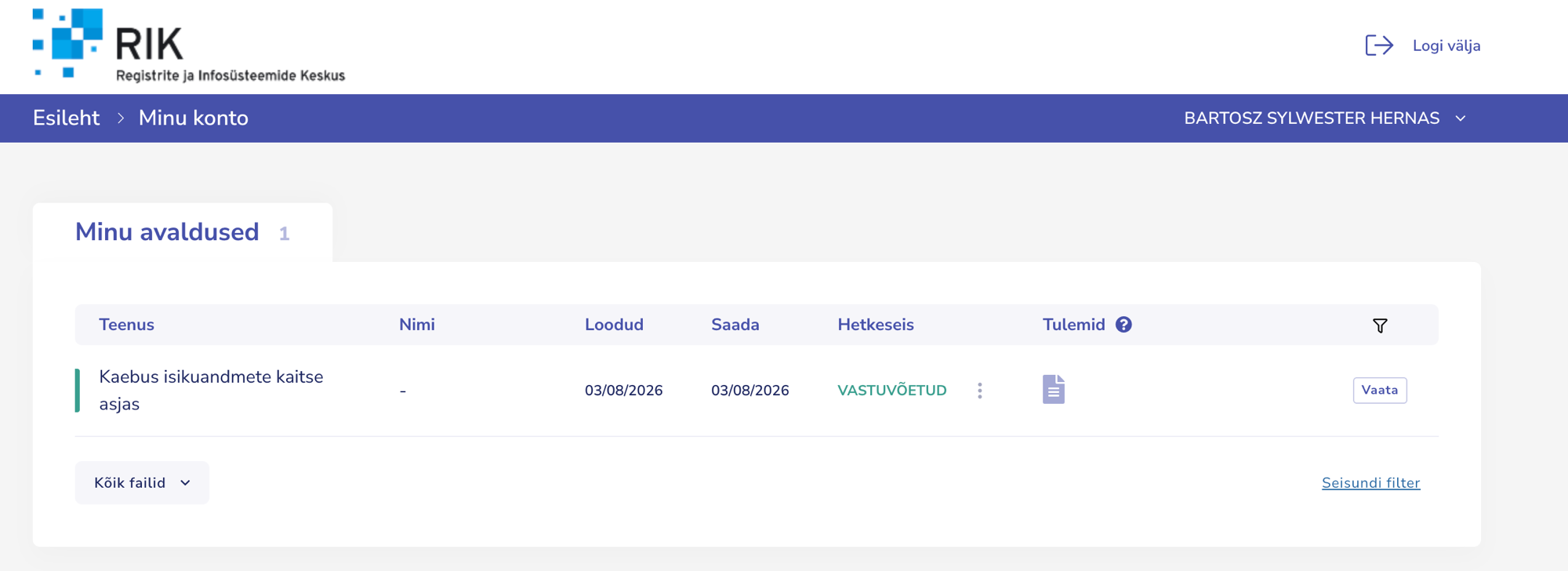
La reclamación alega siete infracciones: no informarme de mis vías de recurso, acceso incompleto y un motivo insostenible para denegarlo, incumplir el plazo de un mes en los dos puntos que pedí el 1 de junio, no facilitar los destinatarios, el plazo de conservación ni la lógica de la decisión, una decisión automatizada del artículo 22 tomada sin valoración humana, ninguna facilitación del ejercicio de mis derechos y ninguna respuesta a mi solicitud de supresión. Pide a la Inspección que colabore con la Autoriteit Persoonsgegevens neerlandesa —autoridad principal de Tesla en la UE— en el procedimiento del artículo 60. La presenté ahora y no en octubre porque esas infracciones ya están consumadas: lo que Tesla envíe en dos meses no deshará el hecho de no haberme informado de mi derecho a reclamar.
Presentada ante la autoridad estonia el 3 de agosto y admitida ese mismo día: siete infracciones alegadas y la petición de implicar a la autoridad principal neerlandesa. El 3 de septiembre la Inspección prorrogó su examen hasta el 5 de octubre.Leer íntegro
Summary of the complaint
On 1 June 2026 the complainant made a request under Article 15 GDPR for, among other things, the telemetry, diagnostic and event data that Tesla relied upon when it remotely disabled Full Self-Driving functionality on the complainant’s vehicle — functionality purchased for EUR 6,200 — on the stated ground that an unauthorised third-party device had been detected. Tesla supplied only a standard account-data export, which contained none of that data.
On 25 June 2026 Tesla asserted that the request had been “fulfilled on 01/06/2026” and that vehicle data is not associated with the complainant’s identity “by default”. That position is irreconcilable with Tesla’s own conduct. A remote decision to disable a specific feature on a specific VIN, taken because of what Tesla says its systems detected in that vehicle, necessarily involved personal data linked to the complainant. Tesla’s own reply lists “a raised hardware or software issue” as a condition that triggers precisely such linkage. That reply also declined the request without informing the complainant of his right to complain to a supervisory authority or to seek a judicial remedy.
On 1 July 2026 the complainant set out five specific items under Articles 15 and 22 GDPR. On 31 July 2026 Tesla stated that it requires two further months. This complaint is nevertheless lodged now, because the infringements are already complete and do not depend on the outcome of the extension.
The controller’s own notifications
The notification is itself proof of linkage. Tesla could not have generated and sent the email of 8 April 2026 unless the detection event had been transmitted from the vehicle to Tesla and associated there with the complainant’s account and email address. Tesla’s statement of 25 June 2026 that “no one – including Tesla – would have knowledge of your activities” cannot stand alongside a notification that Tesla itself sent to him about an event in his vehicle.
A second Tesla department describes a centrally imposed decision. On 25 June 2026, the same day as the privacy response, Tesla’s Warsaw service centre wrote to the complainant in Polish that “Blokada została nałożona odgórnie i jest software’owa, z powodów bezpieczeństwa po wykryciu modyfikacji systemów FSD” — “the block was imposed centrally and is software-based, for safety reasons, after detection of modification of FSD systems”. A block imposed centrally by Tesla following detection is a decision taken by the controller on the basis of vehicle data attributed to this vehicle and this account. It is not an autonomous act of the car, as the wording “your vehicle has detected” implies.
The notifications were dispatched in bulk. An identical notification was sent twenty-three seconds later, at 23:00:23 UTC on 8 April 2026, in respect of a different vehicle, to a further email address controlled by the complainant. The complainant advances no claim in respect of that vehicle or its owner and refers to it only as evidence that these notifications, and the disablements they announced, were dispatched as an automated bulk action rather than following any individual assessment of the vehicle concerned.
Infringements alleged
Article 12(4) — failure to inform of remedies. Tesla’s reply of 25 June 2026 declined to provide the data requested but did not inform the complainant of the reasons for not acting, of the possibility of lodging a complaint with a supervisory authority, or of seeking a judicial remedy. This infringement is complete and is unaffected by the extension of 31 July 2026.
Article 15(1) and 15(3) — incomplete access, and an untenable ground for withholding. A generic account-data export was supplied in place of the personal data actually identified in the request, and Tesla declared the request “fulfilled”. Data that has in fact been linked to the complainant and used to take a decision affecting him is personal data within Article 4(1) and cannot be withheld on the ground that linkage does not occur “by default”.
Article 12(3) — failure to respond within one month as to items 1 and 2. The telemetry data and the dates and times of its processing fell due on 1 July 2026. No extension was notified within that period. These items remain outstanding.
Article 15(1)(c), (d) and (h) — failure to supply required accompanying information. Recipients, retention period, and information on the logic of the automated decision were all requested and none has been provided.
Article 22 — automated decision-making. The disablement appears to have been an automated decision producing a significant effect on the complainant (loss of paid functionality valued at EUR 6,200, with no refund and no restoration under warranty). Tesla has provided no information about the logic applied and no meaningful route to human intervention or to contest the decision. The bulk dispatch of identical notifications seconds apart in respect of different vehicles indicates that no individual human assessment preceded the decision.
Article 12(1) and 12(2) — failure to facilitate the exercise of rights. Tesla’s substantive reply restated its general Privacy Notice and redirected the complainant to Customer Support rather than answering the request. Tesla has since attributed the delay to the request having been spread across its own departments, having itself directed the complainant to a further department.
Article 17 — no response to the erasure request. The request of 1 June 2026 for erasure of telemetry data and cessation of further transmission has never been addressed in any reply.
Action requested
- That the Inspectorate register this complaint and investigate it, in cooperation with the Autoriteit Persoonsgegevens under Article 60 GDPR.
- That the Inspectorate find the infringement of Article 12(4) in respect of the response of 25 June 2026, which does not depend on the extension.
- That the Inspectorate order Tesla under Article 58(2)(c) to comply forthwith as to items 1 and 2, which fell due on 1 July 2026.
- That the Inspectorate require Tesla to state, in writing and to the complainant, the specific date by which it will respond and the reasons for the delay required by Article 12(3).
- That, if Tesla has not fully answered items 3 to 5 by the expiry of the extended period, the Inspectorate proceed on those items without requiring a fresh complaint.
- That the Inspectorate require Tesla to provide the information owed under Article 15(1)(h) and Article 22 concerning the logic and criteria of the automated decision to disable purchased functionality.
- That the Inspectorate examine whether Tesla processed vehicle telemetry from the complainant’s vehicle at a time when telemetry sharing was set to opt-out, and on what legal basis under Article 6.
- That the Inspectorate consider whether the practice complained of extends beyond the complainant, Tesla having reportedly applied the same remote entitlement change to a substantial number of other vehicles.
- That the complainant be informed of the progress and outcome of the complaint under Article 77(2).
I confirm that the information given in this complaint is true and complete to the best of my knowledge, and that I have attempted to resolve the matter directly with the controller. — Bartosz Hernas, 3 August 2026, signed digitally (ID-card / Mobiil-ID)
Reproducida literalmente (en el inglés original) según la reclamación presentada. Se omiten aquí los apartados con mis datos de contacto, la cronología, los cinco puntos solicitados y la lista de anexos; mi domicilio y teléfono están redactados en todo el texto, y el resto ya figura en la <a href="#privacy">sección 11</a> y la <a href="#deadline">sección 15</a>. Se presentaron doce anexos, incluido el hilo de correo completo.
Dos cosas del expediente no habían aparecido antes en esta página, y ambas salieron al reunir las pruebas. Primera: el aviso que recibí el 8 de abril a las 23:00 UTC no se me envió solo a mí. Uno idéntico salió veintitrés segundos después, por otro coche, a otra dirección mía. Lo que tomó esa decisión iba recorriendo una lista. Segunda: el 25 de junio —el mismo día en que el equipo de privacidad me dijo que los datos de mi vehículo no están vinculados a mi identidad— el centro de servicio de Tesla en Varsovia me escribió que «el bloqueo se impuso de forma centralizada y es de software, por motivos de seguridad, tras detectar una modificación de los sistemas FSD». Un departamento de Tesla describiendo sin rodeos lo que otro negaba.
La Inspección ha respondido desde entonces, no con una resolución, sino con un plazo propio. El 3 de septiembre de 2026 la AKI prorrogó el plazo para examinar mi reclamación, al amparo del artículo 61, apartado 2, de la Ley estonia de protección de datos personales, hasta el 5 de octubre de 2026, con el fin —son sus palabras— de aclarar y analizar con más detalle las circunstancias necesarias para resolver el asunto. Lo firma un jurista identificado por su nombre, por delegación del director general. Es una prórroga, y he escrito una sección entera sobre lo que es recibir una, así que merece la pena ser exacto con la diferencia. Esta nombra la disposición que ejerce, da una razón que atañe al caso y no a un sistema interno de archivo, fija una única fecha y lleva un nombre. La de Tesla, llegada seis horas después de que mencionara por primera vez a un regulador, no hizo nada de eso: sección 15. Nada en la carta toca la cooperación del artículo 60 con la autoridad neerlandesa que pedía la reclamación; esa cuestión, si es que llega a responderse, vendrá después. Así que una cuarta fecha se suma a la lista: el 11 de septiembre para las condiciones, el 14 de septiembre para el dinero, el 1 de octubre para la respuesta de Tesla a la oposición, y el 5 de octubre para la del regulador.
17España: sin correo, sin aviso, meses después de la oleada
Un segundo propietario, en España, que compró el Full Self-Driving en propiedad: 7.500 €, de por vida. Su coche también ha dejado de frenar en semáforos en rojo y señales de stop. Lo distinto es cómo se enteró: no se lo dijeron en absoluto. Ni un correo, ni una notificación en el coche. Vio que el coche se saltaba los semáforos, fue a mirar y encontró la opción desaparecida de los ajustes del Autopilot y ausente incluso de los manuales del coche, «como si nunca hubiera existido». Y no ocurrió en abril: en sus palabras, «ha pasado hace poco, no hace meses como la “oleada”».
Lo que le llevó a mirar fue un maletero que hacía ruido. Pidió cita de servicio por eso, y el agente que le escribía le preguntó —sin venir a cuento, para una reparación del maletero— si había hecho modificaciones en el vehículo, instalado alguna aplicación o monitorización de terceros, intervenido para instalar algo en el coche o modificado el cableado. Se quedó, dice, en shock: nunca le habían preguntado eso. Respondió con honestidad. En su coche hay dos cosas: un juego de S3XY stalks —su Model 3 Highland viene sin palancas— y una adaptación para conducir solo con las manos, por movilidad reducida. Ambas registradas y legales desde hace más de dos años. El resumen que le dio Tesla fue: «Retire todo lo que sea posible o no sea legal, para evitar problemas de garantía».
Después, más de una hora al teléfono con el responsable de servicio de su zona, que dio como resultado «no lo sé» y «no tengo esa información», mientras a él le resultaba evidente que el responsable sabía más y no quería decirlo. Le enviaron el enlace a una página de Tesla sin nada relevante, le llamaron de nuevo y le dieron cita en otro centro de servicio. La teoría que acabaron ofreciéndole: como instalar los S3XY stalks es ilegal, anula la garantía, y por eso se desactivó el Autopilot; y una futura actualización lo devolvería. Esa promesa es la frase que me dieron a mí en abril, y la que recibieron los propietarios coreanos antes de que el indicador se apagara y se encendiera en veinte minutos —sección 14. Lo que nadie le da es una lista. Su expresión: un «secreto» a dedo.
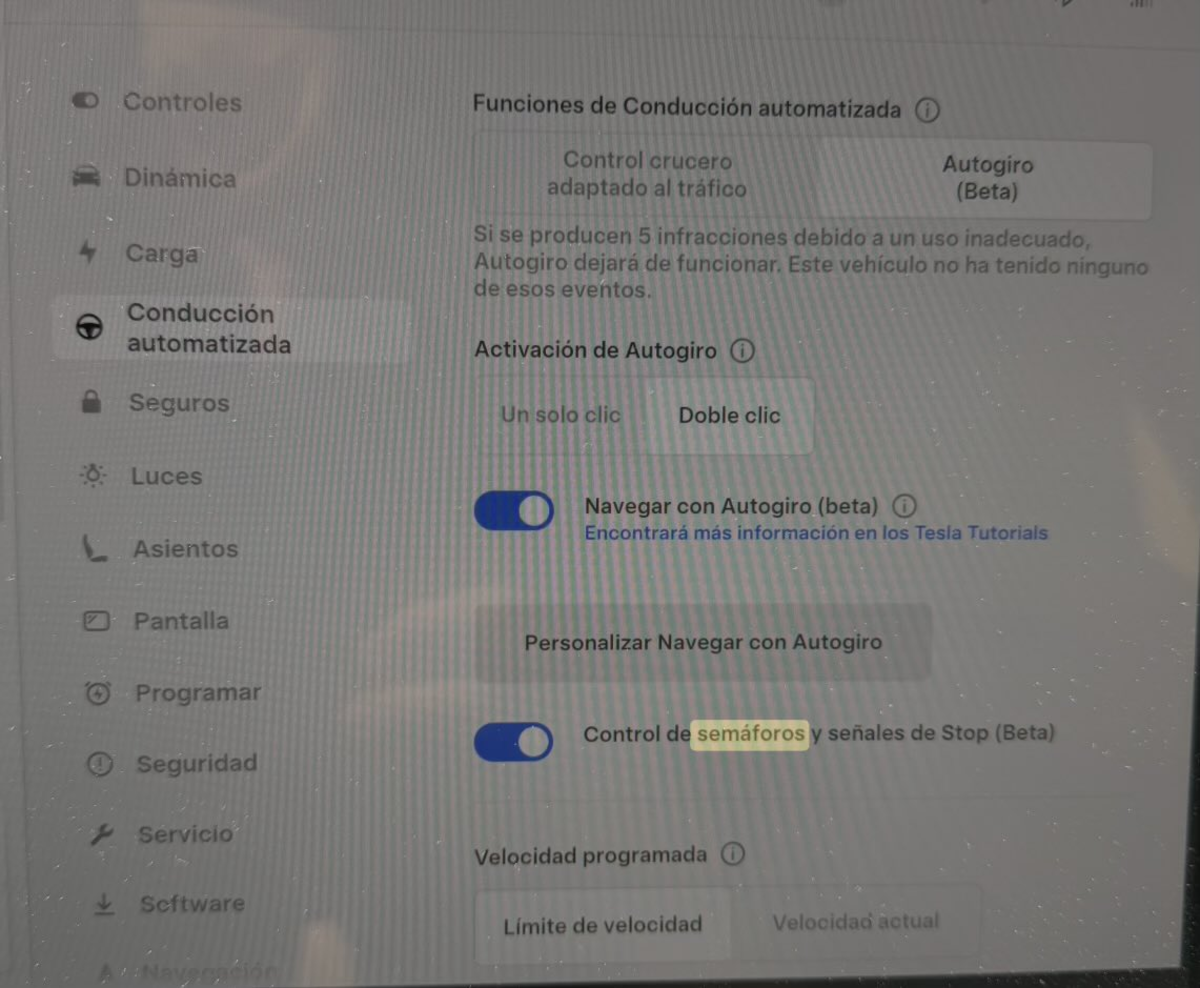 28 de abril de 2026
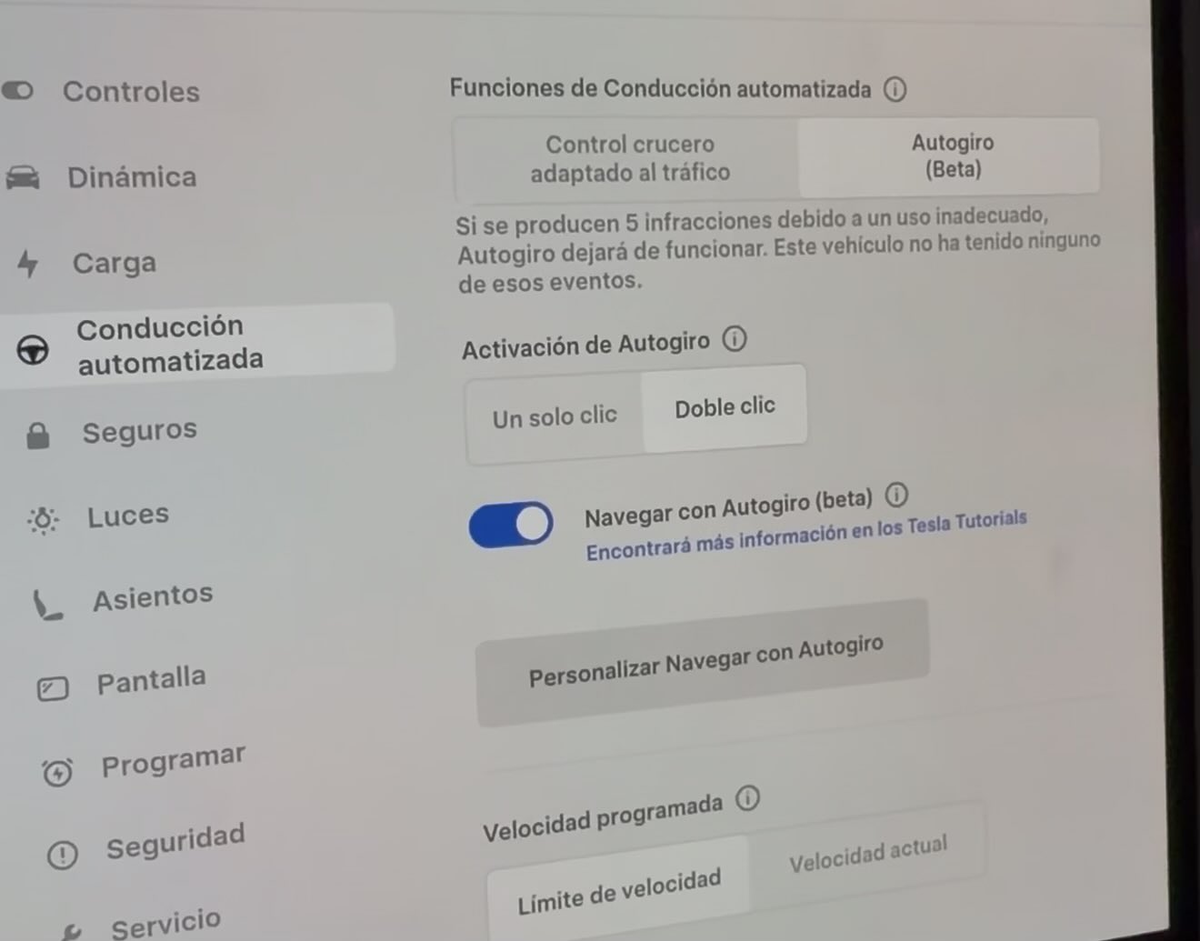 7 de agosto de 2026
«No tengo ningún correo, ninguna notificación… nada. La función simplemente se esfumó y ya está, en silencio».
Un segundo propietario, 7.500 € de FSD de por vida, desaparecido sin un solo correo. Tesla le pidió que lo demostrara en vídeo, culpó al semáforo, y después cerró su reclamación y borró el ticket de su cuenta.Leer íntegro
Tres cosas son aquí peores que en mi caso. Un juego de palancas montado en un coche que se vende sin ellas no puede activar el Full Self-Driving: lo que se detectara, no era un desbloqueo. No recibió ninguna notificación; a mí al menos me llegó un correo a las dos de la mañana. Y ocurrió hace poco, no en la redada de abril, lo que significa que no se está cerrando un episodio pasado, sino que la práctica sigue en marcha. Ha enviado ya a Tesla una reclamación larga: por la retirada silenciosa, por haber pagado la función y por el trato distinto a cada cliente; dice que pedirá el reembolso si no se resuelve nada. Su preocupación va más allá de su coche: si se pueden retirar en silencio funciones pagadas, ¿qué impide que la siguiente sea la frenada automática de emergencia?
Lo que vino después merece contarse en orden, porque duró ocho días y terminó donde yo no esperaba. Primero, Tesla le pidió que demostrara la pérdida. El responsable de servicio quería un vídeo de los ajustes que faltaban —«para poder seguir escalándolo», le dijeron—, así que grabó su pantalla y lo envió. No bastó. Después le pidieron que se grabara conduciendo, para demostrar el fallo en tráfico. Y la explicación que volvía cambió: el problema, le dijeron, no es el coche sino el entorno —intenta activar la función en condiciones demasiado malas para que funcione— y, en un momento dado, que quizá el problema fuera el propio semáforo. Mientras tanto, el servicio seguía preguntándole qué era exactamente lo que había desaparecido, teniendo delante las dos capturas de arriba. Uno de esos mensajes le llegó a las 21:41, más de cuatro horas después del cierre del centro.
Luego hizo él mismo el trabajo de ellos. El 10 de agosto acudió a la cita por el maletero que hacía ruido, que era la cita original. El técnico que le atendió —que mencionó, sin que nadie se lo preguntara, que conoce a muchos propietarios con el mismo accesorio y ningún problema— le sugirió el diagnóstico obvio: poner el coche en modo servicio, reinstalar el firmware del vehículo sin nada conectado y volver a probar. Hizo exactamente eso y esperó mientras el coche reinstalaba su software. No cambió nada. Ni semáforos, ni señales de stop. Lo que notó después es el detalle al que sigo dando vueltas: la función también ha desaparecido del manual del propio coche, mientras que ese mismo manual en la aplicación de Tesla de su teléfono la sigue documentando, y su cuenta sigue mostrando el paquete Full Self-Driving como suyo. En sus palabras, es como si hubieran hecho una actualización solo a su coche para que la función parezca no haber existido nunca.
Y entonces, el 11 de agosto, desapareció la propia reclamación. Tesla cerró su solicitud de servicio y la eliminó del historial de su cuenta: no archivada, no marcada como resuelta, sino ausente de la aplicación, como si nunca se hubiera abierto. Llamó al servicio para asegurarse de que no era un fallo de sincronización, y le dijeron sin rodeos que la solicitud se había cerrado y, en la palabra que le dieron, «shadowed» —ensombrecida—. Había grabado la conversación antes de que desapareciera.
«Cerraron mi ticket y lo quitaron del historial: no existe en mi cuenta».
El motivo por escrito, cuando por fin llegó, era una tercera versión. Él lo resume así: el taller ha revisado el vehículo y no puede dar más información; aun tratándose de un dispositivo homologado, es incompatible con la línea CAN del vehículo, por lo que ciertas funciones pueden haberse limitado por seguridad del Autopilot al haber equipamiento no original; futuras actualizaciones podrían restaurar las funciones; y se cierra la solicitud porque no pueden hacer ningún ajuste por su parte. Póngase eso al lado del motivo que le dieron una semana antes —que instalar los S3XY stalks es ilegal y anula la garantía— y no son la misma afirmación. Ninguna de las dos versiones nombra una función, un dispositivo, una fecha ni una norma. Y ambas terminan en la frase que me dieron a mí el 9 de abril y que recibieron los propietarios coreanos el 30 de julio: que una futura actualización podría devolverlo. En Corea ese mismo derecho se apagó y se volvió a encender en veinte minutos sin actualización ninguna —sección 14. Él ha reabierto el caso y les ha planteado cinco puntos: que el contrato que firmó permite lo que lleva instalado; que nadie le notificó nada, y que ahora quiere una auditoría de todas las funciones retiradas o posiblemente retiradas; que nada cambió en el coche entre dos años sin incidencias y hace unas semanas, y que todo lo instalado está homologado; que si esto va realmente de seguridad, digan qué es lo que falla —los accesorios se retiraron hace semanas, el software se ha reinstalado y sigue sin funcionar—; y por último, que le devuelvan las funciones o el dinero: 7.500 €. Le dijeron que le llamarían.
The guy who was typing me said: Did I made any vehicle modifications? Have you got a third party app or monitoring? Did you made any intervention to install something to the car? Did you modified the wiring?
I was shock. They never asked me that and they was saying all the time. And just for a trunk noisy service.
I said the S3XY stalks (model 3 highland stalkless). And a modification to drive with hands only (reduced mobility). All registered and legal for over 2 years.
The summary is: Please remove everything if possible or not legal, to avoid warranty issues.
I have no mail, no notifications… nothing. The function just vanished and that’s it, silently. Even in the car manuals it’s not appearing, like never existed.
And it happened recently. Not months ago like the “wave”.
Basically he said that is it possible that, because installing s3xy stalks it’s illegal, voids my warranty and they disabled the autopilot, and soon in new updates they’ll give me that back.
My car is adapted to a reduced mobility person so it’s not a choice and was fully homologated over 2 years ago.
So angry right now, they are not giving me details, list of what is banned or not, what’s wrong or not, it’s a “secret” cherry pick and it happened. They don’t know anything, poor guys.
It’s so annoying, I’m worried about if they remove functions silently what’s next? Remove automatic brake collision?
Today the service manager asked me to share a video about my autopilot settings missing and I paid for it. He asked me the video in order to keep escalating it.
The Tesla service closes at 17:00. Well the manager wrote me at 21:41. What the hell? He only said: What options you miss.
That guy said the problem is not the car, it’s the environment. I’m trying to activate it without good conditions that’s why it fails. They asked me to record a video driving demonstrating that. Is not enough recording a video showing autopilot options were gone.
They said, maybe the problem is the traffic light which is so baaad.
They keep asking, but what disappeared? I don’t know if more functions disappeared because I had no more pictures from before.
He told me to try: service mode, reinstall car firmware without commander connected, test it. He knows a lot of commanders and no issues.
Nothing, still same. I’ve noticed the option also disappeared on the car manual. But in my iPhone i see the option in the manual and my car has fsd capability package. It’s like they did an update or modification only to my car making it seem like it does not exist.
They closed my ticket and removed it from the history — it does not exist in my account. I called the service and they told me directly that the ticket was closed and “shadowed” which is strange. We ensured it was not an app bug or sync — no, they DELETED the ticket in my app. Thankfully I recorded the whole chat.
Why 2 years ago no and some weeks ago yes? Nothing changed in the car and all features are HOMOLOGATED. Return me the money or the features.
Feels good, they are playing like it’s a video game. Again, not a big deal the features removed, because were shitty, but they opened the door and it’s super annoying while I didn’t sign for that.
Este es el relato de otro propietario sobre el coche de otro propietario. No me he sentado en él y no soy la fuente. Se publica con su permiso, sin su identidad ni su ubicación a petición suya, y sus mensajes se reproducen tal como los escribió. El mensaje de Tesla del 11 de agosto es su propia versión en inglés de un original en español, y aquí se recoge como discurso referido, no como cita literal. Tesla podría confirmar o desmentir cualquier parte de esto en una frase.
18Show me the contract
Every refusal I have had in four months rests on the same unstated thing: the terms. So on 11 August 2026 I asked Tesla one question, in writing — which Terms of Service does Tesla say I am bound by? Produce the document. Point at the clause.
It is worth seeing how much has been decided without a document ever being named. The car was reset to its “original configuration” — no clause. An “unauthorized third-party device” justified removing a package I had paid for — no clause. Two service centres called a fault under warranty “not serviceable” — no clause. Tesla Poland wrote that “vehicles acquired second-hand are always outside the scope of our standard processes” — no clause, and no scope, and no process. At no point in four months has anyone at Tesla quoted a single line of a single agreement to me.
And this is the part that sharpens it: I was never given anything to sign. The car reached me through an intermediary rather than across a Tesla counter — no order agreement, no terms of service, no FSD licence, nothing presented and nothing accepted. Whatever Tesla believes binds me, I have not read it, because nobody has ever shown it to me. So I asked for six things: the agreement Tesla says governs us; the legal basis on which it says that agreement reaches me; the version in force on the day the car was registered, with proof of how I was notified or deemed to have accepted it; whether different terms apply because an intermediary was involved; the clause relied on to switch off Full Self-Driving; and the clause relied on to decline to answer or to refund. The letter doubles as an Article 15 GDPR request, which puts a date on it: 11 September 2026.
I am not asking for anything beyond clarity on which specific terms Tesla is relying on: which Terms of Service are being invoked to remotely disable FSD I paid for, and to avoid responding to or refunding affected customers.
I asked Tesla to produce the Terms of Service it says I am bound by, and the clause it relies on. The letter doubles as an Article 15 GDPR request, which puts a date on the answer: 11 September 2026.Leer íntegro
To Tesla Privacy, Resolutions, EU Customer Happiness, and Legal teams,
I am the registered first owner of a Tesla Model Y, VIN XP7YGCEK9SB621959, registered on 05.05.2025, equipped with Full Self-Driving (FSD).
My vehicle was purchased through an Estonian intermediary, rather than directly from Tesla or through a lease/financing arrangement with an Estonian bank. As a result, I have never been presented with, signed, or explicitly accepted any Tesla Motor Vehicle Order Agreement, Terms of Service, or FSD-specific purchase agreement. My understanding of any contractual relationship with Tesla is based solely on Tesla’s general assertion that use of the vehicle constitutes acceptance of unspecified terms.
Given that Tesla has disabled the FSD functionality on my vehicle, I am requesting that you provide me directly with:
- 1. The specific, complete Terms of Service, Motor Vehicle Order Agreement, and/or FSD Purchase/License Agreement that Tesla contends governs my relationship with Tesla as the first registered owner and end user of this vehicle;
- 2. Confirmation of the legal basis on which Tesla asserts these terms apply to me, given that I did not purchase the vehicle directly from Tesla nor sign any agreement with Tesla or a Tesla-affiliated financing entity;
- 3. The version of the FSD terms that was in effect at the time of vehicle registration (05.05.2025), together with any documentation showing how or when I was notified of, or deemed to have accepted, those terms;
- 4. Confirmation of whether any different or additional terms apply because the vehicle was acquired through a third-party intermediary rather than directly from Tesla;
- 5. The specific clause(s) of the Terms of Service Tesla is relying on to justify remotely disabling FSD functionality that I paid for and had active on my vehicle;
- 6. The specific clause(s) of the Terms of Service Tesla is relying on to decline to respond substantively to my prior contact attempts, and/or to decline a refund for the disabled FSD functionality.
This request also constitutes a request for personal data and related processing information concerning me under Article 15 of the GDPR, insofar as it relates to records of my account, my acceptance (or lack thereof) of any agreement, and any internal records associating me with specific contractual terms. Under Article 12(3) GDPR, I expect a substantive response without undue delay and in any event within one month of the date of this email — i.e., by 11 September 2026. If Tesla considers this request complex and intends to invoke the further two-month extension permitted under Article 12(3), please notify me of that fact, and the reasons for it, within the initial one-month period.
Please provide the actual requested documents rather than a general link to Tesla’s public website, since those pages are subject to change and do not establish what applied to me at the relevant time.
For context, I am documenting this dispute publicly at TeslaTookWhatIPaidFor.com, which covers the remote disablement of FSD functionality I purchased. This correspondence, including Tesla’s response or lack thereof, will be published there as part of that record. I am not asking for anything beyond clarity on which specific terms Tesla is relying on: I simply want to know which Terms of Service Tesla is invoking to (a) remotely disable FSD I paid for, and (b) avoid responding to or refunding affected customers.
I look forward to your response within the timeline set out above.
Regards, Bartosz Hernas — [email protected] · VIN XP7YGCEK9SB621959
One correction to my own letter. Its third paragraph is loose about the financing: the car was supplied through the intermediary and, in the end, leased through a partner. I am leaving the sentence as it was sent rather than quietly editing it, and correcting it here instead. It changes nothing about the request — the point is the chain the car travelled down, and that at no stage of it did Tesla present me with an agreement to read, sign or accept.
Reproduced verbatim, as sent, save that the intermediary is not named here.
19142 days later, the switch flips back
On 27 August 2026 my car installed software update 2026.27.100.1. A day later, on 28 August, Full Self-Driving was simply there again — the package restored, announced by nothing more than a notice on the car’s own screen.
That notice was the mirror of 8 April — the same kind of message on the screen that announced the ban — section 3. Except that this time, no email followed. The disablement at least produced one, at two in the morning, citing “safety reasons”; the restoration produced nothing in writing at all. Just the car’s software flags, updated. And note the timing, because it is the sequence Korea saw in July — section 14: the restoration did not arrive with the update, it arrived on its own, about a day after it. Between the update finishing and the package appearing, nothing on my side changed — no visit to a service centre, no inspection passed, no appeal granted. For four months, every refusal rested on the claim that this could not simply be undone — that it needed a firmware release, another department, a process. In the end it was undone the way it was done: a flag, flipped on a server, and 142 days of “not serviceable” ended without anyone having to do anything at all.
Here is what the restoration does not change. Tesla has still not answered a single one of the questions in section 7 — not which device it detected, not who decided, not under which clause, not why two service centres refused a repair under warranty. It has not explained why the package was taken on 8 April, and it has not explained why it came back on 28 August. And it has not offered a cent for the 142 days I was locked out of a safety feature I had paid for in full — the meter above stopped where it stood, at what the lockout cost priced at Tesla’s own subscription rate. Getting back what I already owned is not a resolution. It is the minimum, arriving 142 days late, with no explanation attached.
And the restoration did not reach everyone. As far as I can tell from other owners, the flag flipped back only for cars in regions where FSD is approved. Everywhere else, banned owners are still where I was for 142 days: locked out not just of FSD but of Traffic Light and Stop Sign Control — a feature that is fully legal on any road, that shipped working, and that they paid for. And Tesla has still not answered the question that matters most for them: how were owners informed that this part was being removed — or was it simply assumed they would notice? I was never told that stop-sign recognition was going along with the rest; the 9 April email named no feature at all — section 3. Other owners tell the same story, and some tell it the hard way: I have heard accounts of near-crashes from drivers taken by surprise when a car that had always braked for stop signs stopped recognising them out of the blue. A safety feature does not become less dangerous to remove because it was removed quietly.
One remote flag took the package away. One remote flag gave it back. Neither came with a single answer.
So nothing about the legal route changes. The Article 77 complaint with the Estonian Data Protection Inspectorate stands — section 16 — because the infringements it alleges are already complete, and switching the feature back on un-does none of them. Tesla still owes me the terms it says bind me and the clause it relied on, due 11 September — section 18. Its Data Protection Office still owes me the answers it granted itself until 1 October to produce — section 15; what it sent instead, three days after the restoration, is in section 20. And the question this site opened with is sharper now, not duller: if a feature you paid for can be switched off for 142 days and switched back on overnight — no process, no notice, no accountability in either direction — what exactly do any of us own?
20Install the update
On 31 August 2026, at 20:34, Tesla’s Data Protection Office answered — a month before the deadline it had granted itself. Four claims: no automated decision was made; my access request was “fulfilled” on 1 June and 3 August; the “appropriate software update” has already been made available; and unauthorized devices may, under “our Terms” and “local road authorities,” cost you FSD. Then a bulleted list of how to install the update.
Take the claims in turn. “No automated-decision processing was performed.” Good — then a person did it. Someone at Tesla looked at data linked to my VIN on 8 April, decided a diagnostic reader was “unauthorized,” and signed off on removing a package I had paid for. That rules out Article 22 and makes every other question sharper, not softer: who, on what data, by what criteria. “Fulfilled on 01/06/2026 and 03/08/2026.” The first is the day I made the request — Tesla already claimed that in June, section 11. The second is the day I answered its extension and lodged the complaint with the regulator — sections 15 and 16. On neither day did Tesla send me a byte of vehicle data. “The appropriate software update has already been made available.” It had been installed on 27 August, and the package had come back on 28 August — section 19. Tesla’s first written word on the restoration was a set of instructions for installing an update my car had already installed, arriving three days after the restoration it describes.
Then the terms. “As set out in our Terms and as required by local road authorities, such use may result in the restriction or disablement of certain features.” The word “Terms” is a link to a webpage. Three weeks earlier I had asked Tesla to name the document and the clause — section 18 — and asked, in so many words, not to be sent a general link to the public site, because that page can change and does not establish what applied to me. This is that general link, from the office that owes me the answer by 11 September. As for “local road authorities”: the road authority where my car is registered approved FSD, which is the only reason the package was usable at all, and no road authority I know of has required Tesla to switch off stop-sign recognition on a car with a diagnostic reader in the port. If one has, Tesla can name it. I asked it to.
Tesla’s first written word about the restoration was a set of instructions for installing an update my car had already installed.
Tesla’s Data Protection Office answered a month early: no automated decision, request “fulfilled,” install the update — three days after the package had already come back. I have asked for the 142 days back in money, for the clause, and, separately, for Tesla to stop using my car’s data to decide what I may use.Leer íntegro
Thank you for contacting us. No automated-decision processing was performed on the matter with regard to your reference to Article 15. Our records show that your data subject access request was fulfilled on 01/06/2026 and 03/08/2026, and further show that the appropriate software update has already been made available to your vehicle in connection with the unauthorized third-party device detection dated 8 April 2026.
Please note that the use of unauthorized third-party devices can create a safety risk to the driver and other road users. As set out in our Terms and as required by local road authorities, such use may result in the restriction or disablement of certain features, including Full Self-Driving (FSD), for safety reasons.
Steps to install the software update:
- Connect your vehicle to Wi-Fi
- On the touchscreen, go to Controls > Software, download the available update, then select Install now or schedule installation for a convenient time
- After installation, go to Controls > Self-Driving and enable Full Self-Driving (Supervised)
We apologize for any inconvenience. Should you have any feedback about your experience, please do not hesitate to contact Customer Support.
I confirm that following your last message the Full Self-Driving Capability package has been restored to my vehicle. Thank you.
The restoration is welcome, but it also settles the central point of my complaint: the functionality was Tesla’s to restore at any time, by remote configuration, and was restored once challenged. That confirms it was withdrawn unilaterally and could have been reinstated at any point during the period it was withheld. Restoration therefore resolves the feature, but not the complaint. Two matters remain outstanding, and your last message addressed neither.
1. Reimbursement and compensation
From 8 April 2026 until its restoration — a period of over three months — I was deprived of functionality I had paid for in full. In particular, my vehicle lost Traffic Light and Stop Sign Control: it no longer recognised or stopped automatically at red lights and stop signs. This is a safety-relevant driver-assistance function that was working normally before Tesla’s intervention.
Crucially, I was never informed in advance that this feature would be removed. The remote change was applied first, on 8 April 2026 at 22:27, and only afterwards did I receive an email — which itself did not clearly state that stop-sign and traffic-light recognition specifically would cease to function. I was therefore driving a vehicle whose safety behaviour had been silently altered, without notice. That is the basis of my claim: not an abstract inconvenience, but the uncompensated loss of a paid safety function, removed without warning.
I therefore require:
- (a) Reimbursement for loss of use over the full period. Tesla’s own published subscription price for this functionality is approximately €99 per month, and I ask that reimbursement be calculated on that basis for the entire duration of the deprivation.
- (b) Compensation, separately, for the diminution in value of the vehicle caused by the demonstrated fact that paid features can be and were remotely revoked, and for the time and cost incurred in obtaining a restoration Tesla could have performed at any moment. I invite Tesla to propose a figure; failing agreement, it will be quantified with supporting evidence.
2. The “Terms” you rely upon
Your message states that such use “may result in the restriction or disablement of certain features... as set out in our Terms.” Before Tesla relies on any such Terms, I require you to establish that they bind me at all:
- (i) Identify the exact document and the exact clause relied upon.
- (ii) State when, and by what act, I am said to have agreed to those Terms. I did not agree to any term permitting Tesla to remotely disable a paid safety feature, and Tesla has not shown otherwise.
- (iii) State where, before purchase, it was disclosed that paid features could be remotely disabled over the presence of a third-party device.
A clause a customer never agreed to, and was never shown before purchase, cannot be the basis for removing something that customer paid for.
3. The questions that remain unanswered
My previous letter put eighteen specific questions to Tesla. Your reply answered none of them. The following in particular require a written answer, because they concern whether this will recur, to me or to others:
- (iv) Who authorised the disablement of the paid entitlement, and on what documented evidence? Your latest message states that no automated processing occurred — which means a person made this decision. I ask again who, and on what basis.
- (v) What specifically was the detected device (make and model), and what log or telemetry entry, with timestamp, led to its detection?
- (vi) Who at Tesla determines whether a device is “authorized” or “unauthorized,” by what published criteria, and is there a list an owner can consult in advance? Does Tesla regard a standard CANBUS diagnostic tool, used through the manufacturer’s own diagnostic port, as “unauthorized”?
- (vii) What process does Tesla follow to establish whether the registered owner installed or was even aware of a device before penalising that owner — given that a device may be fitted by a previous keeper, an intermediary, or a workshop without the owner’s knowledge?
Your reference to “our Terms” and to “local road authorities” in the abstract is not an answer. I ask you to identify the specific clause and the specific authority relied upon.
Please respond in writing within 14 days. In the absence of a substantive response on reimbursement, compensation, the basis of the Terms, and the questions above, I will treat the matter as unresolved and escalate to the competent consumer-protection authority. This correspondence forms part of a documented public record at TeslaTookWhatIPaidFor.com. — Bartosz Hernas
Further to my last message, I want to record one point that remains entirely unaddressed.
Tesla states that an “unauthorized third-party device” was detected on my vehicle on 8 April 2026, and that Full Self-Driving was disabled as a result. To this day I have not been given the data that detection was based on. Specifically, Tesla has not identified:
- what data was collected from my vehicle;
- what within that data was interpreted as indicating a device;
- the date, time, and source of that data; and
- the logic or criteria by which that data was judged to indicate an “unauthorized” device.
This is not a new request. I first requested this data on 1 June 2026, and reiterated it on 1 July 2026. The one-month period under Article 12(3) in respect of it expired on 1 July 2026, and no extension was validly notified within that period. It is therefore already overdue, independently of the two-month extension Tesla later purported to take for my other items.
Your reply of 31 August 2026 states that “no automated-decision processing was performed.” If that is correct, then a person reviewed specific data linked to my VIN and account and reached a decision — which makes the underlying data plainly my personal data and plainly disclosable under Article 15. If instead the detection was automated, then Article 15(1)(h) and Article 22 entitle me to meaningful information about the logic involved. Either way, the data and the basis for the decision must be disclosed. They have not been.
Tesla cannot both assert that a device was detected via vehicle data and decline to show me the vehicle data said to have detected it. I therefore repeat my request for the specific telemetry, diagnostic, and event data — with timestamps — that Tesla relied upon to conclude a device was present and to disable the feature I paid for. If Tesla maintains it holds no such data, I require a clear statement to that effect, given that Tesla’s own notification asserts the detection occurred.
This remains outstanding and forms part of the complaint already lodged with the Estonian Data Protection Inspectorate.
Following the remote disablement of paid functionality on my vehicle based on data Tesla collected from it, I am exercising my rights under the GDPR in respect of the personal data generated by my vehicle. This letter concerns the future processing of that data; my outstanding access request regarding the detection of 8 April 2026 remains separate and unanswered.
1. What I am asking
I do not consent to my vehicle transmitting to Tesla, or to Tesla processing, any data that identifies me or that can be linked to me, my account, or my vehicle (including by VIN), beyond what is strictly necessary. In particular, I object to the collection or use of any such data for the purpose of monitoring, detecting third-party equipment, or making decisions that restrict or disable features of my vehicle.
2. The rights I am relying on
- (a) Article 21 — I object to the processing of my personal data carried out on the basis of Tesla’s legitimate interests, including any profiling. This specifically includes processing used to detect “unauthorized third-party devices” and to determine whether to restrict or disable features.
- (b) Article 7(3) — to the extent any processing relies on my consent, I withdraw that consent with effect from the date of this letter.
- (c) Article 18 — I request restriction of processing of the relevant data pending your response to my objection and to my outstanding access request.
3. What I require Tesla to confirm in writing
- (i) A complete list of the categories of data transmitted from my vehicle to Tesla, and for each category, the specific legal basis relied upon (consent, contract, legal obligation, or legitimate interest).
- (ii) For each category relied upon as “legitimate interest” or “contract,” a specific explanation of why it is claimed to be strictly necessary, so that I may exercise my objection meaningfully.
- (iii) Which categories of transmission I am able to disable myself (for example via the vehicle’s data-sharing settings), and confirmation of the effect of disabling them.
- (iv) Confirmation that, following my objection, Tesla will cease any processing of my vehicle data for the purpose of detecting third-party equipment or of restricting or disabling paid features — or, if Tesla refuses, a clear statement of the specific lawful basis on which it intends to continue that processing over my objection.
- (v) Confirmation of whether disabling data transmission affects the vehicle’s functionality or any feature I have paid for, and if so, how.
4. Note
I understand that certain limited processing may be necessary for safety recalls, regulatory compliance, or the basic connected operation of the vehicle. I am not asking Tesla to breach a legal obligation. I am asking Tesla to identify precisely which processing it claims is necessary and on what basis, to stop everything that is not, and in particular to stop using my vehicle’s data to make decisions that take away what I have paid for. Where Tesla asserts a basis that overrides my objection, I require that assertion in writing so that it can be assessed by the supervisory authority.
Please respond within one month, as required by Article 12(3). This matter forms part of the complaint already lodged with the Estonian Data Protection Inspectorate. — Bartosz Hernas, owner, 2025 Tesla Model Y · VIN XP7YGCEK9SB621959
All four letters are reproduced verbatim; greetings and signature blocks have been removed. The correspondence is in English. In Tesla’s message, “Terms” and “Customer Support” are hyperlinks — the first to Tesla’s public terms page, the second to its support page; neither names a document or a clause.
I answered the same evening, and the answer starts from what the restoration proves. The package was Tesla’s to give back at any moment, by the same remote configuration that took it, and it was given back once challenged. So the feature is resolved; the complaint is not. I asked for two things. First, the 142 days back in money — loss of use priced at Tesla’s own subscription rate, the figure the meter above stopped at — and, separately, compensation for what it does to a car’s value when its paid features are shown to be revocable from a server, and for the months spent obtaining a restoration Tesla could have performed in an afternoon. Second, the clause: not a link, but the document, the provision, the act by which I am said to have agreed to it, and where, before purchase, anyone disclosed that a diagnostic reader could cost me a paid safety feature. And once more the questions Tesla has now, by its own account, a named human being able to answer: who decided, what device, what criteria, what process for checking the owner even knew. Fourteen days, so 14 September. A follow-up in the same thread records the item that is not merely unanswered but overdue: the data the detection was based on, first requested on 1 June, due 1 July, and still not produced. Tesla cannot say a device was detected through vehicle data and decline to show the vehicle data. If a person reviewed it, it is my personal data and Article 15 reaches it. If no person did, Article 22 does. There is no third option in which it stays in a drawer.
And on 1 September, in a separate letter, I turned to the mechanism rather than the incident. The package is back; the thing that took it is still running. So I objected under Article 21 to any processing of my car’s data on the basis of Tesla’s legitimate interests, withdrew under Article 7(3) whatever consent Tesla thinks it holds, and asked under Article 18 for the processing to be restricted while it answers. I am not asking Tesla to break a law. I am asking it to list what my car sends, name the legal basis for each item, say which of it I can switch off myself, and stop using the rest to decide what I am allowed to use. Under Article 12(3) that answer is due within a month — on 1 October, the day Tesla already owes me everything else.